
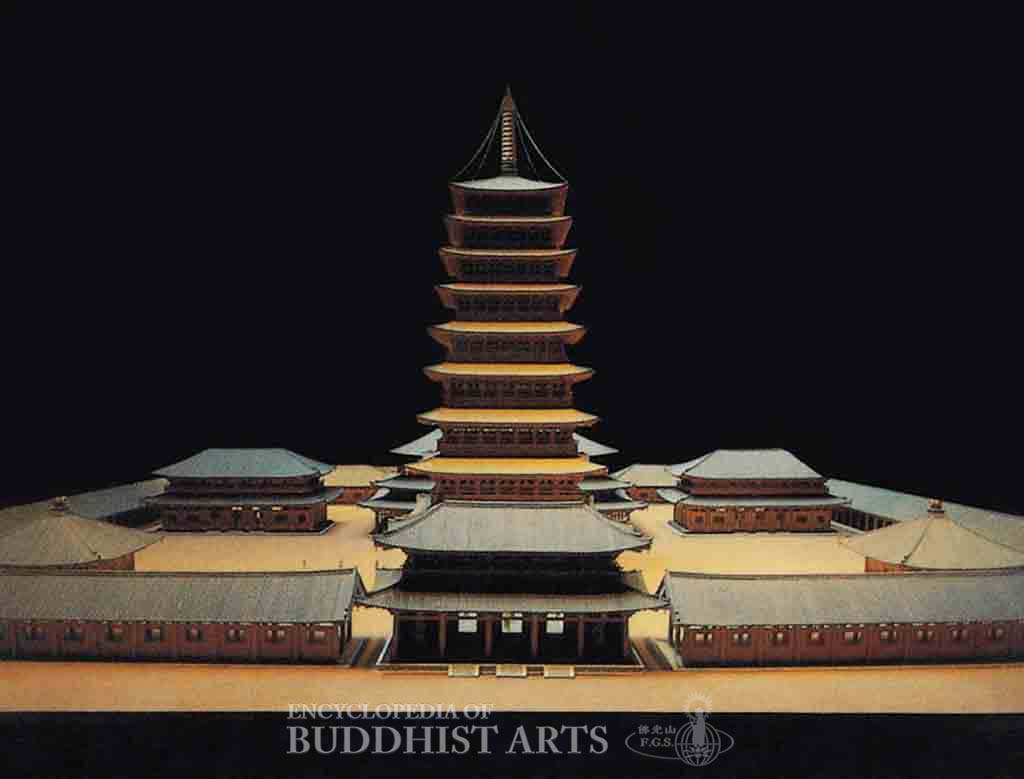
Hwangnyongsa Temple: Model
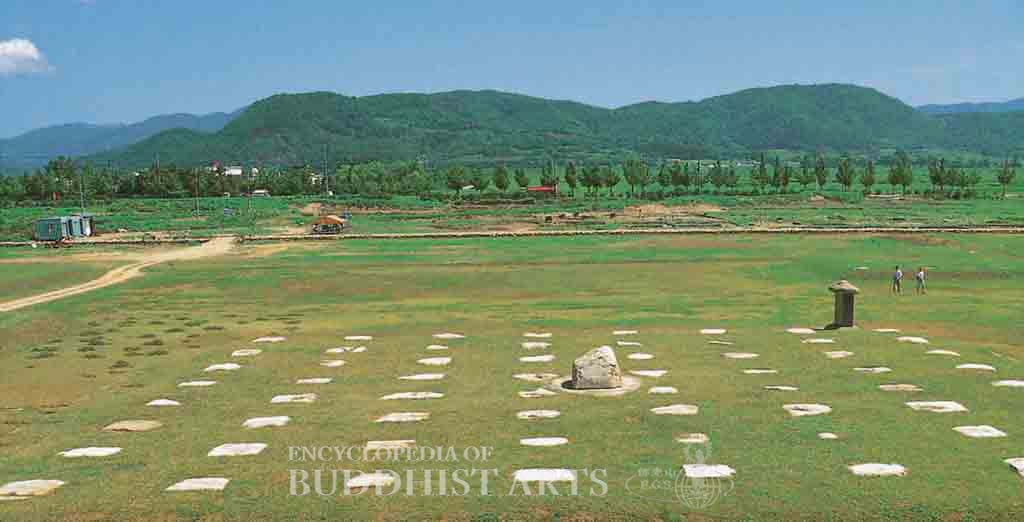
Hwangnyongsa Temple: Site of Nine-Tier Wooden Pagoda
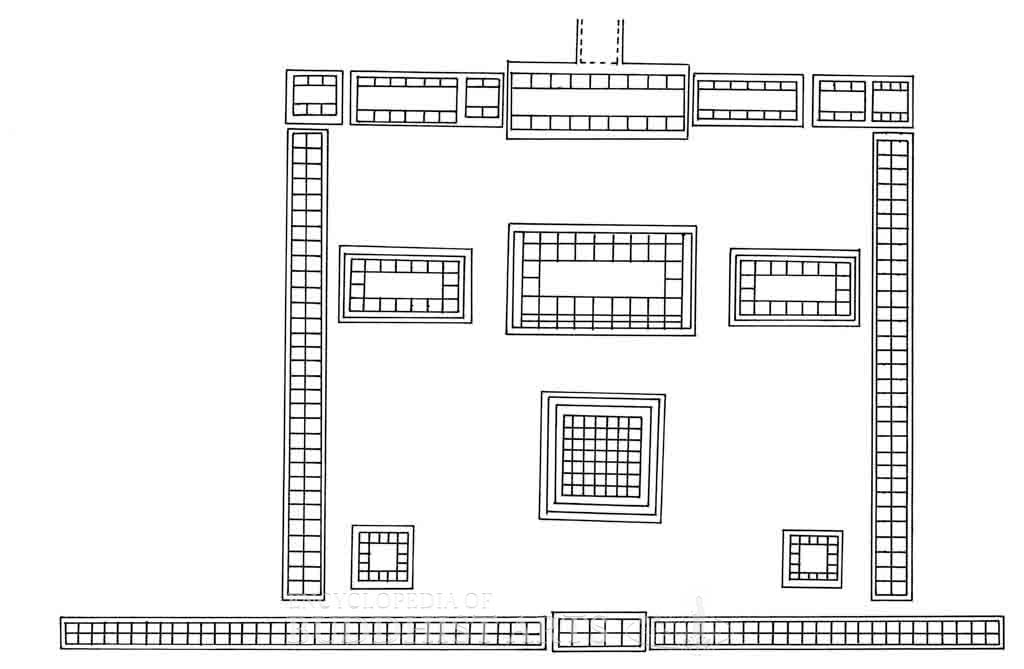
Hwangnyongsa Temple (site layout)
Hwangnyongsa Temple
SOUTH KOREA, North Gyeongsang, Gyeongju
Hwangnyongsa means Imperial Dragon Temple. It is also known as the Temple of the Yellow Dragon and it is located in Kuhwang village. According to the records, the construction of the temple started in 553 during the Silla dynasty under the rule of King Jinheung (reigned 540–575), who had originally begun to build a royal palace at the site. However, after a golden dragon appeared there, the king decided to build a temple instead. The construction of the temple took over 90 years and it became the largest and most important temple in Silla at that time. During the next few centuries, it served as the royal temple of the Silla and subsequent dynasties. A Great Golden Buddha statue was erected in 573 and a Golden Hall was built in 584. In 645 Architect Abiji of Baekje built a large-scale nine-tier wooden pagoda. In 1238 during the Goryeo dynasty, it was destroyed by fire during the Mongolian invasion. Eight years of excavation work, starting in 1969, revealed the temple layout and the foundations of the pagoda. As part of the Gyeongju Historic Areas, the temple was listed as a UNESCO World Heritage Site in 2000.
According to archaeological findings, the temple was arranged in a three-hall-one-pagoda style. Along the central axis of the temple, starting in the south, there were the main gate, nine-tier wooden pagoda, the Central Golden Hall, and lecture hall. The Central Golden Hall was flanked by the East Golden Hall and the West Golden Hall, all of which faced south. To the sides, in front of the nine-tier wooden pagoda, were the bell tower and sutra tower. The entire temple complex was surrounded by covered walkways. The temple exhibited the characteristics of Buddhist temples from the Goguryeo dynasty (37 BCE–668 CE).
During the excavation, it was discovered that the temple’s foundations consisted of two levels. On the lower level there were traces of the conversion from the royal palace to the temple in 566. The upper level contained remains of structures built during the years between the construction of the Great Golden Buddha and the building of the nine-tier wooden pagoda. It also indicated the scale of the temple before it was destroyed by fire. Based on these findings, the nine-tier wooden pagoda had a base that was seven-by-seven bays. According to the records, the pagoda was 68 m high including the stacked rings of the spire. The artifacts discovered at the temple site included reliquaries, statues of Buddhas and Bodhisattvas, ceramics, roof tiles with lotus or animal designs, and bricks with lotus designs.
For more details, go to the Encyclopedia of Buddhist Arts: Architecture G-L, page 487.
Cite this article:
author = Hsingyun and Youheng and Johnson, Peter and Mankuang and Lancaster, Lewis,
booktitle = {Encyclopedia of Buddhist Arts: Architecture G-L},
pages = 487,
title = {{Hwangnyongsa Temple}},
volume = 2,
year = {2016}}