
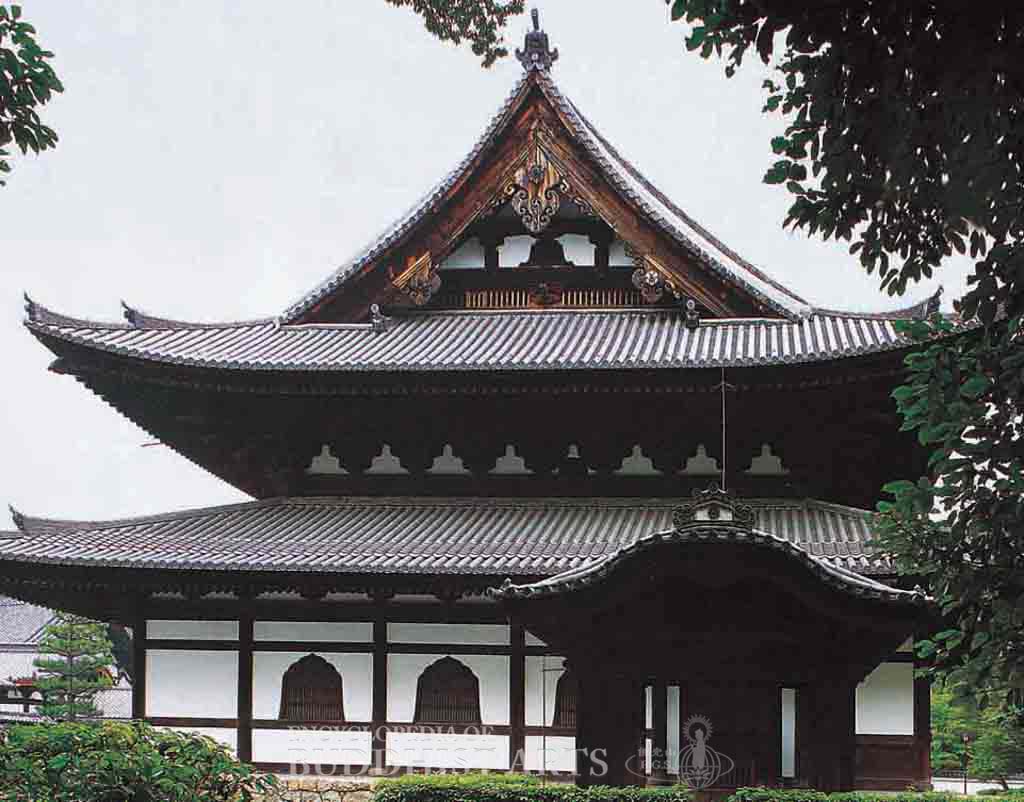
Shokokuji Temple: Dharma Hall
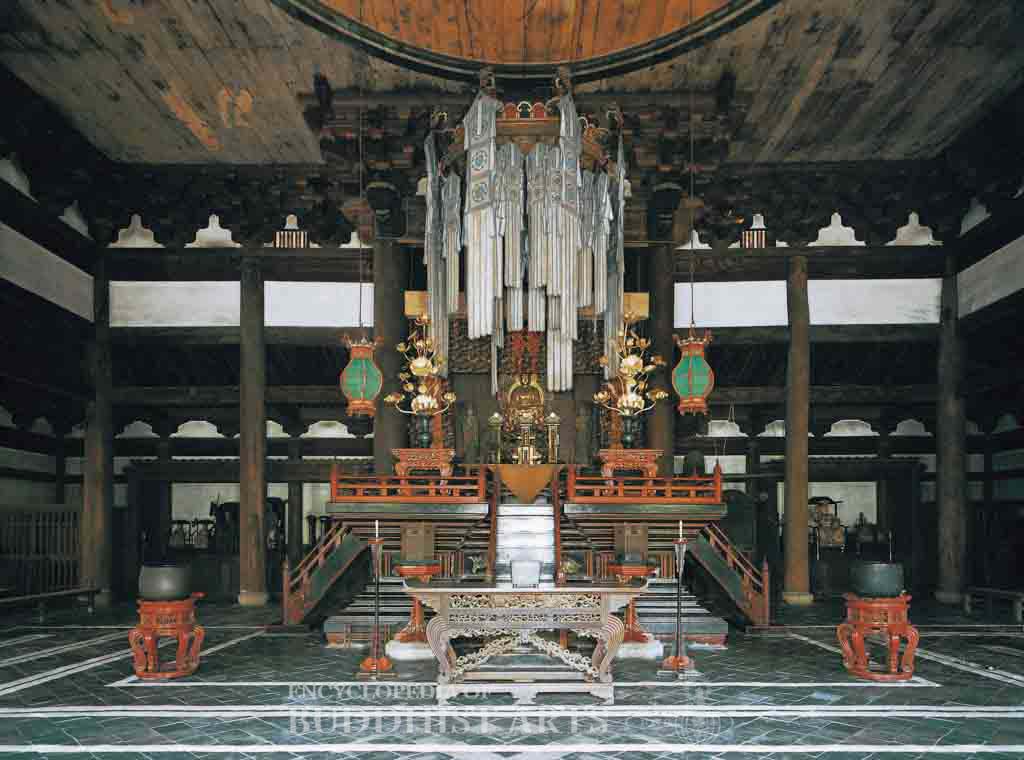
Shokokuji Temple: Dharma Hall (interior)
Shokokuji Temple
JAPAN, Kyoto
The temple’s full name is Mannenzan Shokoku Joten Zenji Temple and it is the head temple of the Shokokuji branch of the Rinzai school of Japanese Buddhism. General Ashikaga Yoshimitsu established the temple in 1383 during the Nanbokucho period. The Buddha hall was completed in 1385 and the temple is considered one of the Five Great Zen Temples of Kyoto in the following year. The temple was destroyed by fire on a number of occasions. It was rebuilt during the Edo period (1615–1868).
The temple occupies 13.2 ha and the main structures consist of the Imperial Messenger Gate, Dharma Hall, abbot’s quarters, founder’s hall, meditation hall, and bell tower. The seven–by–six bay Dharma Hall, or Fearless Hall, serves as the main hall. It stands at the center with a covered walkway connecting to other buildings. It is 28.7 m wide and 22.8 m deep. The hall houses a statue of Sakyamuni Buddha, flanked by Mahakasyapa and Ananda. On the ceiling there is a painting of a coiling dragon by Kano Mitsunobu.
The abbot’s quarters was rebuilt in 1807 during the Edo period. It has a roof covered with square wavy tiles. It measures 25.5 m wide and 16 m deep. The temple houses examples of the calligraphy of Wuxue Zuyuan and Muso Soseki, and the Ten Ox Herding Verses by Zekkai Chushin. The temple also has paintings of the Ten Ox Herding Pictures attributed to Tensho Shubun, Vaisravana by Sesshu Toyo, and the Sixteen Arhats by Lu Xinzhong.
For more details, go to the Encyclopedia of Buddhist Arts: Architecture M-S, page 1002.
Cite this article:
author = Hsingyun and Youheng and Johnson, Peter and Mankuang and Lancaster, Lewis,
booktitle = {Encyclopedia of Buddhist Arts: Architecture M-S},
pages = 1002,
title = {{Shokokuji Temple}},
volume = 3,
year = {2016}}