
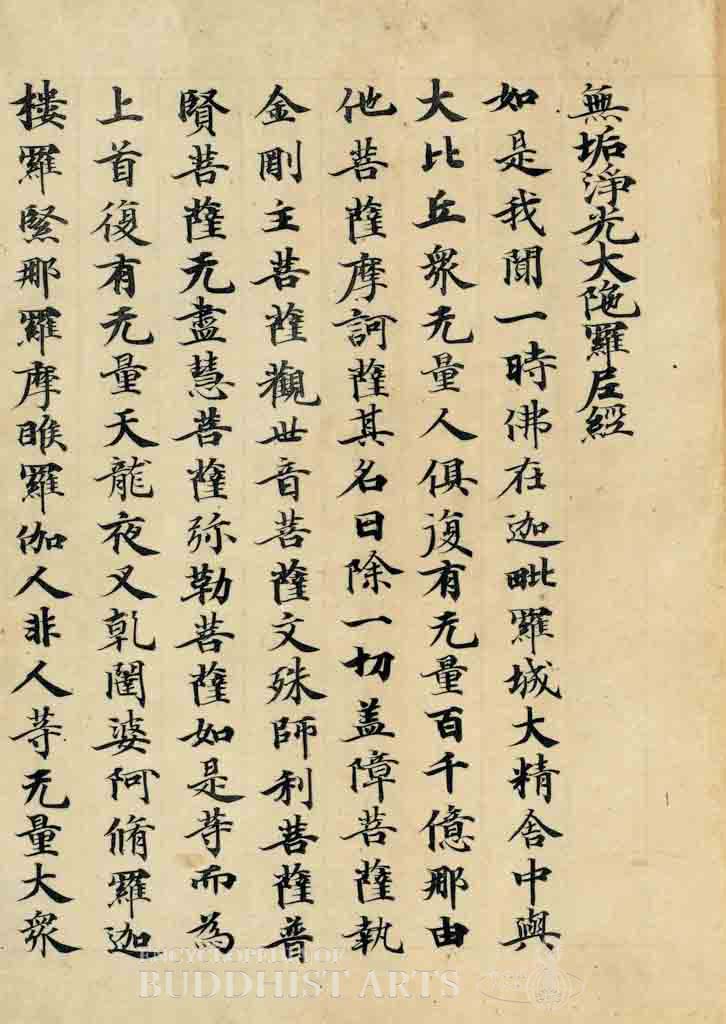
Pure Light Dharani Sutra (right end section)
Ink on paper
Pure Light Dharani Sutra
CHINA; Tang dynasty
This sutra was translated into Chinese during the early Tang dynasty (618–907), and consists of several characters invented by Empress Wu Zetian (reigned 690–705). This detail leads to the assumption that the manuscript was produced during the 8th century. It was listed as a National Treasure of South Korea in 1967.
A Vajrayana Buddhist scripture, the Pure Light Dharani Sutra expounds that by partaking in the repair of Buddhist structures, presenting offerings, and chanting mantras, one gains benefits such as the extension of sentient life and the removal of obstacles on the path to enlightenment.
There is a distinct Tang regular script essence in the character form, defined by its strong and natural brushwork. Articulations using the brush tip can be seen around the beginning and end of each stroke. Characters are closely structured in a rigid layout, while lengthy strokes are extended into the buffer spaces.
For more details, go to the Encyclopedia of Buddhist Arts: Calligraphy, page 192.
Cite this article:
author = Hsingyun and Youheng and Youlu and Pokorski, Stefanie and Mankuang and Edson, Gary,
booktitle = {Encyclopedia of Buddhist Arts: Calligraphy },
pages = 192,
title = {{Pure Light Dharani Sutra}},
volume = 17,
year = {2016}}