
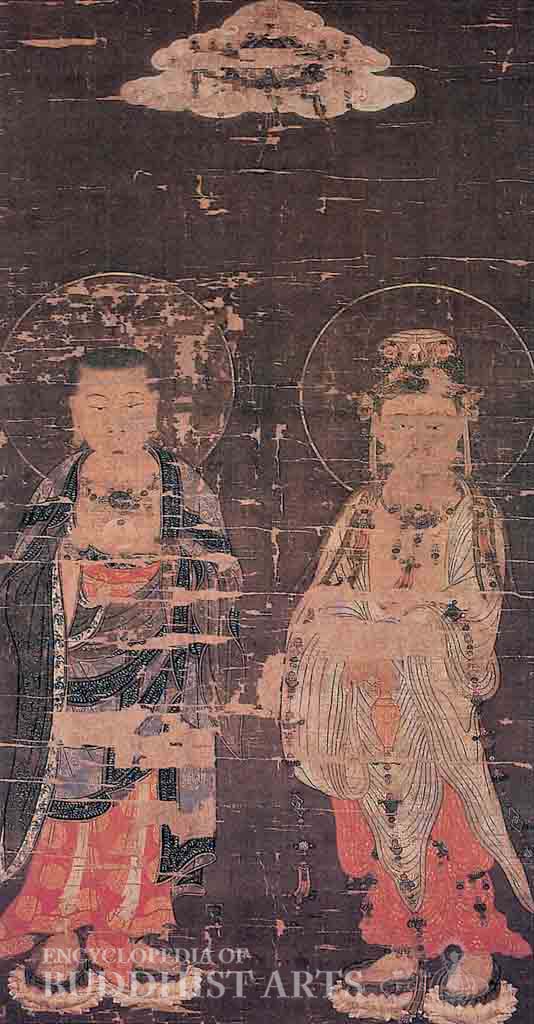
Avalokitesvara and Ksitigarbha Bodhisattvas
Ink and color on silk
Avalokitesvara and Ksitigarbha Bodhisattvas
KOREA; Goryeo dynasty
When Avalokitesvara and Ksitigarbha are painted standing side by side, they are known as the “Bodhisattvas of Shining Light.” This name originated from the mural of the two Bodhisattvas painted by Zhang Sengyao in Shanji Temple in Hanzhou (present day Guanghan, Sichuan) during the Liang dynasty (502–557). The mural was said to radiate light.
Avalokitesvara stands on the right, dressed in white and holding a vase, while Ksitigarbha is on the left, holding up a pearl with both hands. The two Bodhisattvas are both inclined toward the center, making for a balanced composition. An inscription by the canopy and clouds at the top of the painting reads “Bodhisattvas of Shining Light.”
For more details, go to the Encyclopedia of Buddhist Arts: Painting A-H, page 68.
Cite this article:
author = Hsingyun and Youheng and Youlu and Wilson, Graham and Manho and Mankuang and Huntington, Susan,
booktitle = {Encyclopedia of Buddhist Arts: Painting A-H},
pages = 68,
title = {{Avalokitesvara and Ksitigarbha Bodhisattvas}},
volume = 14,
year = {2016}}