
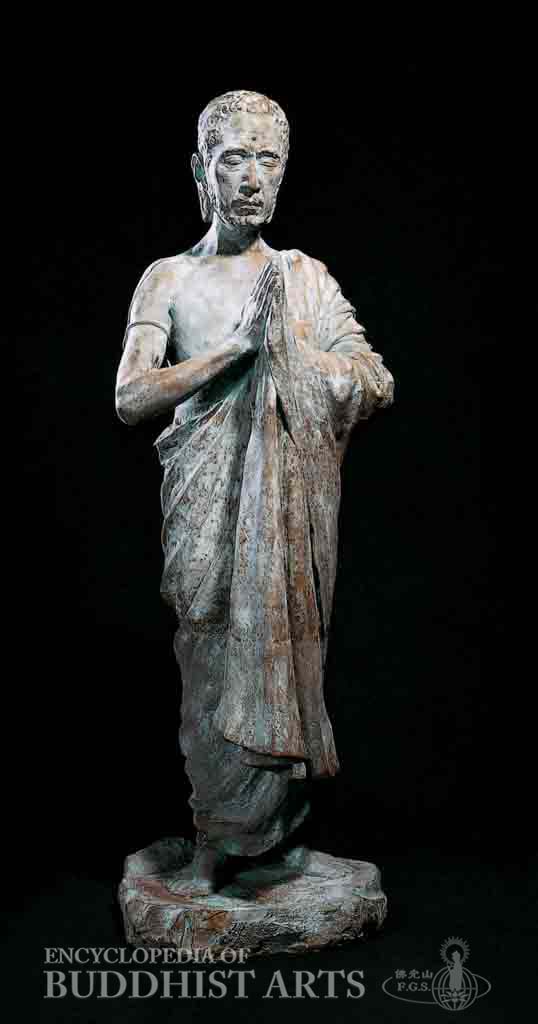
Ascetic Sakyamuni
Copper alloy
Ascetic Sakyamuni
CHINA
The statue was created in 1927 by Huang Tushui under the commission of Longshan Temple in Taipei. The overall design is drawn from a painting titled Sakyamuni Emerging from the Mountains by Liang Kai, an artist of the Southern Song dynasty (1127–1279). The statue was first modeled in plaster and then cast in copper to capture the detail. The Buddha has curly haired but no usnisa. He wears a monastic robe that leaves the right shoulder bare and holds the hands in anjali (reverence) mudra. The statue is extremely realistic, especially in the rendition of bone structure, muscle tone, and the folds of the robes. The original statue was destroyed in 1945 due to war but re-cast in bronze using the original plaster mold.
For more details, go to the Encyclopedia of Buddhist Arts: Sculpture A-F, page 56.
Cite this article:
author = Hsingyun and Youheng and Lovelock, Yann and Chou, Yuan and Huntington, Susan and Edson, Gary and Neather, Robert,
booktitle = {Encyclopedia of Buddhist Arts: Sculpture A-F},
pages = 56,
title = {{Ascetic Sakyamuni}},
volume = 10,
year = {2016}}