
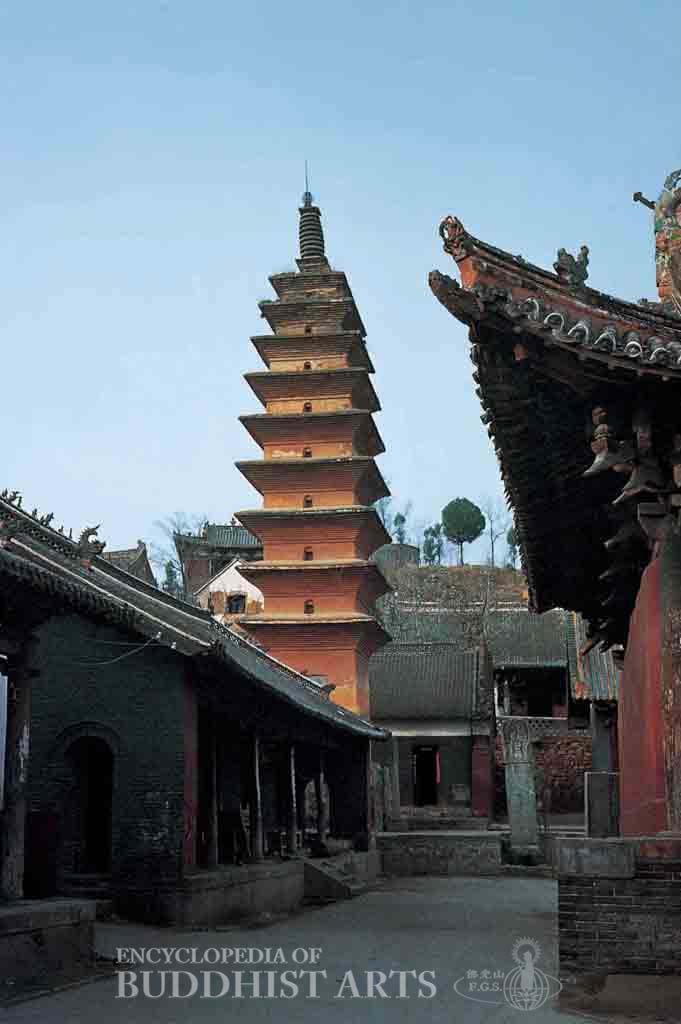
Fengxue Temple: Seventh Patriarch Pagoda
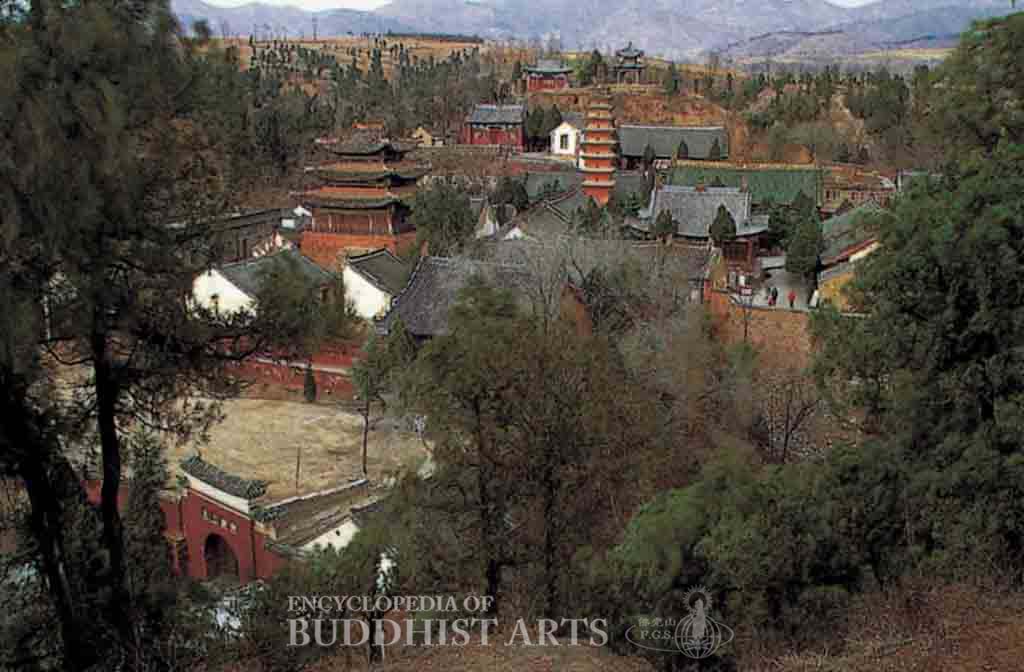
Fengxue Temple
Fengxue Temple
CHINA, Henan, Pingdingshan
The temple was founded during the Northern Wei dynasty (386–534), but was later destroyed by war and rebuilt during the Sui dynasty (581–618). It was expanded during the Tang dynasty (618–907). It was repaired and expanded at various times, so that buildings from different dynasties can be found within the temple grounds. The temple and the forest of pagodas were listed as a National Cultural Heritage Site in 1988.
The temple faces southwest and was built according to the contours of the mountain. The flatter terrain has buildings, while pavilions are built on steeper ground. Bridges and water pavilions are built over streams. The principal buildings include the main temple gate, Heavenly King Hall, bell tower, Central Buddha Hall, Seventh Patriarch Pagoda, Vairocana Hall, abbot’s quarters, Wangzhou Pavilion, and Avalokitesvara Pavilion.
The bell tower is located at the southwest corner of Central Buddha Hall. It was constructed in 1125 during the Northern Song dynasty, and repaired in 1584 during the Ming dynasty. The three-by-three bay tower stands on a 6 m high stone platform. It has a triple-eave hip-and-gable roof and the main ridge is decorated with dragons with fishtails and iron phoenixes. A large inscribed iron bell hangs from the beam. The three-by-three bay Central Buddha Hall was built during the Jin dynasty (1115–1234) and repaired in 1712 during the Qing dynasty. It has a single-eave hip-and-gable roof.
To the northwest of Central Buddha Hall there stands the Seventh Patriarch Pagoda, which is the funerary pagoda of the seventh patriarch Chan Master Zhen. The nine-tier, square, brick pagoda is 24.2 m high and was built in 738 during the Tang dynasty. The eaves are in the form of corbeling. The spire consists of a harmika, nine stacked rings, canopy, and a jewel. The pagoda faces the Central Buddha Hall at a distance of about 10 m. This unusual layout, with a pagoda directly lined up behind a hall, is similar to the layout of Horyuji Temple in Japan.
There are 146 pagodas dispersed throughout the temple. They date back to the Tang, Yuan (1271–1368), Ming (1368–1644), and Qing (1644–1911) dynasties, and there are also some more recent examples. Most of the pagodas are constructed from brick, while some are from stone. This forest of pagodas is one of the largest in China, second only to that of Shaolin Temple. Steles from various periods can also be found in various places around the temple.
For more details, go to the Encyclopedia of Buddhist Arts: Architecture A-F, page 298.
Cite this article:
author = Hsingyun and Youheng and Johnson, Peter and Mankuang and Lancaster, Lewis,
booktitle = {Encyclopedia of Buddhist Arts: Architecture A-F},
pages = 298,
title = {{Fengxue Temple}},
volume = 1,
year = {2016}}