
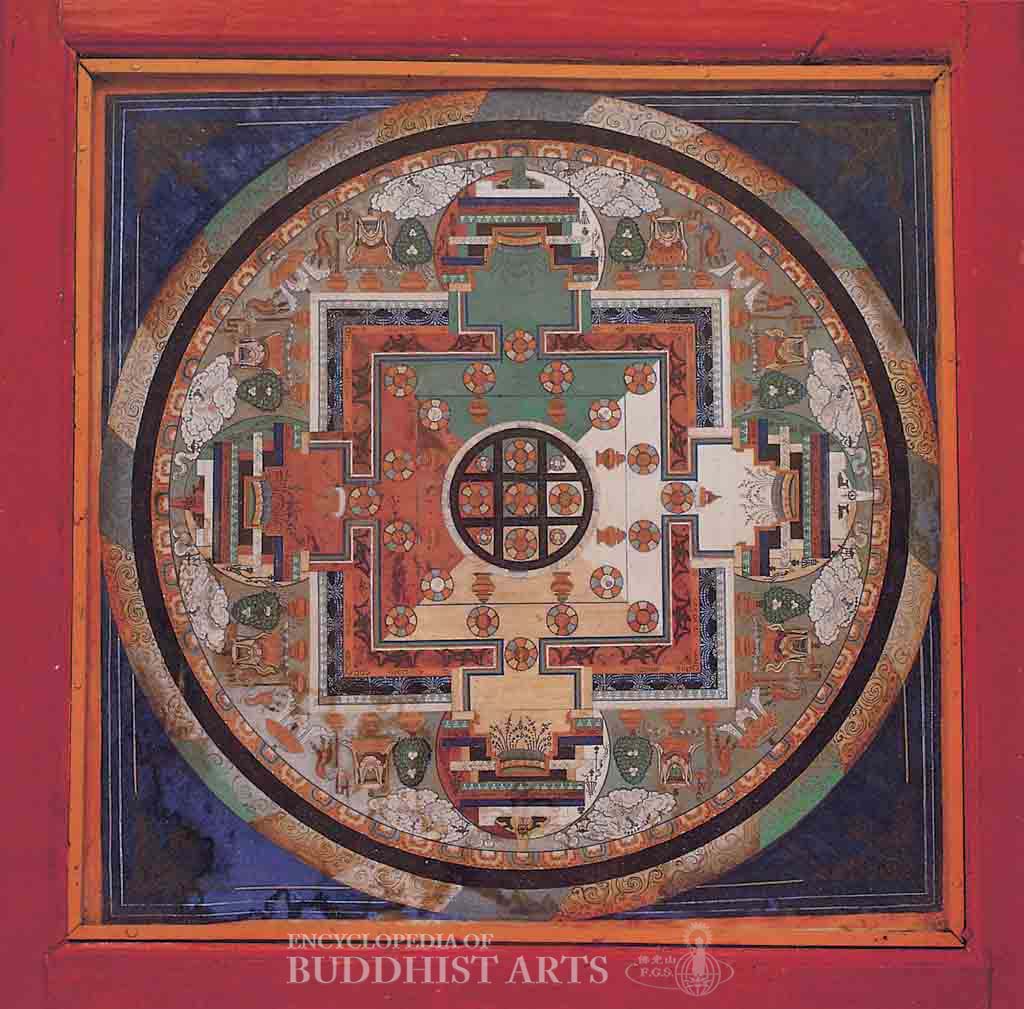
Kumbum Monastery Vajrayana College: Samaya Mandala
Ink and color on wood
Kumbum Monastery Vajrayana College: Samaya Mandala
CHINA, Qinghai, Xining; Yuan dynasty
The Vajrayana College at the Kumbum Monastery was built in 1649. This mandala is painted on the ceiling. There are four basic types of mandalas: mandalas of specific Buddhas and Bodhisattvas; Samaya Mandalas, which are comprised of symbolic objects held by Buddhas and Bodhisattvas such as banners, vajras, lotuses, and Dharma implements; Dharma Seed Mandalas, which are a visual display of sutras and mantras; and Karma Mandalas, which are depictions of the past actions and lives of Buddhas and Bodhisattvas.
This Samaya Mandala is composed of concentric circles and squares. Black lines divide the inner circle into nine segments, each containing a lotus flower symbolizing a Buddha or Bodhisattva. Elaborate gates are painted on all four sides of the inner square. Ritual objects such as parasols, banners, and vases are placed within the outer circle. The three outermost rings of the mandala are adorned with a lotus, vajra and flame pattern respectively. The mandala is colorful, symmetrical, and highly symbolic.
For more details, go to the Encyclopedia of Buddhist Arts: Painting I-O, page 466.
Cite this article:
author = Hsingyun and Youheng and Youlu and Wilson, Graham and Manho and Mankuang and Huntington, Susan,
booktitle = {Encyclopedia of Buddhist Arts: Painting I-O},
pages = 466,
title = {{Kumbum Monastery Vajrayana College: Samaya Mandala}},
volume = 15,
year = {2016}}