
Bihar: Tara
Schist
Bihar: Tara
INDIA, Bihar
This work was unearthed in Bihar. According to its inscription, it possibly originated from the region of Kurkihar. The inscription dates it to around the late 9th century.
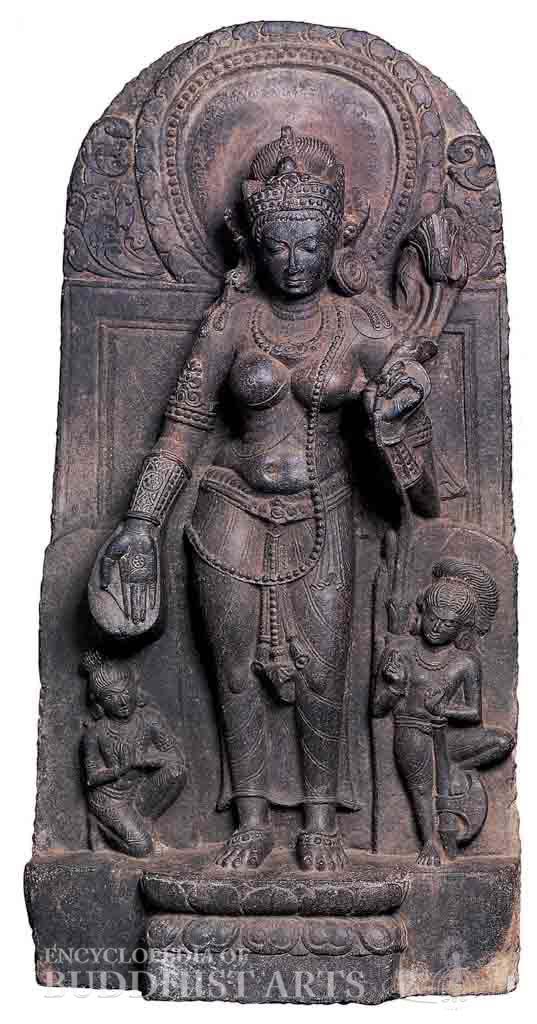
Tara is depicted with hair tied into a large topknot and secured with an ornate headdress, while a few braids of hair can be seen on the shoulders. The nimbus is decorated with rings of beads and flame, while some inscriptions of the Buddha’s teaching are on the innermost circle. A large amount of jewelry is worn by the figure and of particular interest are the pair of cuff bracelets that are usually found on Hindu sculptures. A tight-fitting dhoti with incised lines covers the lower body to the ankles. The stem of a lotus flower is held in the left hand, while the right hand makes the varada (wish-granting) mudra. Visible on the right palm is the lotus, which represents compassion.
The kneeling figure making the anjali (reverence) mudra is believed to be a devotee or Sudhana. The figure on the other side is either a Dharma protector or Hayagriva, who rests his foot on his battle-axe.
For more details, go to the Encyclopedia of Buddhist Arts: Sculpture A-F, page 155.
Cite this article:
author = Hsingyun and Youheng and Lovelock, Yann and Chou, Yuan and Huntington, Susan and Edson, Gary and Neather, Robert,
booktitle = {Encyclopedia of Buddhist Arts: Sculpture A-F},
pages = 155,
title = {{Bihar: Tara}},
volume = 10,
year = {2016}}