
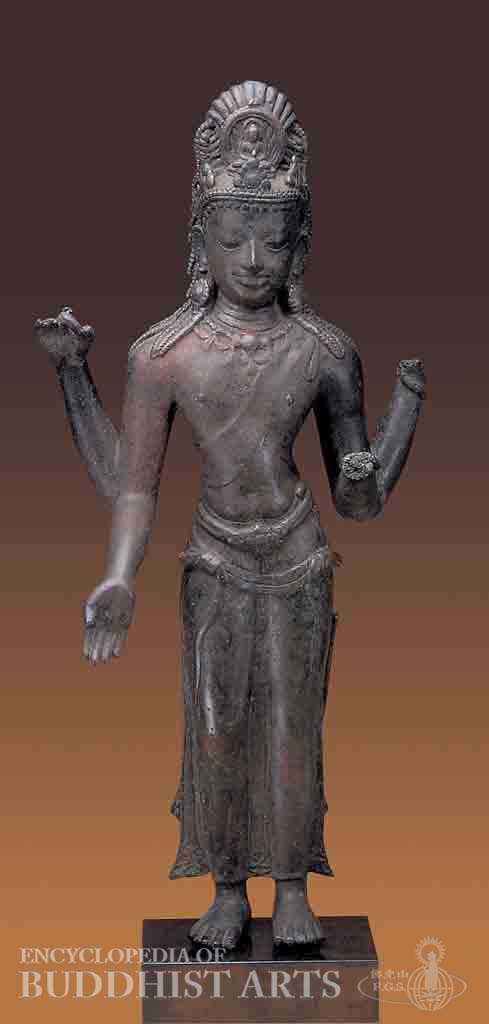
Four-Armed Avalokitesvara
Bronze
Four-Armed Avalokitesvara
INDONESIA
The Bodhisattva stands in a graceful posture with the head slightly inclined to the right. A high headdress is fronted with a Buddha, from under which plaits hang down over the shoulders. A high necklace encircles the neck and there is the faint indication of stole worn diagonally across the chest. The long skirt is of a thin material that shows the shape of the legs beneath. The skirt is secured with a buckled belt, while another belt made from a double ribbon is knotted further down. Most of the hands have broken short, but the lower right opens in varada (wish-granting) mudra. The origin of the statue is uncertain since it is in similar style of either the Srivijaya Empire (circa 7th–13th century) or of southern Thailand.
For more details, go to the Encyclopedia of Buddhist Arts: Sculpture A-F, page 351.
Cite this article:
author = Hsingyun and Youheng and Lovelock, Yann and Chou, Yuan and Huntington, Susan and Edson, Gary and Neather, Robert,
booktitle = {Encyclopedia of Buddhist Arts: Sculpture A-F},
pages = 351,
title = {{Four-Armed Avalokitesvara}},
volume = 10,
year = {2016}}