
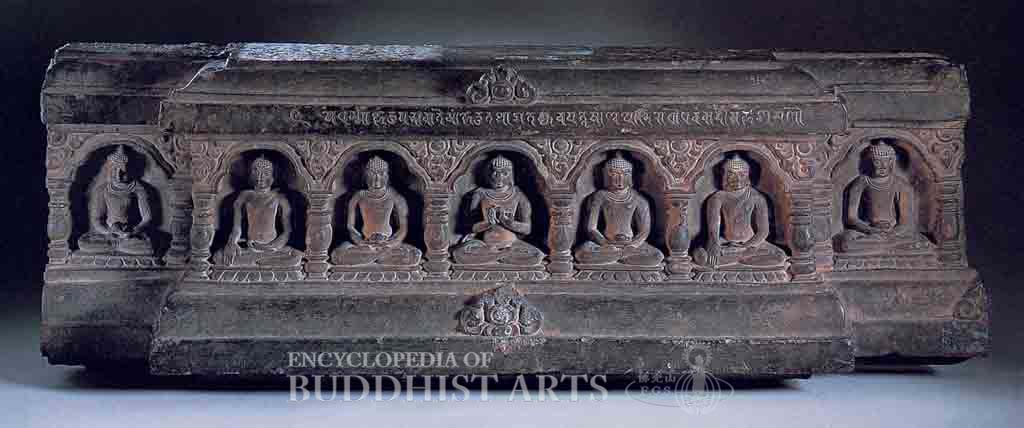
Bihar: Seven Buddhas
Chlorite
Bihar: Seven Buddhas
INDIA, Bihar
This series of seven Buddhas was excavated in Bihar. It is believed to have been created in the 10th century during the Pala period (circa 8th–12th century).
The Buddhas are each enshrined in their own niches that are separated by pillars. The spandrels are decorated with lotus flowers, while the strip above the figures is engraved with an inscription of Buddhist teachings. The niche arches are shaped like trefoils. All seven Buddhas sit on a lotus throne in the full lotus position. They probably represent the five Buddhas of the past, together with the present Buddha, Sakyamuni, and the future Buddha, Maitreya. The first, third, fifth and seventh Buddhas form the dhyana (meditation) mudra and hold a bowl, while the second and sixth Buddhas form the bhumisparsa (earth-touching) mudra. The Buddha in the center forms the Dharmacakra (Dharma wheel) mudra.
For more details, go to the Encyclopedia of Buddhist Arts: Sculpture A-F, page 154.
Cite this article:
author = Hsingyun and Youheng and Lovelock, Yann and Chou, Yuan and Huntington, Susan and Edson, Gary and Neather, Robert,
booktitle = {Encyclopedia of Buddhist Arts: Sculpture A-F},
pages = 154,
title = {{Bihar: Seven Buddhas}},
volume = 10,
year = {2016}}