
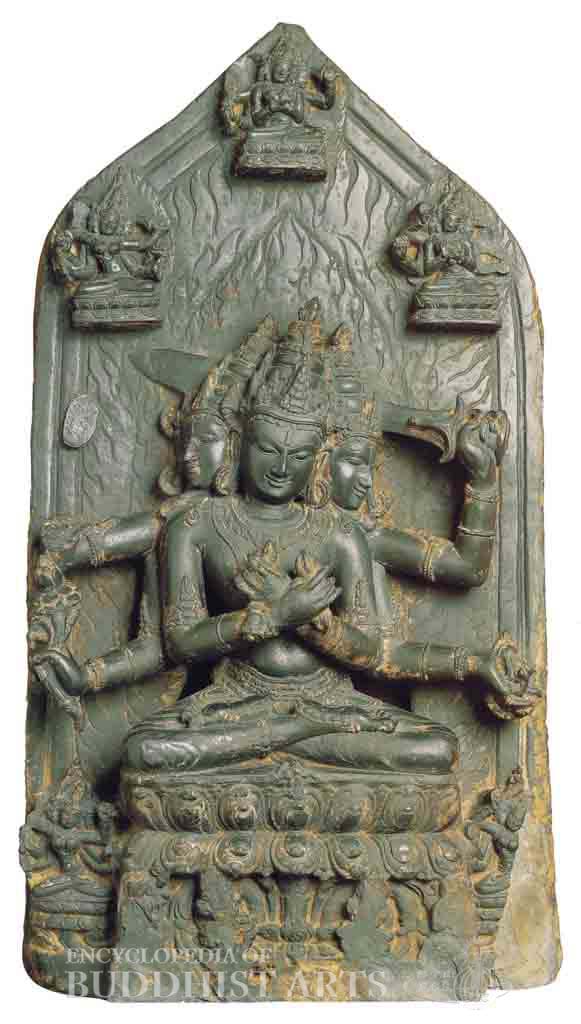
Stele with Buddhas and Bodhisattvas
Chlorite

Stele with Buddhas and Bodhisattvas (detail)
Stele with Buddhas and Bodhisattvas
INDIA / BANGLADESH
Probably of Bengali origin, the sculpture is in the later Pala style at a time when statues of Vajrayana subjects were prominent in the art. One manifestation of this development is the way in which Buddhist figures are depicted with multiples heads and arms and holding a diverse range of symbolic attributes. The central figure probably represents a form of Manjusri, perhaps Manjuvara.
The statue has three heads and six arms and is seated in the full lotus position upon a double lotus throne. Each head wears a high crown and there is a variety of rich jewelry on the body. The two hands crossed at the front are in the vajrahumkara (embracing wisdom) mudra, used when holding the ritual vajra and bell. The raised left hand brandishes a sword and the lower left hand a jewel. The upper right arm is broken and the remaining hand holds a lotus flower.
The petal-shaped back-screen is festooned in flames and smaller figures surrounding the main figure as though functioning as a mandala. The Buddha at the very top mirrors the attitude and carries the same attributes as the figure at the center. Four scarcely differentiated female figures appear at the corners of the rectangular section of the stele. They are probably the consorts of the four transcendental Buddhas portrayed in small-sizes above their heads. Clockwise from the tip of the sword, they are: Locana, consort of Aksobhya; Pandara, consort of Amitabha; Tara, consort of Amoghasiddhi; and Vajradhatisvari, consort of Vairocana.
For more details, go to the Encyclopedia of Buddhist Arts: Sculpture St-Z, page 1170.
Cite this article:
author = Hsingyun and Youheng and Lovelock, Yann and Chou, Yuan and Huntington, Susan and Edson, Gary and Neather, Robert,
booktitle = {Encyclopedia of Buddhist Arts: Sculpture St-Z},
pages = 1170,
title = {{Stele with Buddhas and Bodhisattvas}},
volume = 13,
year = {2016}}