
Kong Pisei: Seated Buddha
Sandstone
Kong Pisei: Seated Buddha
CAMBODIA, Kampong Speu, Kong Pisei
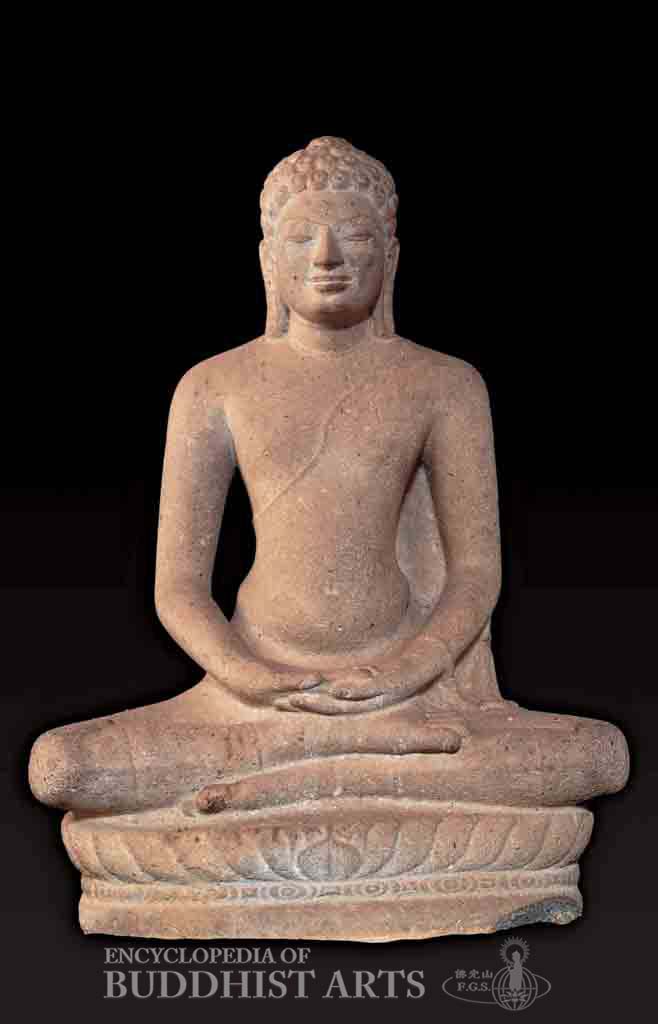
Discovered in Kong Pisei, the seated Buddha has similarities to sculptures from the Gupta period (circa 320–550), the influence of which is seen in other places in Cambodia such as Angkor Borei and Phnom Da. It is especially noticeable in the oval face, full chin and almond-shaped eyes of this figure.
The Buddha’s eyes are closed in a face of transcendental serenity. The diaphanous monastic robe leaves the right shoulder bare and is only indicated by faint lines across the chest and wrist, but its fall on the right behind the body is also apparent. There is a slight bulge around the waist, as if indicating the lower robe. The Buddha sits in half lotus position on a lotus throne of overlapping petals. His hands are in the dhyana (meditation) mudra. A decorative relief runs along the base beneath the throne.
For more details, go to the Encyclopedia of Buddhist Arts: Sculpture G-M, page 554.
Cite this article:
author = Hsingyun and Youheng and Lovelock, Yann and Chou, Yuan and Huntington, Susan and Edson, Gary and Neather, Robert,
booktitle = {Encyclopedia of Buddhist Arts: Sculpture G-M},
pages = 554,
title = {{Kong Pisei: Seated Buddha}},
volume = 11,
year = {2016}}