
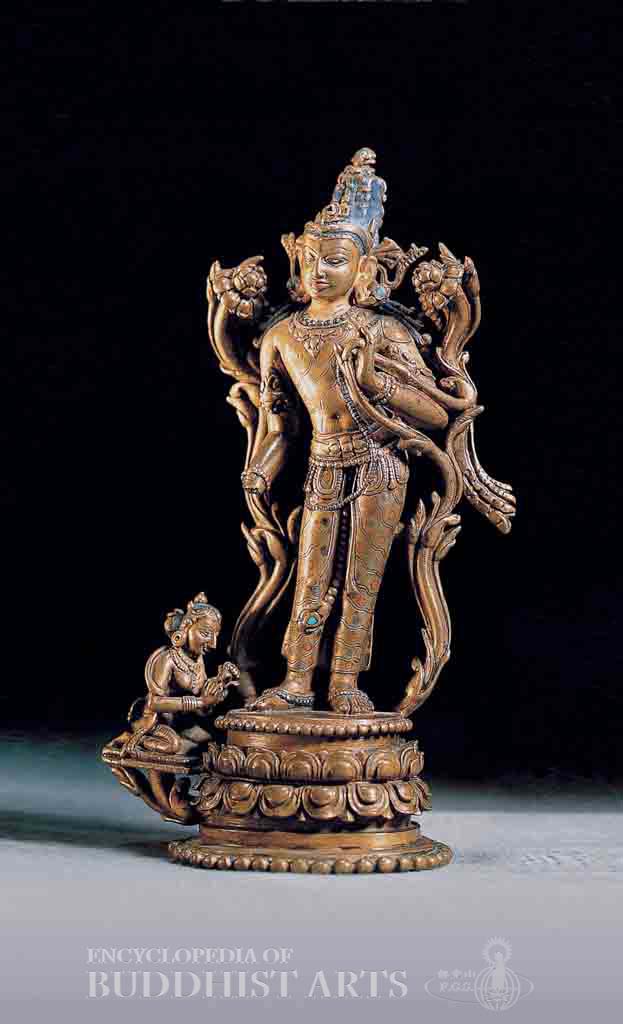
Avalokitesvara Bodhisattva
Brass
Avalokitesvara Bodhisattva
INDIA
Though the sculpture is of Bengali origin which is in eastern India, the presence of gold paint on the face leads experts to speculate that the statue was taken to Tibet. Inlays of silver can be found in the eyes, urna, necklace, and sacred thread, while the lower lip is inlaid with copper. The decorations on the clothing are inlaid with both copper and silver.
The high headdress has an Amitabha Buddha at its center and fluttering ribbons on either side. The Bodhisattva’s facial features are mostly delineated with fine lines. Numerous pieces of jewelry inlaid with gems add to the statue’s splendor. The figure stands on a double lotus pedestal with right foot foremost and the weight on the left, inclining the hips and head to one side. Although the right hand is broken, it can be seen that, like the left, it once held a long-stemmed lotus that rises to head height. An extension from the pedestal supports a female devotee who offers a lotus at the Bodhisattva’s feet.
For more details, go to the Encyclopedia of Buddhist Arts: Sculpture A-F, page 96.
Cite this article:
author = Hsingyun and Youheng and Lovelock, Yann and Chou, Yuan and Huntington, Susan and Edson, Gary and Neather, Robert,
booktitle = {Encyclopedia of Buddhist Arts: Sculpture A-F},
pages = 96,
title = {{Avalokitesvara Bodhisattva}},
volume = 10,
year = {2016}}