
Bharhut: Life of the Buddha - Departure and Renunciation
Sandstone
Bharhut: Life of the Buddha - Departure and Renunciation
INDIA, Madhya Pradesh, Bharhut
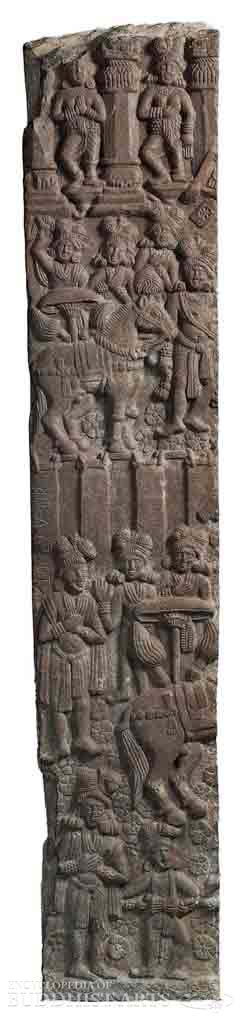
This carving depicts the incident when Prince Siddhartha departs from Kapilavastu. The narrative proceeds down the column in a manner that combines the composite with the sequential. A parasol accompanied by a whisk is the only reference to the prince. Female deities standing between columns are located at the top with the prince’s footprint visible at the foot of a staircase. This symbol signifies his departure from the palace. Three deities witness his departure as the charioteer, Chandaka, leads the horse before them. Like the above register, the parasol and whisk on the horse’s back represents the prince.
The scene then shifts downwards to similarly turbaned witnesses outside the walls of the city, with the hind-quarters of the horse disappearing to the right. The smaller of the two figures at the bottom is playing a double-ended drum. The flowers on the ground were scattered by the deities.
For more details, go to the Encyclopedia of Buddhist Arts: Sculpture A-F, page 132.
Cite this article:
author = Hsingyun and Youheng and Lovelock, Yann and Chou, Yuan and Huntington, Susan and Edson, Gary and Neather, Robert,
booktitle = {Encyclopedia of Buddhist Arts: Sculpture A-F},
pages = 132,
title = {{Bharhut: Life of the Buddha - Departure and Renunciation}},
volume = 10,
year = {2016}}