
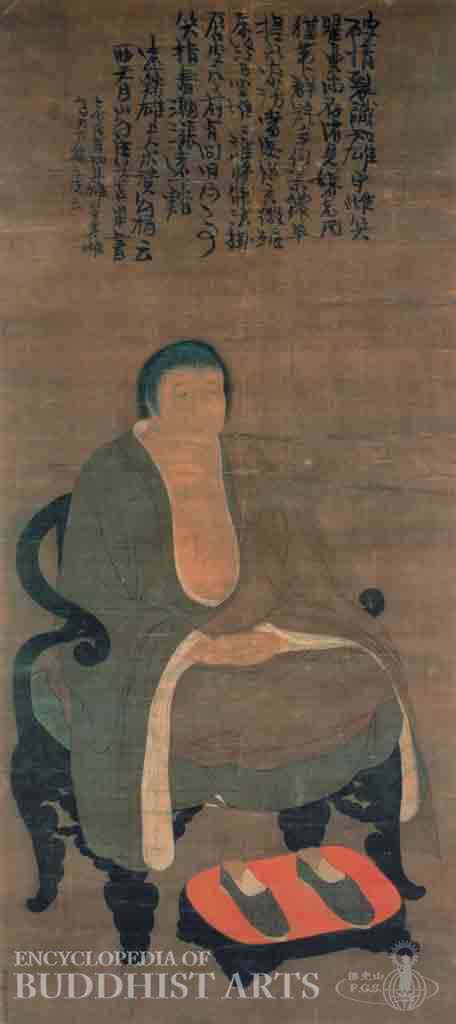
Master Zhongfeng Mingben; Yuan dynasty
Ink and color on paper
Zhongfeng Mingben
CHINA, Zhejiang, Hangzhou; Yuan dynasty
Zhongfeng Mingben was a calligrapher and Chan master of the Linji school from Qiantang (present day Hangzhou, Zhejiang) also known as Huanzhu Daoren and originally from a family with the surname Sun. At the age of 15, he resolved to renounce and in 1286 at the age of 23, he visited Chan Master Gaofeng Yuanmiao at Tianmushan (Eyes of Heaven Mountain) and eventually received precepts under him and succeeded his teachings. Zhongfeng was said to be highly self-motivated and disciplined.
Emperor Renzong (reigned 1311–1320) of the Yuan dynasty once formally invited Master Zhongfeng to teach in the imperial palace, but he insistently declined. Later, the emperor honored him with a gold monastic robe and the title Chan Master Foci Yuanzhao Guanghui (Buddha’s Compassion, Perfect Illumination, Broad Wisdom). Zhao Mengfu, a well-known scholar and artist, greatly respected him as a teacher and frequently visited him to inquire about the Dharma. Many Japanese monks who traveled to China during the Yuan dynasty, such as Muin Genkai and Jakushitsu Genko, also sought Chan teachings from Master Zhongfeng. Emperor Yingzong (reigned 1320–1323) took refuge in the Triple Gem under his certification, and after his passing, Emperor Wenzong (reigned 1328–1329) bestowed Master Zhongfeng with the posthumous title of Chan Master Zhijue (Awakened Wisdom) and named his funerary pagoda Fayun (Dharma Cloud). In 1334, his title was changed to National Master Pujue (Broad Awakening). The essentials of his teachings were collected and compiled into 30 fascicles of Extended Records of Tianmushan Master Zhongfeng and three fascicles of Miscellaneous Records.
He was skilled in calligraphy with a style exhibiting an unrestrained composition and character structure. His inscriptions appear in the paintings of Avalokitesvara in a White Robe by Jueji Yongzhong, Sixteen Arhats by monk Fanlong, and Eighteen Arhats by Guan Daosheng. His extant works include Advice to Tesshu Tokusai’s Attendant, kept at Tokiwayama Bunko Foundation in Kanagawa, Japan; and Correspondence with Otomo Sadamune is at Seikado Bunko Art Museum in Tokyo, Japan. Both items are listed as Important Cultural Properties of Japan.
For more details, go to the Encyclopedia of Buddhist Arts: People, page 357.
Cite this article:
author = Hsingyun and Youheng and Youlu and Pokorski, Stefanie and Yichao and Mankuang and Miaohsi,
booktitle = {Encyclopedia of Buddhist Arts: People },
pages = 357,
title = {{Zhongfeng Mingben}},
volume = 19,
year = {2016}}