
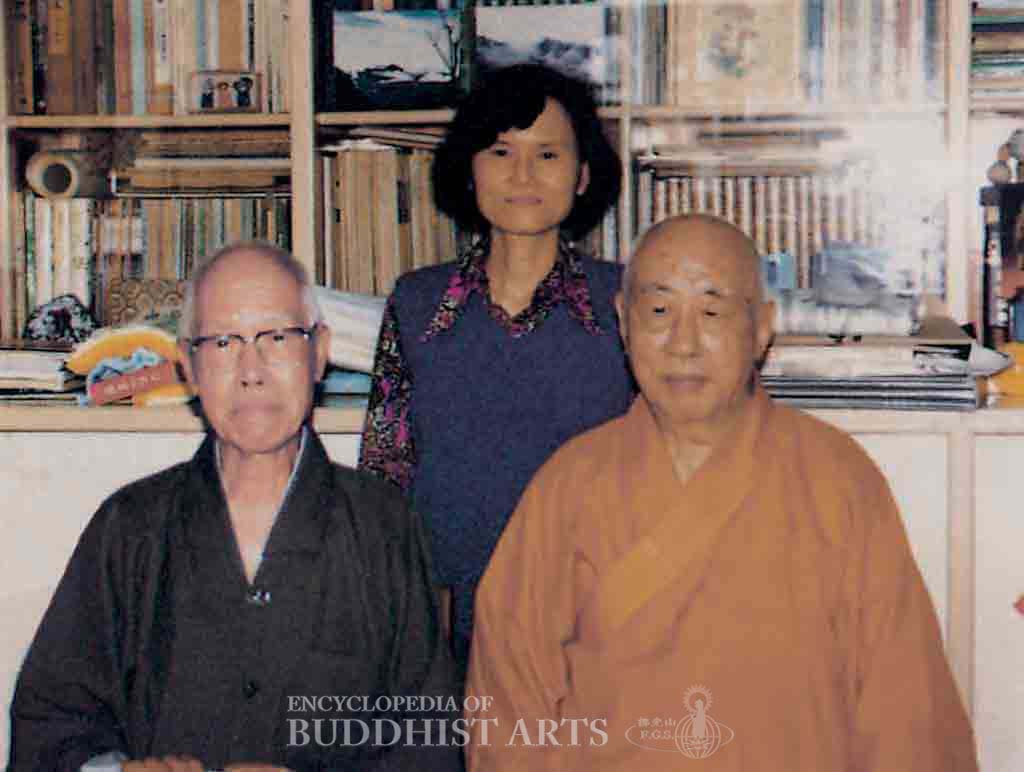
Pen Hui
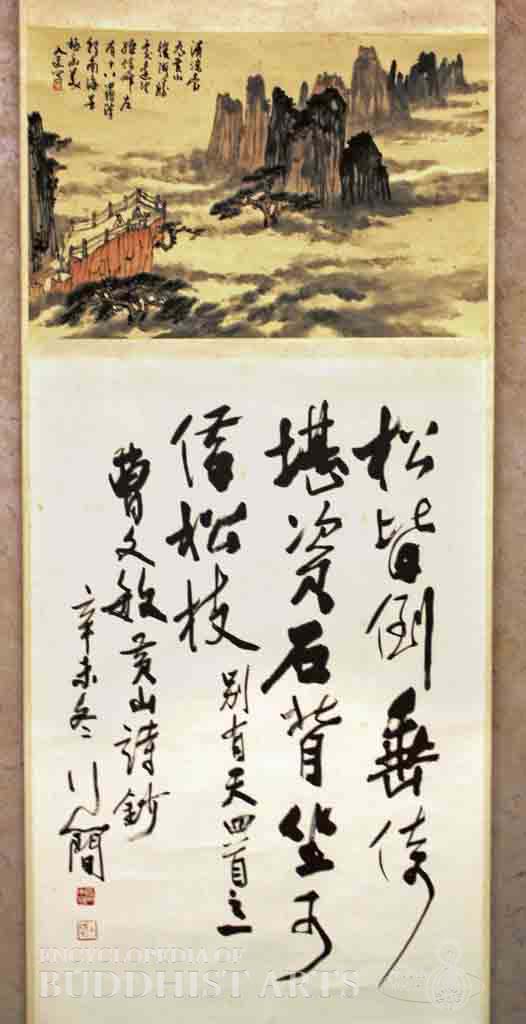
Huangshan by Pen Hui; Dated 1991
Ink and color on paper
Pen Hui
CHINA, Beijing
Pen Hui’s original name was Ren Bowu and he was also known as Ruyu. He was a monk skilled in calligraphy, painting, and poetry. At the age of six, Pen learned calligraphy from his father and practiced copying the Stele of Cao Quan in clerical script. He continued to cultivate his skills by following Ouyang Xun’s style, as well as studying the small seal script of Stele of Yishan and the large seal script of ancient bronze inscriptions. Pen began to produce works in running and cursive scripts by emulating other renowned calligraphers including Wang Xizhi and Wang Xianzhi. He started painting at the age of ten by imitating the Manual of the Mustard Seed Garden, later learning how to paint landscapes from Xiao Qianzhong. In addition, he studied the art of seal carving under Qi Baishi and applied these skills to his paintings.
Pen attended Peking University when he was 18 years old and studied in the Department of Chinese Literature. He later went to Taiwan in 1948 and taught at Fu Jen Catholic University, as well as the National Taiwan University of Art. In 1979, he moved to Yuan Kuang Chan Monastery in Taoyuan, and taught Chinese literature in Yuan Kuang Buddhist College. He donated his calligraphy and paintings to the Buddhist College and in 1998, the college established the Master Ruyu Calligraphy Exhibition Hall, where his work, Huangshan, is kept. He authored Collection of Calligraphy and Paintings of Teacher and Students at Shouzhongzhai.
He became a Buddhist in 1940 after taking refuge under Master Hongyi, and later renounced in 1972 at the age of 56 under Master Xuxiang at Jixiang Temple in Taipei. Completely devoting himself to cultivation and research on Buddhism, Pen annotated the Diamond Sutra, the Universal Gateway Chapter of the Lotus Sutra, the Ksitigarbha Sutra, and other books and Buddhist texts. He used Buddhist teachings in his calligraphy and paintings, and he vowed to liberate sentient beings by means of writing, calligraphy, and painting. Apart from holding exhibitions in Seoul and San Francisco, he organized several solo exhibitions at the National Museum of History in Taipei, National Dr. Sun Yat-Sen Memorial Hall in Taipei, and the National Taiwan Museum of Fine Arts in Taichung.
For more details, go to the Encyclopedia of Buddhist Arts: People, page 207.
Cite this article:
author = Hsingyun and Youheng and Youlu and Pokorski, Stefanie and Yichao and Mankuang and Miaohsi,
booktitle = {Encyclopedia of Buddhist Arts: People },
pages = 207,
title = {{Pen Hui}},
volume = 19,
year = {2016}}