
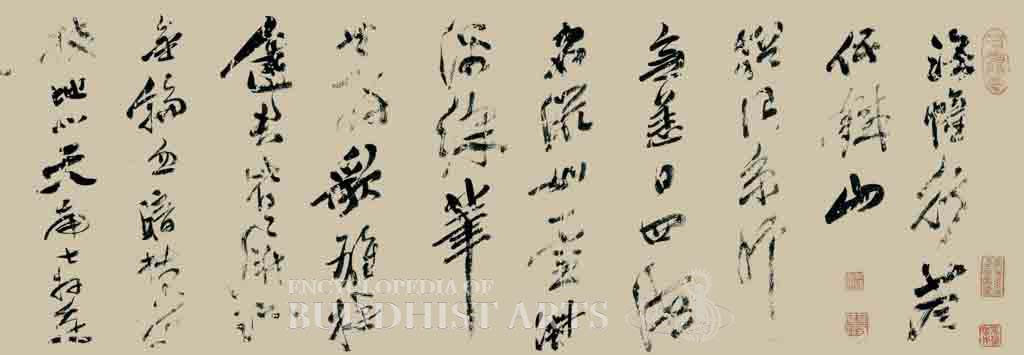
Journey to Haichuang Temple by Dangui Jinshi (detail); Ming to Qing dynasty
Ink on paper
Dangui Jinshi
CHINA, Zhejiang, Hangzhou; Ming to Qing dynasty
Originally named Jin Bao, and also known as Xingyin, Dangui Jinshi was a monk and a calligrapher. He passed the imperial examination in 1640 and became an Imperial Scholar. He served various positions in the imperial court and was revered for his honest character and integrity. He renounced after the fall of the Ming dynasty (1368–1644), and studied the teachings of the Caodong school of Chan Buddhism under Master Tianran Hanshi. After establishing Biechuan Temple in Guangdong, he invited Master Tianran to be the abbot, and later assumed the role upon Master Tianran’s retirement. Relics were found after Dangui’s death and enshrined by his disciples in a pagoda bearing his name in Shanguan, Guangdong.
Dangui was accomplished in both poetry and calligraphy, and was particularly adept in running script, which he modeled after the firm and prominent works of the Jin dynasty (265–420). Examples of his pieces in semi-cursive style include Journey to Haichuang Temple, which exhibits a soft inner spirit encased in a bold outward appearance, and Letter from Master Dangui Jinshi, both of which are currently kept at the Ho’s Calligraphy Foundation in Taipei, Taiwan. Other works of calligraphy include transcriptions of the Heart Sutra and the Thousand Character Classic, also in running script. He authored a number of annotations and written works, such as two editions of a poetry collection entitled Travels Through the Hall.
For more details, go to the Encyclopedia of Buddhist Arts: People, page 36.
Cite this article:
author = Hsingyun and Youheng and Youlu and Pokorski, Stefanie and Yichao and Mankuang and Miaohsi,
booktitle = {Encyclopedia of Buddhist Arts: People },
pages = 36,
title = {{Dangui Jinshi}},
volume = 19,
year = {2016}}