
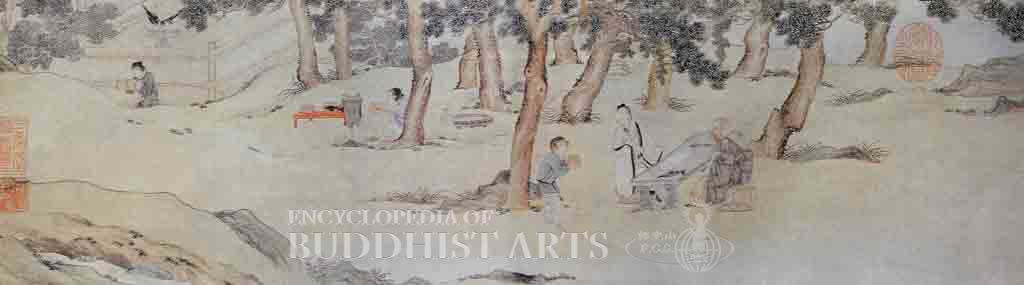
Zhao Mengfu Transcribing the Heart Sutra in Exchange for Tea by Qiu Ying, Ming dynasty, dated 1542–1543
Ink and color on paper
Qiu Ying
CHINA, Jiangsu, Suzhou; Ming dynasty
Qiu Ying, also known as Shifu or Shizhou, was a painter from Taicang (in present day Suzhou). Studying painting under Zhou Chen, he diligently imitated works by famous painters of the Tang (618–907) and Song (960–1279) dynasties, producing works that were almost like the originals.
Highly proficient in all painting techniques such as coloring, ink washing, and line drawing, Qiu’s brushwork was agile, graceful, and exquisite. His figure paintings, particularly that of ladies,were depicted with vivid expressions, and his landscape paintings were lively with meticulous brushstrokes. He was a good friend of Wen Zhengming, who praised his works to be as refined and elegant as those by renowned painters Liu Songnian and Zhao Boju. Qiu, alongside Shen Zhou, Tang Yin, and Wen Zhengming is regarded as one of the Four Masters of the Ming dynasty, as well as the Four Masters of Wu. His daughter, Qiu Zhu, was also a famous painter at the time.
Extant paintings by Qiu are plentiful and are kept in various museums and art galleries around the world. His Buddhist paintings of Avalokitesvara Bodhisattva, Three Great Bodhisattvas, and Samantabhadra Bodhisattva, as well as illustrations on various written works by Wen Zhengming and Zhao Mengfu, are kept at the National Palace Museum in Taipei, Taiwan. A fine example of his painting is the Zhao Mengfu Transcribing the Heart Sutra in Exchange for Tea, kept in Cleveland Museum of Art in Ohio, USA. Other paintings include a copy of the Five Hundred Arhats, originally line-drawn by Li Gonglin, and Avalokitesvara Crossing the Sea.
For more details, go to the Encyclopedia of Buddhist Arts: People, page 219.
Cite this article:
author = Hsingyun and Youheng and Youlu and Pokorski, Stefanie and Yichao and Mankuang and Miaohsi,
booktitle = {Encyclopedia of Buddhist Arts: People },
pages = 219,
title = {{Qiu Ying}},
volume = 19,
year = {2016}}