
Emeishan
Emeishan
CHINA, Sichuan, Leshan
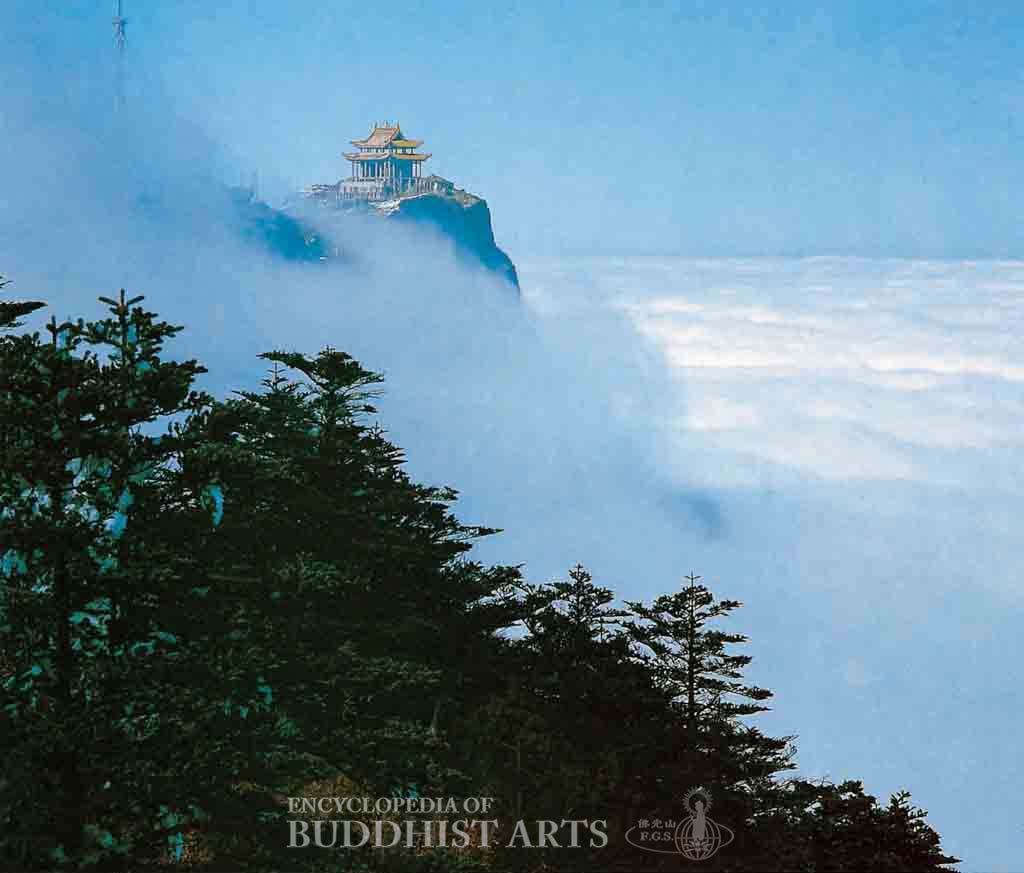
Emeishan, or Mount Emei, means Delicate Eyebrow Mountain. It is one of the Four Sacred Buddhist Mountains of China, and the tallest of the four. It is the abode of Samantabhadra Bodhisattva, who is associated with Buddhist practice. The shape of the mountain is long, slender, and slightly bent, and the highest peak is 3,099 m above sea level. The place is unique in its long established Buddhist culture and its natural beauty, and it was listed as a UNESCO World Heritage Site in 1996.
There are different accounts regarding the arrival of Buddhism on Emeishan: one maintains that it started during the Eastern Han dynasty (25–220); the other states that it was established during the Jin dynasty (265–420). During the Sui (581–618) and Tang (618–907) dynasties Buddhism flourished here but it was not until the Song dynasty (960–1279) that it officially became associated with Samantabhadra, when a copper statue of the Bodhisattva was cast and enshrined here. Construction of temples continued in the Ming (1368–1644) and Qing dynasties (1644–1911).
There are currently more than 20 temples on the mountain. There are three temples with the most imposing structures and containing the most artifacts: Baoguo Temple located in the foothills, Wannian Temple built on the mountainside, and Jingding Huazang Temple on the highest peak.
Emeishan has 164 historical sites and more than 6,800 artifacts. Among the latter there are the Buddha’s tooth relics, the Samantabhadra Bodhisattva of Wannian Temple, palm leaf manuscripts, a ceramic Vairocana Buddha statue, and a golden seal of Samantabhadra. Emeishan is also known as a geological museum due to its variety of layers of rocks that have accumulated over a long period of time.
For more details, go to the Encyclopedia of Buddhist Arts: Architecture A-F, page 266.
Cite this article:
author = Hsingyun and Youheng and Johnson, Peter and Mankuang and Lancaster, Lewis,
booktitle = {Encyclopedia of Buddhist Arts: Architecture A-F},
pages = 266,
title = {{Emeishan}},
volume = 1,
year = {2016}}