
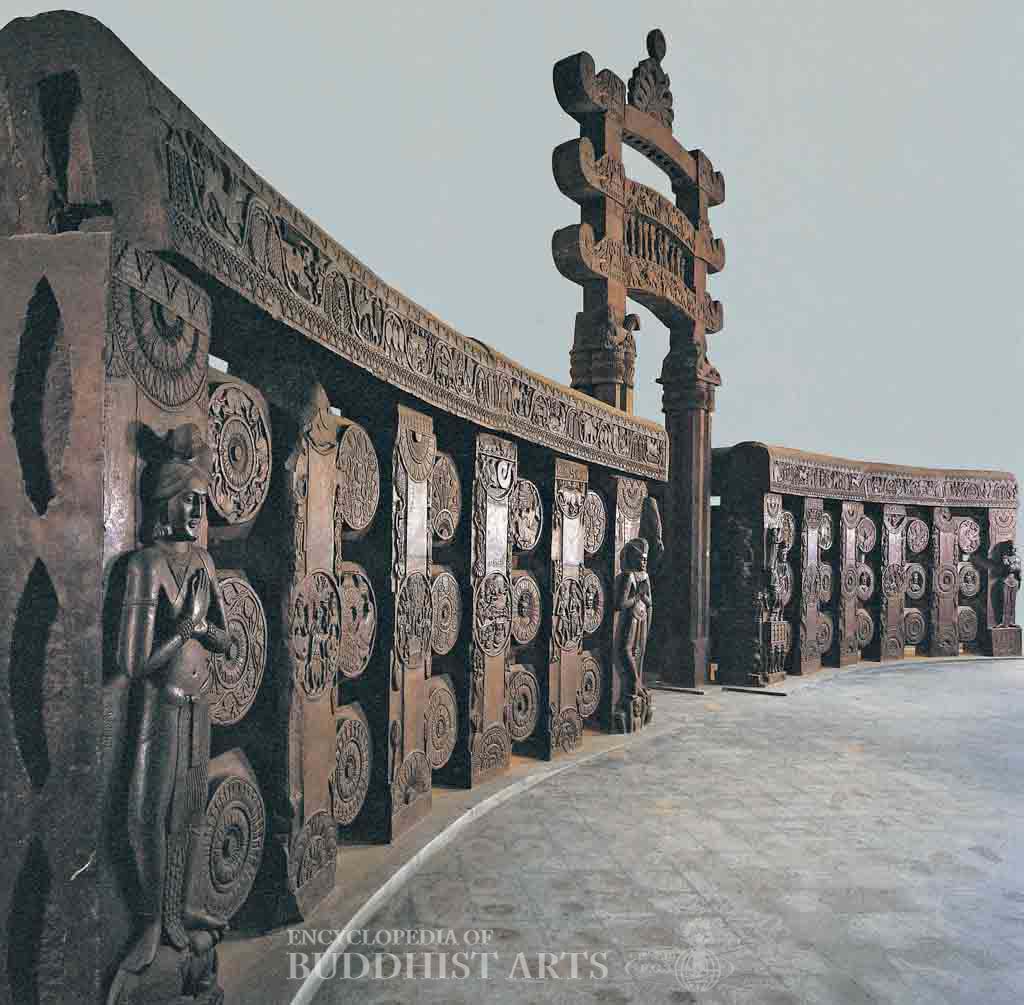
Bharhut Stupa: East Gateway and Railings
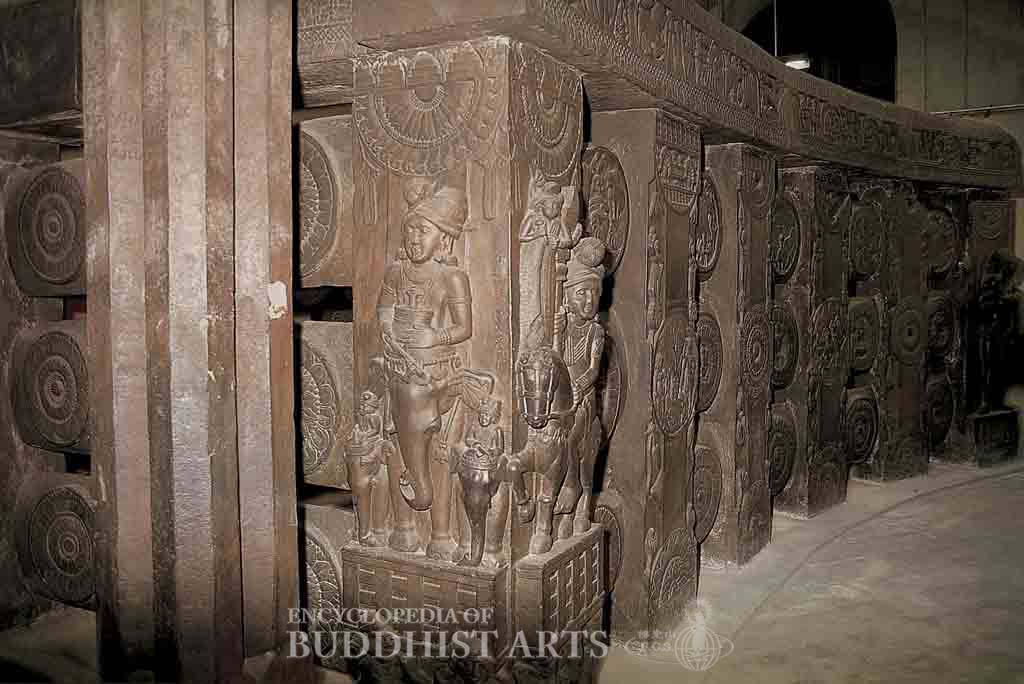
Bharhut Stupa: Railings (detail)
Bharhut Stupa
INDIA, Madhya Pradesh, Bharhut
Bharhut is a village located approximately 15 km south of Satna and 190 km southwest of Allahabad. The Bharhut Stupa, together with Sanchi Stupa 1, was considered the best example of early Buddhist architecture in India. It is said to have been built by King Asoka (reigned circa 269–232 BCE) during the 3rd century BCE. The stupa was enlarged by kings of the Sunga Empire (circa 185–75 BCE) by adding railings in the 2nd century BCE and gateways in the 1st century BCE. The site was discovered and excavated by British archaeologist Alexander Cunningham in 1873. By then the stupa was no longer extant, with only the east gateway and parts of the railings remaining. In 1875 the remaining parts of the railings and the east gateway were removed to the Indian Museum in Kolkata for display. Some of the remains of sculptures are preserved at the Allahabad Museum.
The stupa was originally made of bricks and covered with plaster. It was estimated to have been 20.1 m in height and 20.7 m in diameter. The unadorned stupa body was encircled by richly carved railings. The area between the railings and the stupa body defined a path for circumambulation that was approximately 3.2 m wide. The railings were built with 80 posts, each with a height of 2.7 m. Four towering gateways once stood at the four cardinal directions. At present, only the lowest part of the stupa, approximately 1 m high, still remains at the site.
The existing east gateway and the railings displayed in the museum were sculpted in sandstone in imitation of wooden structures. They are elaborately carved with beautiful reliefs. The gateway consists of two columns and three slightly curved crossbars. Each columns is formed by joining together four octagonal shafts, which are crowned by inverted lotus capitals. Above each capital there is an abacus on which rests a larger capital consisting of two lions and two bulls. The crossbars of the gateway are engraved with the Worship of the Bodhi Tree and with reliefs of stupas on the two sides. The gateway is crowned by a palm leaf pattern with a Dharma wheel above it.
The end posts of the railings are carved with yaksas and other deities in high relief. Round medallions in bas-relief decorate the intermediate posts and are located in the spaces between the posts. They depict themes from the Jataka tales, the Life of Buddha, the Teaching of the Dharma, and scenes from everyday village life. There are also other decorative images, such as lotus designs, yaksa busts, images of deer, elephants, and peacocks. Many of the narrative reliefs are inscribed with identifying labels. The long horizontal rail at the top is carved with the Worship of the Bodhi tree, stupas and the Dharma wheel. This is in conformity with the early aniconic phase of Buddhist art, where the Buddha is not represented in human form but through symbols, such as the Dharma wheel, Bodhi tree, stupa, lotus throne, and footprint.
For more details, go to the Encyclopedia of Buddhist Arts: Architecture A-F, page 76.
Cite this article:
author = Hsingyun and Youheng and Johnson, Peter and Mankuang and Lancaster, Lewis,
booktitle = {Encyclopedia of Buddhist Arts: Architecture A-F},
pages = 76,
title = {{Bharhut Stupa}},
volume = 1,
year = {2016}}