
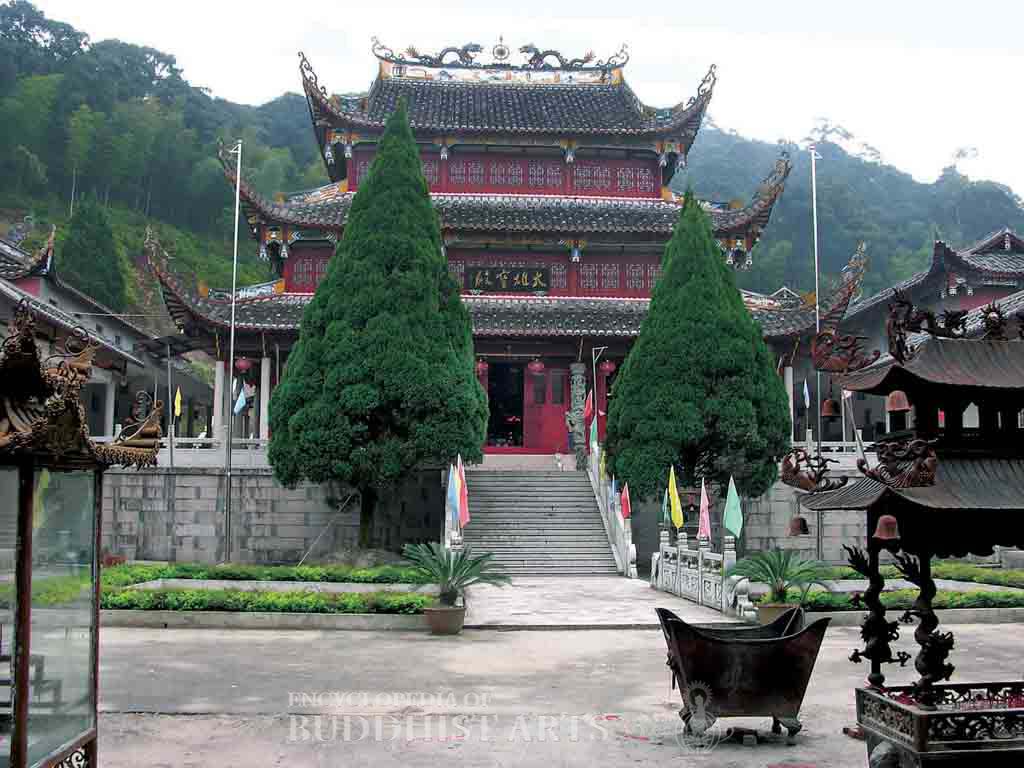
Zhiti Temple: Great Hero Hall
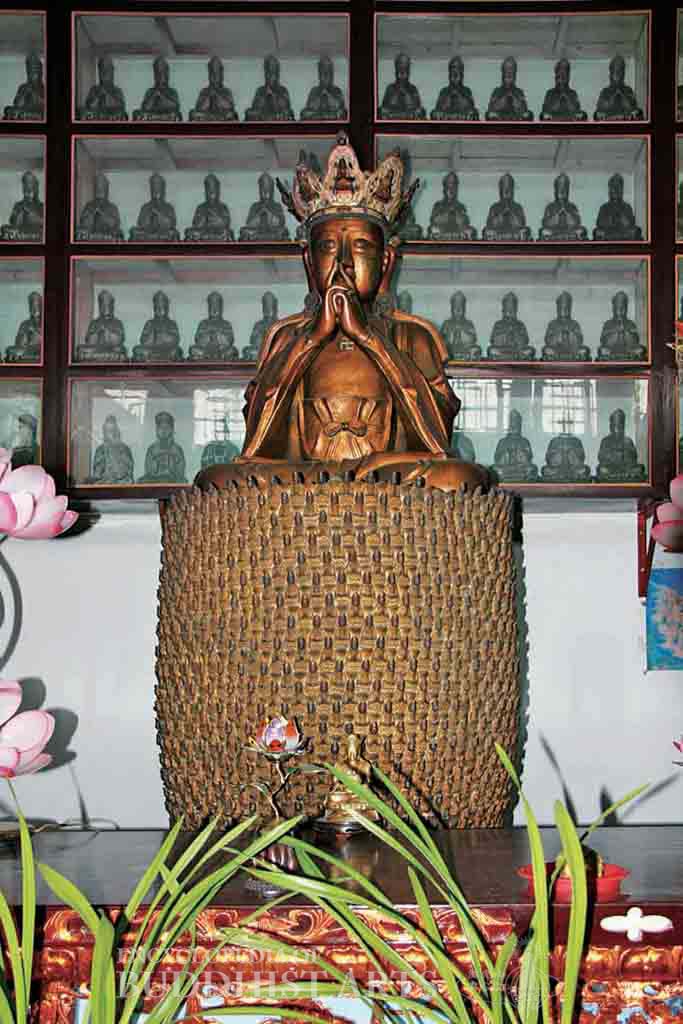
Zhiti Temple: Flower Treasure Hall - Vairocana Buddha
Zhiti Temple
CHINA, Fujian, Ningde
Zhiti stands for Caitya and was given this name because it is located on the west side of Zhitishan (Caitya Mountain). The temple was built in 971 during the Northern Song dynasty by King Qian Hongchu (reigned 948–978) of Wuyue. It was restored in 1407 during the Ming dynasty. Zhitishan was once considered to be a sacred mountain of Buddhism and many believed that every monastic should go there at least once in their lifetime. At the height of it prosperity it was visited by an endless stream of devotees and wandering monks. The temple was listed as a key Buddhist temple in the Han region of China in 1983.
The principal buildings of the temple include the main temple gate, Heavenly King Hall, Great Hero Hall, Flower Treasure Hall, Celestial Crown Pavilion, Patriarch Hall, Sangharama Hall, and the chanting hall. The Great Hero Hall is the main building of the temple. It has a triple-eave hip-and-gable roof whose corners are greatly exaggerated. On the main ridge of the building there are two dragons playing with a pearl at the center. Inside the Flower Treasure Hall there is a gilt bronze seated statue of Vairocana Buddha. It is 2.5 m high and weighs around 500 kg. The exquisitely carved base has 1,000 Buddha reliefs carved on it. Its arrangement makes it look like numerous upright lotus petals.
The temple houses a collection of 1,000 cast iron statues of Bodhisattvas, which date back to the Ming dynasty (1368–1644). Each statue is around 30 m high and weighs 10 kg. The temple has 7,840 fascicles of the Buddhist Canon, as well as a purple monastic robe bestowed by Emperor Wanli (reigned 1572–1620) of the Ming dynasty. There are also structures such as the Chan Master Stupa from the Yuan dynasty (1271–1368), and Stupa of National Master Daxing from the Ming dynasty.
For more details, go to the Encyclopedia of Buddhist Arts: Architecture T-Z, page 1405.
Cite this article:
author = Hsingyun and Youheng and Johnson, Peter and Mankuang and Lancaster, Lewis,
booktitle = {Encyclopedia of Buddhist Arts: Architecture T-Z},
pages = 1405,
title = {{Zhiti Temple}},
volume = 4,
year = {2016}}