
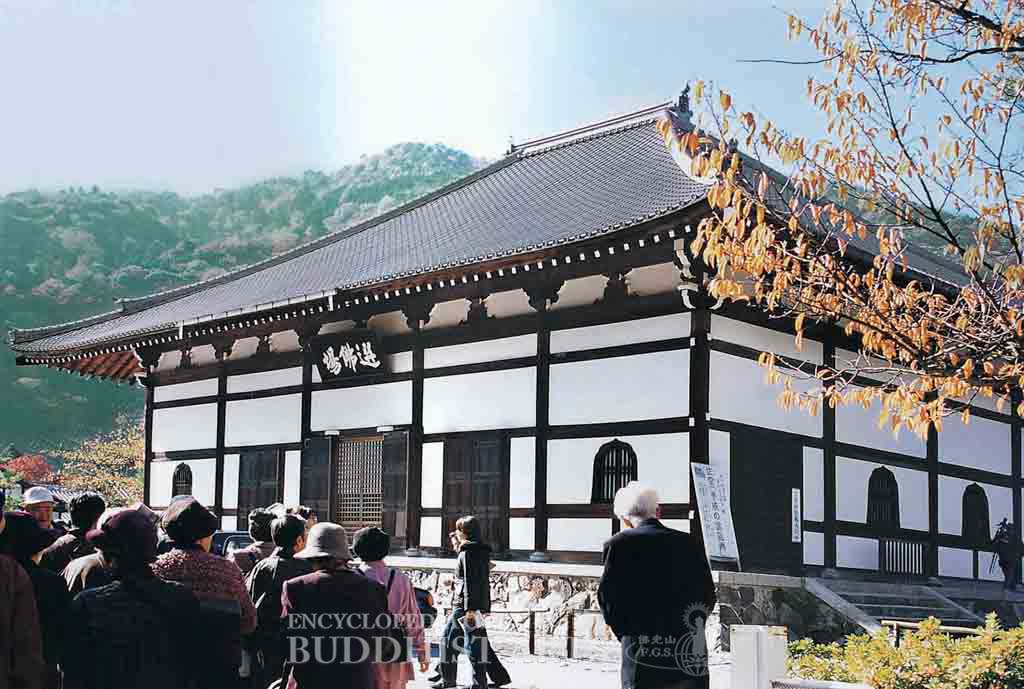
Tenryuji Temple: Dharma Hall

Tenryuji Temple: Dharma Hall (interior)
Tenryuji Temple
JAPAN, Kyoto
Tenryu means Dragon of the Sky. Formally known as Reigizan Tenryu Shiseizenji, it is the head temple of the Tenryuji Branch of the Rinzai school of Japanese Zen Buddhism. The temple was founded in 1339 during the Nanbokucho period by Shogun Ashika Takauji. National Master Muso had requested the temple to be built in order to pray for the late Emperor Daigo (reigned 1318–1339). Since it was founded the temple has suffered from seven fires. The existing halls were mostly constructed during the Meiji period (1868–1912). As part of the Historic Monuments of Ancient Kyoto, the temple was listed as a UNESCO World Heritage Site in 1994.
The main structures of the temple complex include the Imperial Messenger Gate, Dharma Hall, abbot’s quarters, Prabhutaratna Hall, kitchen, monastic quarters, and Sogen pond. The Imperial Messenger Gate, built in 1641 during the Edo period, is the oldest structure in the temple. The Dharma Hall was built in 1766 during the Edo period and has a hip roof covered with wavy square tiles. Statues of Sakyamuni Buddha, Manjusri Bodhisattva, and Samantabhadra Bodhisattva seated upon Sumeru thrones are enshrined within the hall. On the ceiling there is an image of a dragon in the clouds painted by Kayama Matazo in 1997. The painting is 9 m in diameter and depicts a lively dragon that appears to be descending from the heavens. The kitchen has an overhanging gable roof with a chimney. The Sogen pond is in a stroll-style garden that was constructed by Master Muso, who utilized the views of Arashiyama (Storm Mountain) and Reigizan (Turtle Mountain) as borrowed scenery to create a garden with a splendid view. The pond is registered as a historical landmark and a place of special interest. The temple also houses portraits of Chinese Chan Masters Yunmen and Fayan.
For more details, go to the Encyclopedia of Buddhist Arts: Architecture T-Z, page 1103.
Cite this article:
author = Hsingyun and Youheng and Johnson, Peter and Mankuang and Lancaster, Lewis,
booktitle = {Encyclopedia of Buddhist Arts: Architecture T-Z},
pages = 1103,
title = {{Tenryuji Temple}},
volume = 4,
year = {2016}}