
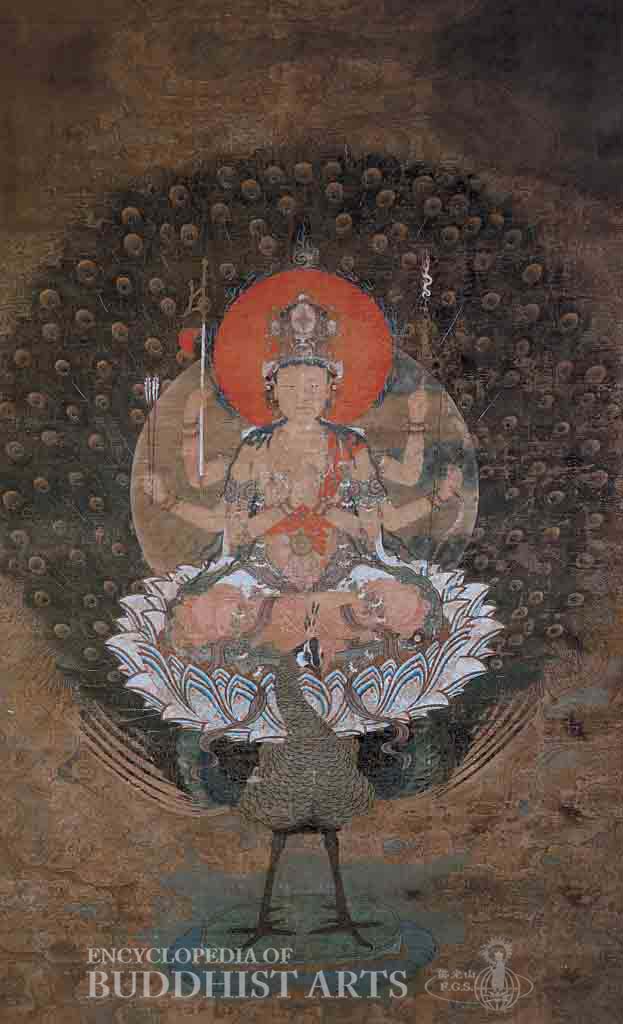
Mahamayuri
Ink and color on silk
Mahamayuri
CHINA; Northern Song dynasty
This painting is based on descriptions of Mahamayuri in the Mahamayuri Vidyarajni Sutra. It was painted in China during the late 11th century, but was later brought to Japan, and was listed as a National Treasure in 1951.
Mahamayuri has three heads and six arms. The central head has a peaceful appearance and is topped with a tall golden crown, while the other two heads appear wrathful. The body is adorned with ornate bracelets, armlets, and beaded ornaments. Two of the hands are joined in reverence in front of the chest, while the other three hands hold a bow, arrows, and a halberd. The top left hand balances a vajra on the index finger. Mahamayuri is seated in full lotus position upon a brilliant white lotus throne on the back of a peacock. Standing on a lotus pedestal, the peacock spreads its beautifully painted feathers behind Mahamayuri’s bright red nimbus and brown aureole.
For more details, go to the Encyclopedia of Buddhist Arts: Painting I-O, page 497.
Cite this article:
author = Hsingyun and Youheng and Youlu and Wilson, Graham and Manho and Mankuang and Huntington, Susan,
booktitle = {Encyclopedia of Buddhist Arts: Painting I-O},
pages = 497,
title = {{Mahamayuri}},
volume = 15,
year = {2016}}