
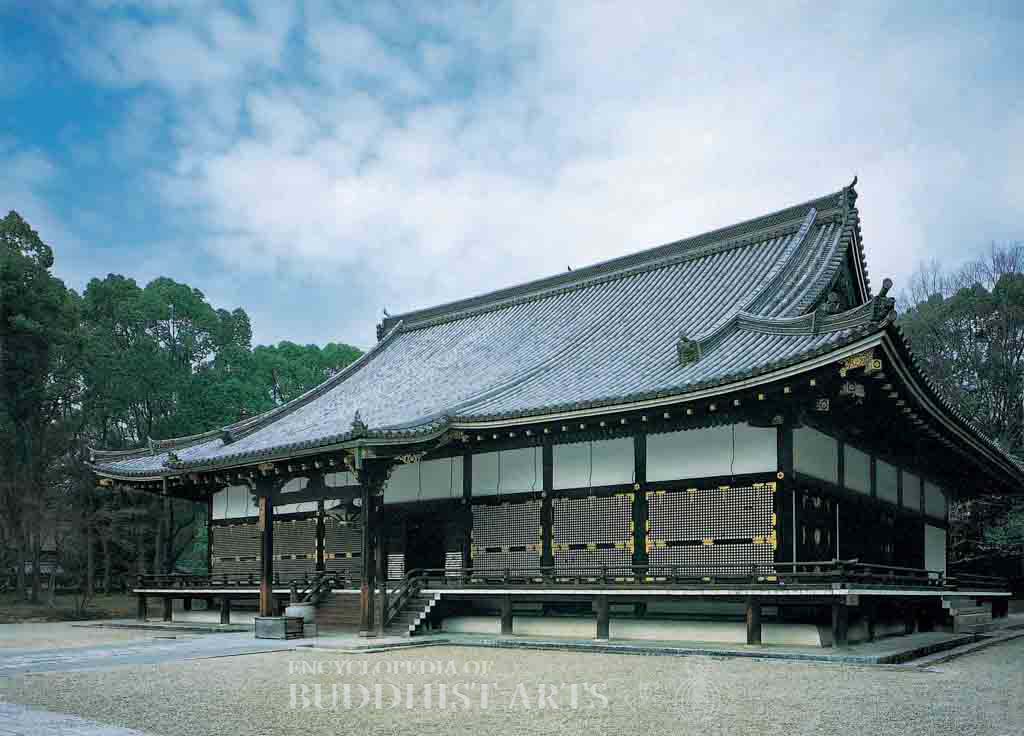
Ninnaji Temple: Golden Hall
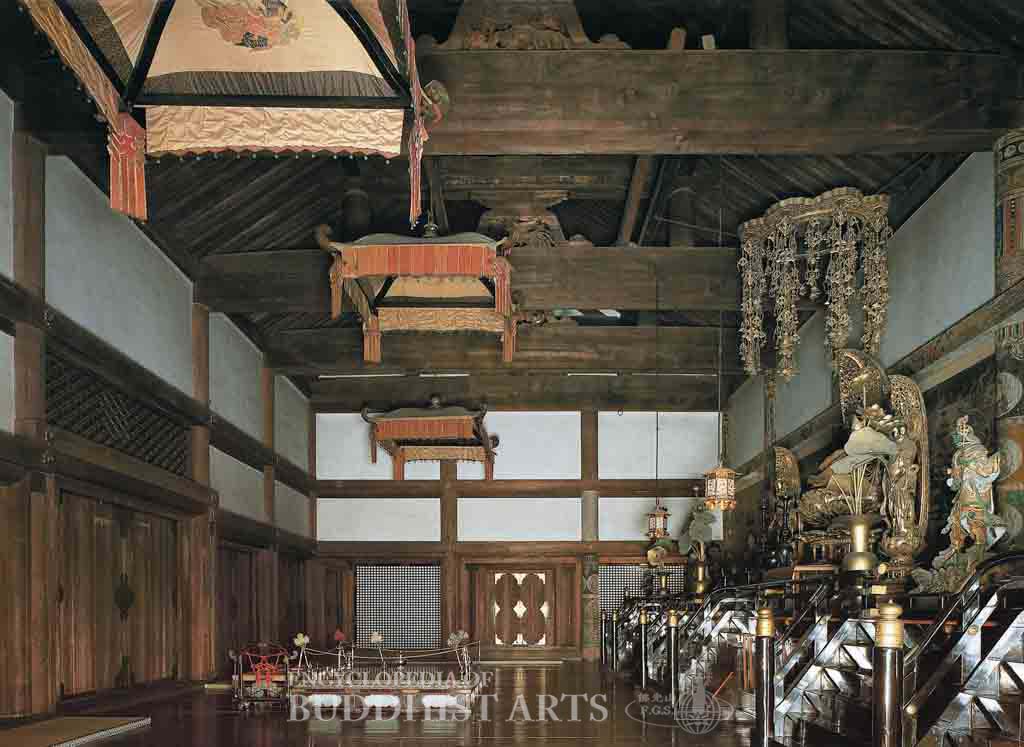
Ninnaji Temple: Golden Hall (interior)
Ninnaji Temple
JAPAN, Kyoto
Ninna refers to the reign in which the temple was built. It is the head temple of the Omuro branch of the Shingon school of Japanese Buddhism. Construction of the temple started in 886 during the Heian period in response to a wish by Emperor Koko (reigned 884–887) that the country would be at peace. When Emperor Uda (reigned 887–897) renounced in 899, he became the first Japanese emperor to retire to a monastic community. He constructed the monastic quarters in 904 and became the first abbot. Subsequent abbots also came from the imperial family and it was the first temple at which the imperial family resided. The temple flourished between the middle of the Heian (794–1185) and early Kamakura (1185–1333) periods. The abbot of the temple continued to be a member of the imperial family until the Meiji period (1868–1912). Along with the Historic Monuments of Ancient Kyoto, the temple was listed as a UNESCO World Heritage site in 1994.
Over a hundred halls and quarters were destroyed during war in the 15th century. Most of the structures were rebuilt, and they include the imperial hall, five-story pagoda, Avalokitesvara Hall, Gate of Two Kings, founder’s hall, tea house, and the Golden Hall, which was listed as a National Treasure in 1953. The Golden Hall was rebuilt from the imperial hall in 1613 during the Azuchi-Momoyama period, and preserves the appearance of the imperial hall from the Heian period. The seven-by-five bay structure has a single-eave hip-and-gable roof covered with cylindrical tiles. The interior has the appearance of a Buddha hall, with inner and outer shrines. The hall has latticed windows as well as sliding doors on both sides. The imperial hall was completed in 1914 during the Taisho period. It is in the imperial style of the Heian period and contains features of the study room built during the Kamakura and Muromachi periods. The founder’s hall, built in 1641 during the Edo period, is a square hall whose sides are 10 m long. The roof is covered with cypress bark. A statue of Master Kukai is enshrined within the hall. The temple houses National Treasures, including statues of the Amitabha Buddha Triad and Medicine Buddha, and a portrait of Mahamayuri. The temple also has a sculpture of Prince Siddhartha, which is an Important Cultural Property.
For more details, go to the Encyclopedia of Buddhist Arts: Architecture M-S, page 796.
Cite this article:
author = Hsingyun and Youheng and Johnson, Peter and Mankuang and Lancaster, Lewis,
booktitle = {Encyclopedia of Buddhist Arts: Architecture M-S},
pages = 796,
title = {{Ninnaji Temple}},
volume = 3,
year = {2016}}