
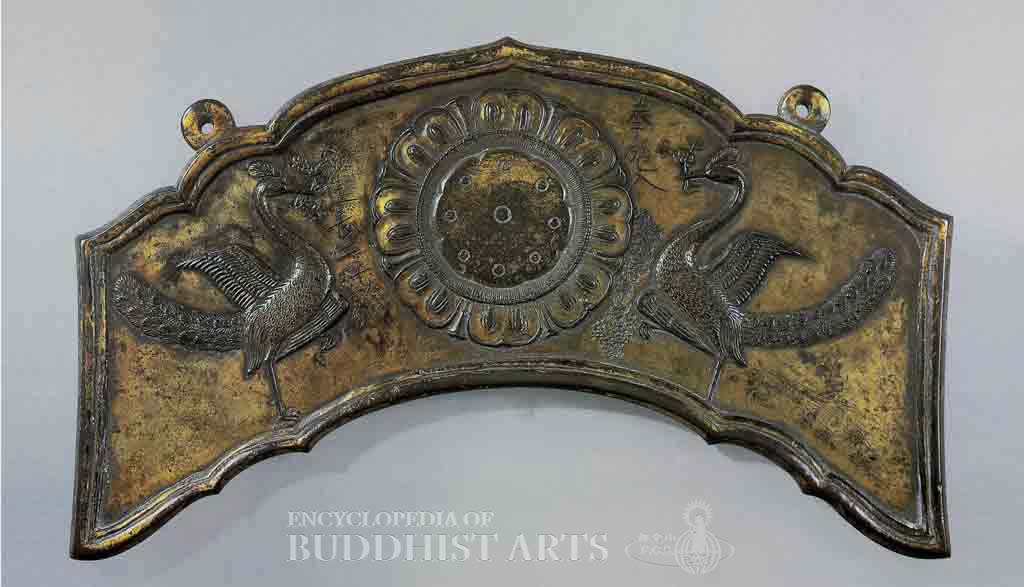
Motsuji Temple Hall of Thousand Arms: Gong
Gilt bronze
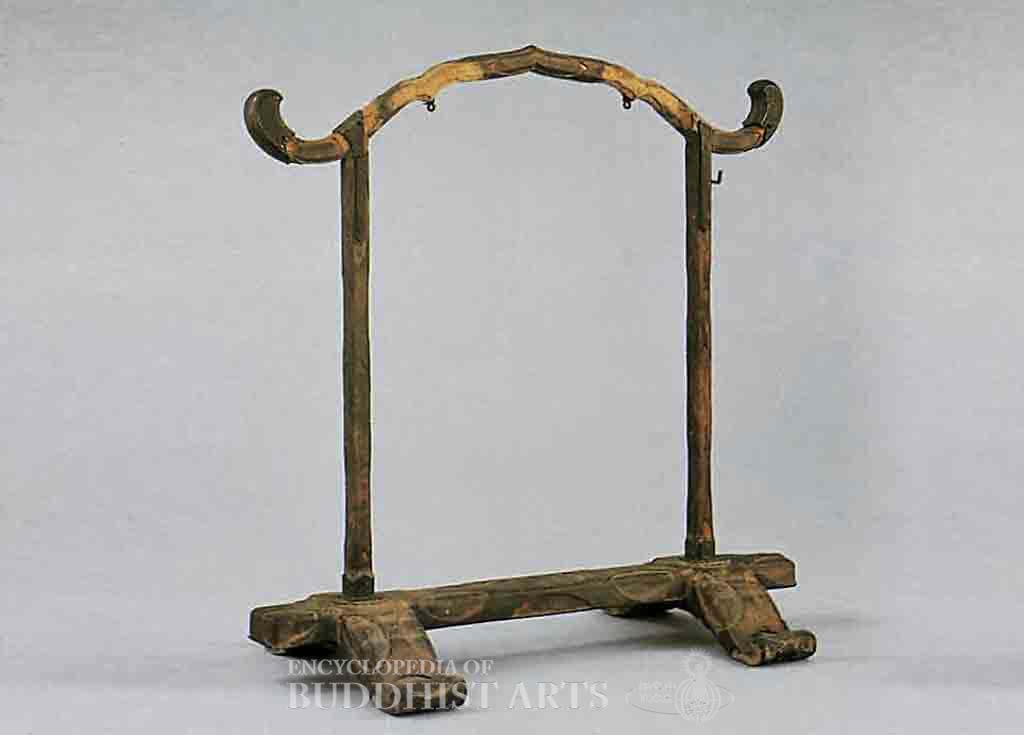
Motsuji Temple Hall of Thousand Arms: Gong Stand
Wood
Motsuji Temple Hall of Thousand Arms: Gong
JAPAN, Iwate, Nishiiwai; Kamakura period
The inscriptions on this gong indicate that it was used as a Dharma instrument in Senjudo Hall of Motsuji Temple and dates from 1250. It is now located in Chusonji Temple and was listed as a National Treasure in 1953.
The gilt bronze ritual gong is elegantly curved with a height of 13 cm and width of 32 cm; it weighs 2 kg. The raised center boss has a diameter of 9.5 cm. It contains lotus seeds and is surrounded by lotus petals. On either side, there is a lively peacock standing on one leg. The peacocks’ crests, bodies, feathers, and plumes are engraved with fine lines. Similar features can be found on the rear of the gong.
For more details, go to the Encyclopedia of Buddhist Arts: Artifacts, page 204.
Cite this article:
Hsingyun, et al. "Motsuji Temple Hall of Thousand Arms: Gong." Encyclopedia of Buddhist Arts: Artifacts , vol. 18, 2016, pp. 204.
Hsingyun, Youheng, Youji, Stefanie Pokorski, Mankuang, and Wen Fan. 2016. "Motsuji Temple Hall of Thousand Arms: Gong" In Encyclopedia of Buddhist Arts: Artifacts , 18:204.
Hsingyun, Youheng, Youji, Pokorski, S., Mankuang, & Fan, W.. (2016). Motsuji Temple Hall of Thousand Arms: Gong. In Encyclopedia of Buddhist Arts: Artifacts (Vol. 18, pp. 204).
@misc{Hsingyun2016,
author = Hsingyun and Youheng and Youji and Pokorski, Stefanie and Mankuang and Fan, Wen,
booktitle = {Encyclopedia of Buddhist Arts: Artifacts },
pages = 204,
title = {{Motsuji Temple Hall of Thousand Arms: Gong}},
volume = 18,
year = {2016}}
author = Hsingyun and Youheng and Youji and Pokorski, Stefanie and Mankuang and Fan, Wen,
booktitle = {Encyclopedia of Buddhist Arts: Artifacts },
pages = 204,
title = {{Motsuji Temple Hall of Thousand Arms: Gong}},
volume = 18,
year = {2016}}