
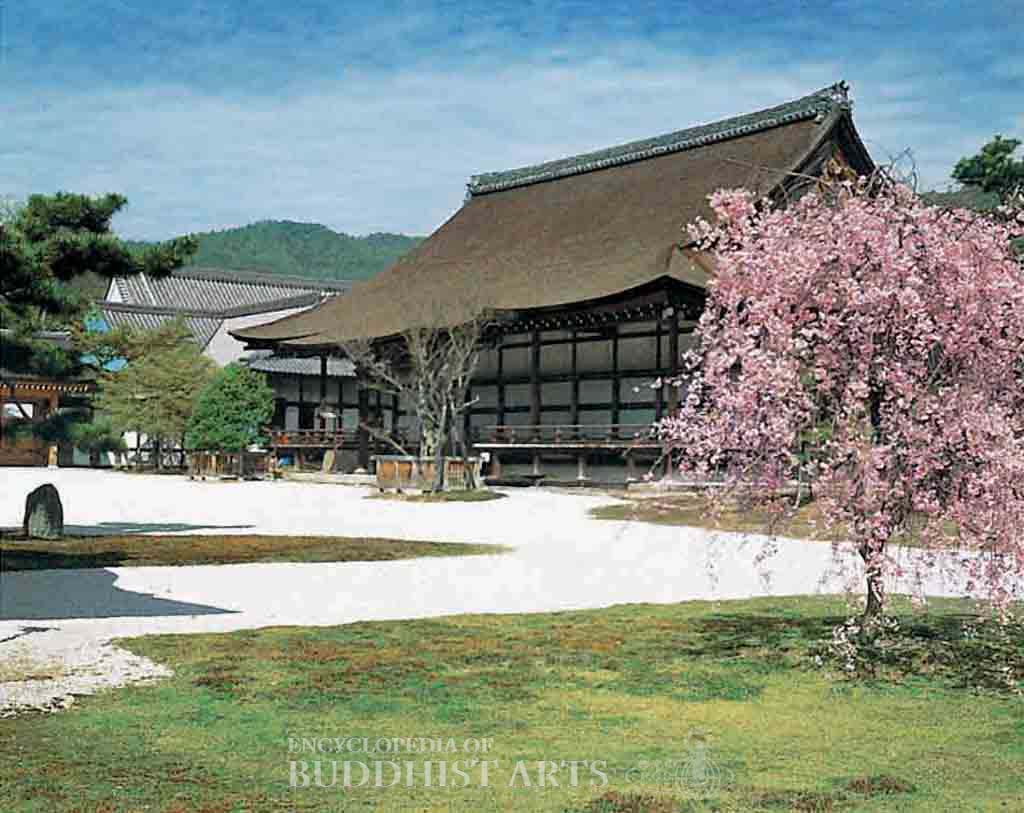
Daikakuji Temple: Imperial Hall
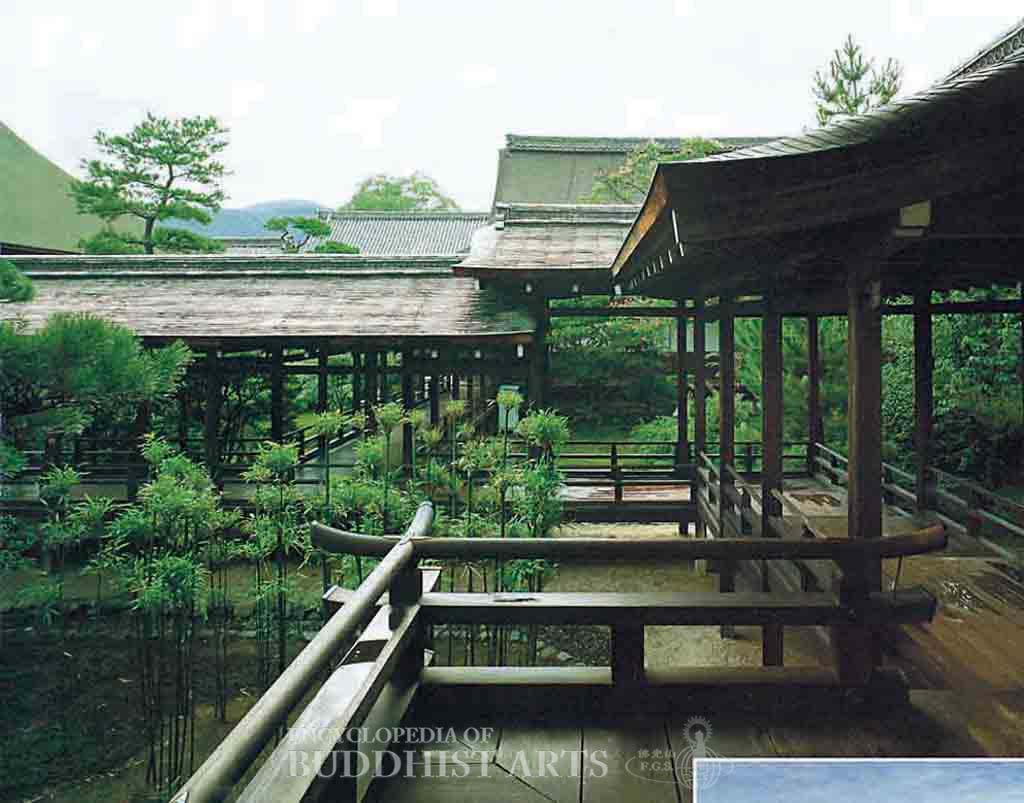
Daikakuji Temple: Covered Walkway
Daikakuji Temple
JAPAN, Kyoto
Daikakuji is the head temple of the Daikaku branch of the Shingon school. It was originally built as the imperial villa when Emperor Saga (reigned 809–823) married Empress Darin. In 876 during the Heian period, the emperor’s daughter renovated it and converted it to a temple. Kojuaku Hosshino, who was a monastic from the imperial family, was invited to be the founder. Since then the abbot’s position has been filled by members of the imperial family. In 1307 during the Kamakura period, Emperor Uda expanded the temple. The temple declined and then flourished again during the Azuchi-Momoyama period (1573–1615).
The temple’s design and layout do not follow those of traditional temples, but preserve the rich and colorful design of an imperial villa. The principal buildings of the temple include the main hall, Imperial Hall, founder’s hall, Chinese gate, reception hall, and bell tower. The temple’s buildings are connected by covered wooden walkways lined with balustrades. The Imperial Hall has a single-eave hip-and-gable roof covered with cypress bark and is surrounded by a veranda.
The Osawa Pond, to the east of the temple, is Japan’s oldest garden pond surrounded by cherry blossoms and maple trees, reflecting the beauty of the temple. This temple has been known for sutra writing ever since the time of Emperor Saga. It houses a calligraphy of Emperor Go-Uda that is listed as a National Treasure. There are also three sets of Five Wisdom King statues sculpted during different periods.
For more details, go to the Encyclopedia of Buddhist Arts: Architecture A-F, page 198.
Cite this article:
author = Hsingyun and Youheng and Johnson, Peter and Mankuang and Lancaster, Lewis,
booktitle = {Encyclopedia of Buddhist Arts: Architecture A-F},
pages = 198,
title = {{Daikakuji Temple}},
volume = 1,
year = {2016}}