
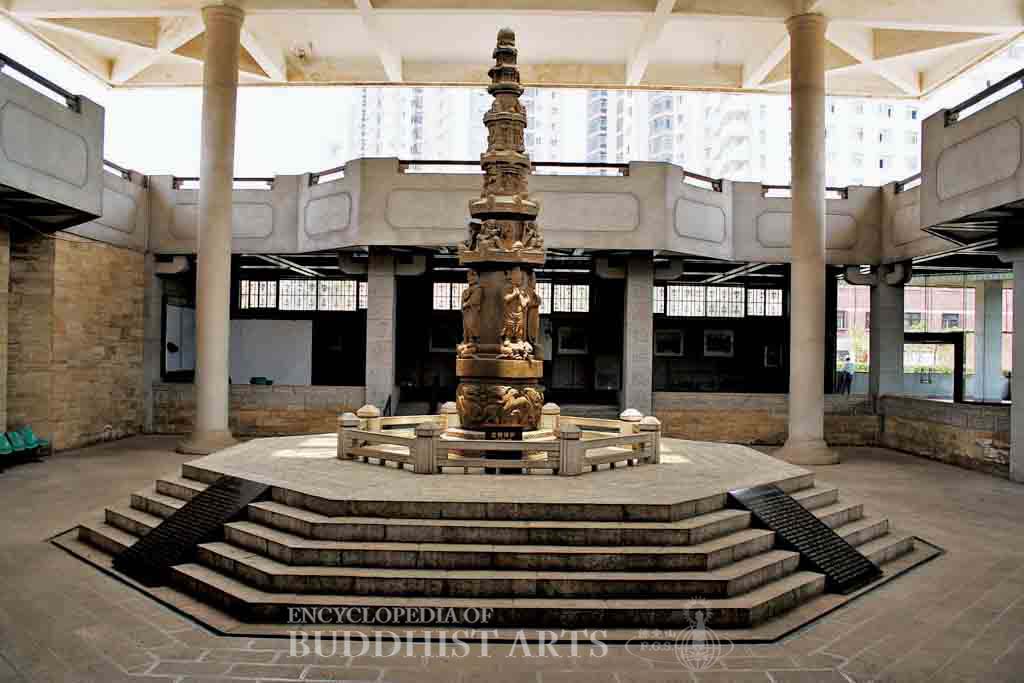
Dali Sutra Pillar
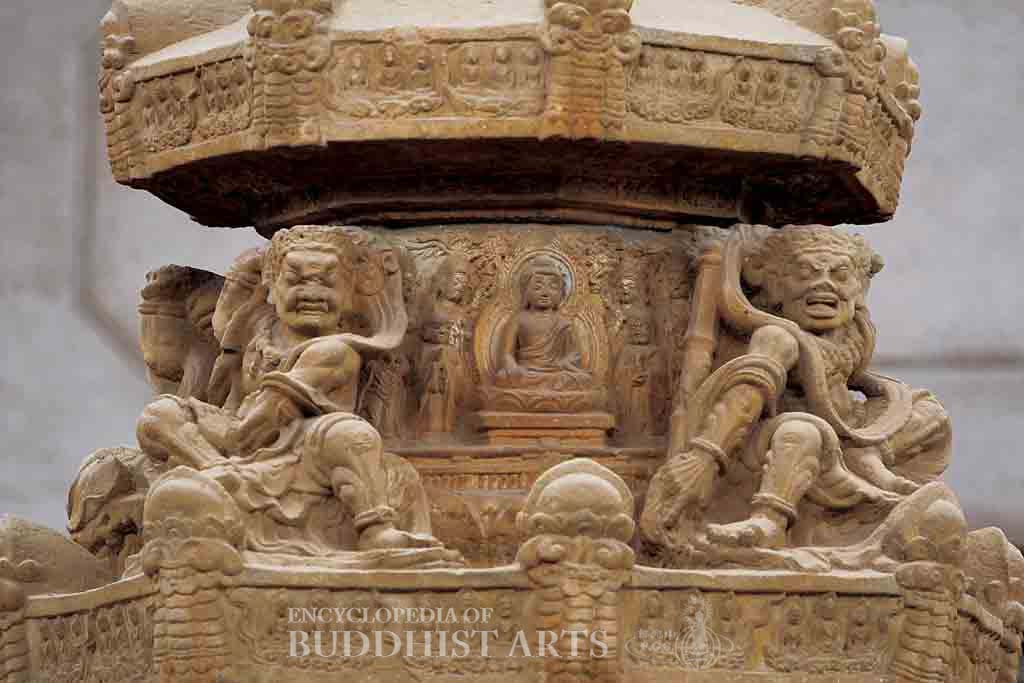
Dali Sutra Pillar (detail)
Dali Sutra Pillar
CHINA, Yunnan, Kunming
The pillar was originally located within the grounds of Dizang (Ksitigarbha) Temple. It is now on prominent display in Kunming Museum. The date of its construction is unknown but according to inscriptions carved on the pillar, it was created during the later period of the Kingdom of Dali (937–1253). It was listed as a National Cultural Heritage Property in 1982.
The pillar is 8.3 m high. The base is in the form of a drum with reliefs of dynamic dragons against a background of waves. It is surmounted by an octagonal section inscribed with the Heart Sutra, as well as the inscription recording the construction of the pillar by Yan Douguang, minister of the Dali Kingdom. The pillar body consists of seven tiers. The first tier is octagonal and inscribed with the Usnisavijaya Dharani Sutra, together with high reliefs of the Four Heavenly Kings. The second tier has niches on four sides housing the four Buddhas: Aksobhya, Ratnasambhava, Amitabha, and Amoghasiddhi. Each niche has a warrior in high relief on each side. The third and fourth tiers are both intricately decorated with niches on all sides. The niches of the third tier contain the four main Bodhisattvas of Yunnan Vajrayana Buddhism: Avalokitesvara, Ksitigarbha, Akasagarbha, and Sarvanivarana Viskambhin. The niches within the fourth tier house the Medicine, Maitreya, Sakyamuni, and Prabhutaratna Buddhas. The fifth tier is in the form of an inverted bowl with reliefs of four garudas. The sixth and seventh tiers have Buddhist images in pavilions. The whole pillar is surmounted by a wish-fulfilling jewel resting on a lotus flower. Vairocana is not depicted in the carvings but is represented by the pillar itself. The whole sculpture has been exquisitely carved and perfectly preserved, and is one of the best surviving stone Buddhist artworks of the Dali Kingdom.
For more details, go to the Encyclopedia of Buddhist Arts: Architecture A-F, page 208.
Cite this article:
author = Hsingyun and Youheng and Johnson, Peter and Mankuang and Lancaster, Lewis,
booktitle = {Encyclopedia of Buddhist Arts: Architecture A-F},
pages = 208,
title = {{Dali Sutra Pillar}},
volume = 1,
year = {2016}}