
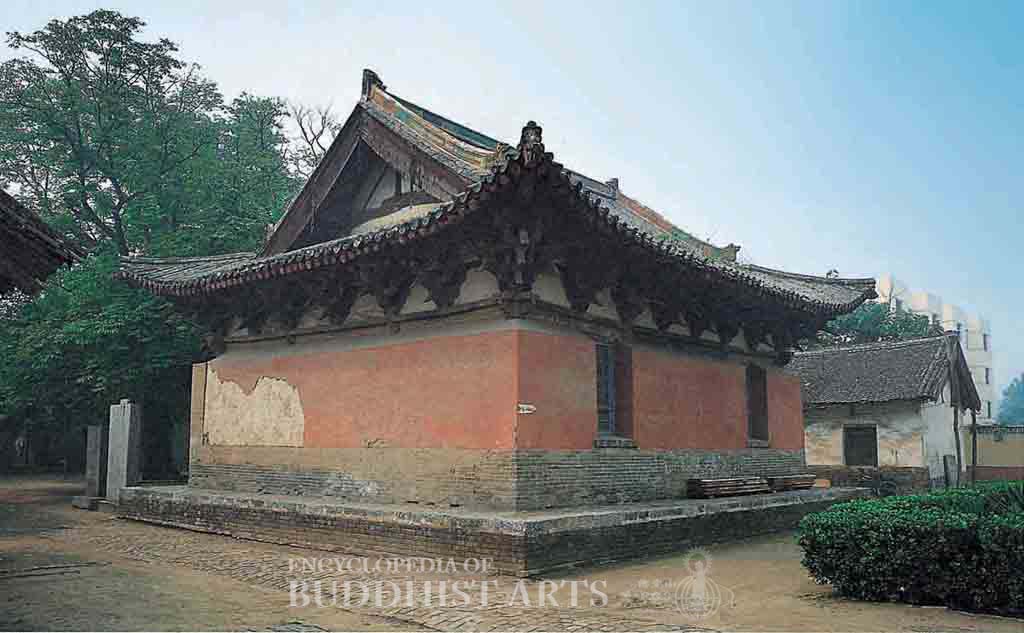
Daming Temple: Middle Buddha Hall
Daming Temple
CHINA, Henan, Jiyuan
The temple was founded during the Song dynasty (960–1279). It has been rebuilt and repaired a number of times throughout its history. The existing buildings date back to the Yuan (1271–1368), Ming (1368–1644) and Qing (1644–1911) dynasties. The temple was listed as a National Cultural Heritage Site in 2001.
Facing south, the temple occupies 2.1 ha and has a square layout. Along the central axis there are the main temple gate, Central Buddha Hall, and Rear Buddha Hall. On either side, there are the Sangharama Hall, Vajra Hall, and Ksitigarbha Hall. The three-bay wide main temple gate has a flush gable roof covered in gray tiles. It was constructed during the late Ming dynasty. The three-by-three bay Central Buddha Hall is the main temple building and was built during the Yuan dynasty. It has a single-eave hip-and-gable roof with eaves supported by prominent bracket sets and downward-pointing cantilevers. This is one of the four existing structures in Henan built during the early Yuan dynasty. Repaired during the Qing dynasty, the three-by-three bay Rear Buddha Hall has a single-eave overhanging gable roof. The beams and the boards to which the bracket sets adhere are decorated with colorful paintings of the white horse laden with sutras.
The temple houses several steles, one of which dates back to 1327. There is also a pair of stone lions from 1482 and a sala tree that is reputed to be more than a thousand years old.
For more details, go to the Encyclopedia of Buddhist Arts: Architecture A-F, page 210.
Cite this article:
author = Hsingyun and Youheng and Johnson, Peter and Mankuang and Lancaster, Lewis,
booktitle = {Encyclopedia of Buddhist Arts: Architecture A-F},
pages = 210,
title = {{Daming Temple}},
volume = 1,
year = {2016}}