
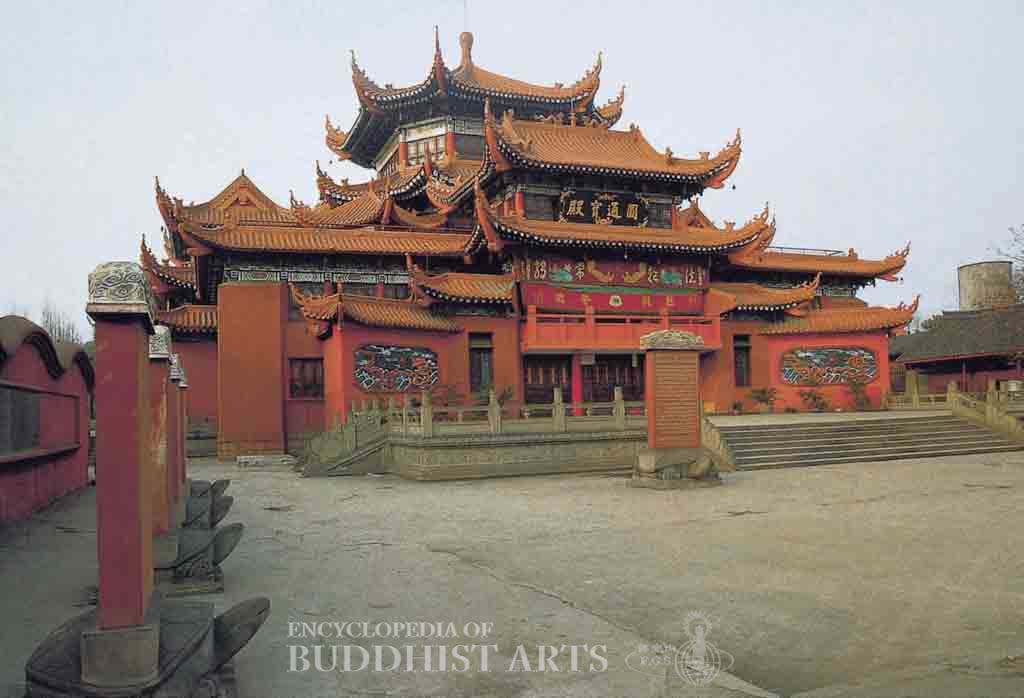
Zhaojue Temple: Perfect Understanding Hall
Zhaojue Temple
CHINA, Sichuan, Chengdu
The temple was founded during the reign of Emperor Taizong (reigned 627–649) of the Tang dynasty. It was destroyed in wartime in 1644 at the end of the Ming dynasty. All the existing buildings were rebuilt in 1666 during the Qing dynasty. It was listed as a key Buddhist temple in the Han region of China in 1983.
The temple occupies around 2 ha and the principal buildings include the main temple gate, octagonal pavilion, Heavenly King Hall, Great Hero Hall, Perfect Understanding Hall, Nirvana Hall, and sutra repository. The Great Hero Hall has a double-eave hip-and-gable roof and houses a statue of Sakyamuni Buddha. The construction of the Perfect Understanding Hall was completed in 1994. It is a combination of hall and pagoda, which gives it an unusual design. The rectangular hall has a double-eave hip-and-gable roof, whereas the circular pagoda in the center has an octagonal pyramidal roof. The 24 m high pagoda has spectacular cornices. Altogether, the entire building has 156 columns. A 12 m high seated statue of the Thousand-Armed, Thousand-Eyed Avalokitesvara Bodhisattva is enshrined within the hall. The sutra repository has a double-eave hip roof with carvings of dragons and phoenixes along its main ridge.
For more details, go to the Encyclopedia of Buddhist Arts: Architecture T-Z, page 1393.
Cite this article:
author = Hsingyun and Youheng and Johnson, Peter and Mankuang and Lancaster, Lewis,
booktitle = {Encyclopedia of Buddhist Arts: Architecture T-Z},
pages = 1393,
title = {{Zhaojue Temple}},
volume = 4,
year = {2016}}