
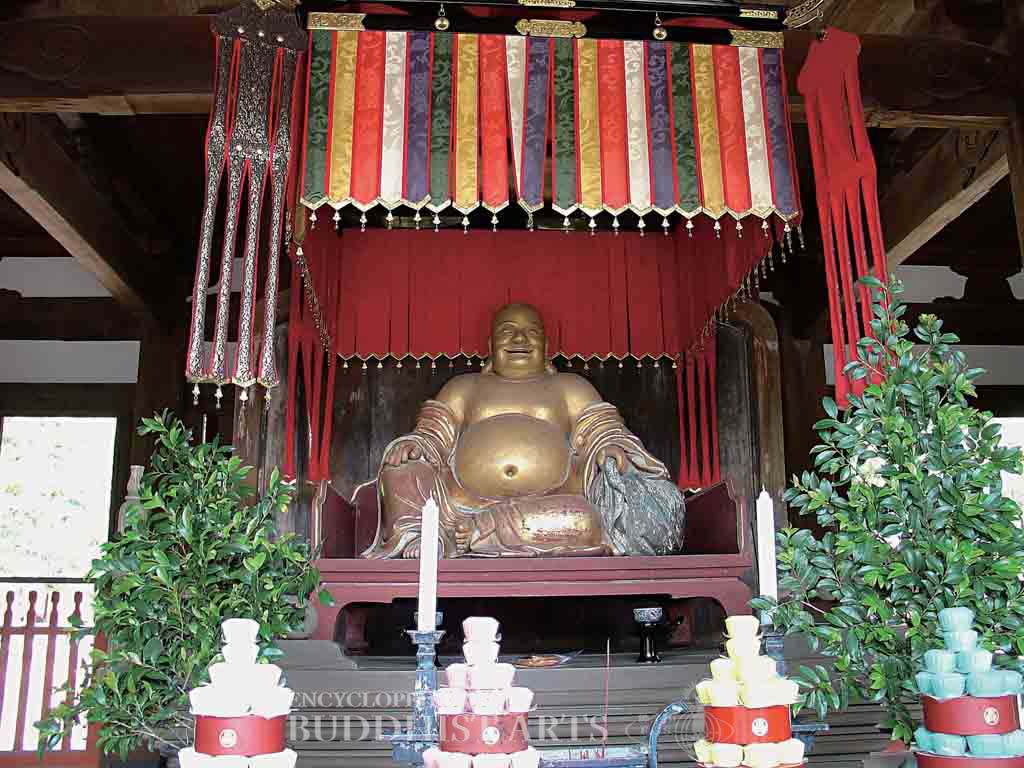
Manpukuji Temple Heavenly King Hall: Maitreya Buddha
Teak wood
Manpukuji Temple Heavenly King Hall: Maitreya Buddha
JAPAN, Kyoto; Edo period
The statue is recorded as being created by Fan Daosheng, a Chinese sculptor who was invited by Master Yinyuan Longqi to Japan in 1663. The work was carved from teak and coated in gold paint, with details highlighted in other colors. A Chinese version of the future Buddha Maitreya, the figure sits in the posture of royal ease with a sack on the left side. The upper body of the pot-bellied and smiling figure wears only a stole that has slipped from the shoulders. The style is characteristic of sculptures from the end of the Ming dynasty (1368–1644).
For more details, go to the Encyclopedia of Buddhist Arts: Sculpture G-M, page 687.
Cite this article:
Hsingyun, et al. "Manpukuji Temple Heavenly King Hall: Maitreya Buddha." Encyclopedia of Buddhist Arts: Sculpture G-M, vol. 11, 2016, pp. 687.
Hsingyun, Youheng, Yann Lovelock, Yuan Chou, Susan Huntington, Gary Edson, and Robert Neather. 2016. "Manpukuji Temple Heavenly King Hall: Maitreya Buddha" In Encyclopedia of Buddhist Arts: Sculpture G-M, 11:687.
Hsingyun, Youheng, Lovelock, Y., Chou, Y., Huntington, S., Edson, G., & Neather, R.. (2016). Manpukuji Temple Heavenly King Hall: Maitreya Buddha. In Encyclopedia of Buddhist Arts: Sculpture G-M (Vol. 11, pp. 687).
@misc{Hsingyun2016,
author = Hsingyun and Youheng and Lovelock, Yann and Chou, Yuan and Huntington, Susan and Edson, Gary and Neather, Robert,
booktitle = {Encyclopedia of Buddhist Arts: Sculpture G-M},
pages = 687,
title = {{Manpukuji Temple Heavenly King Hall: Maitreya Buddha}},
volume = 11,
year = {2016}}
author = Hsingyun and Youheng and Lovelock, Yann and Chou, Yuan and Huntington, Susan and Edson, Gary and Neather, Robert,
booktitle = {Encyclopedia of Buddhist Arts: Sculpture G-M},
pages = 687,
title = {{Manpukuji Temple Heavenly King Hall: Maitreya Buddha}},
volume = 11,
year = {2016}}