
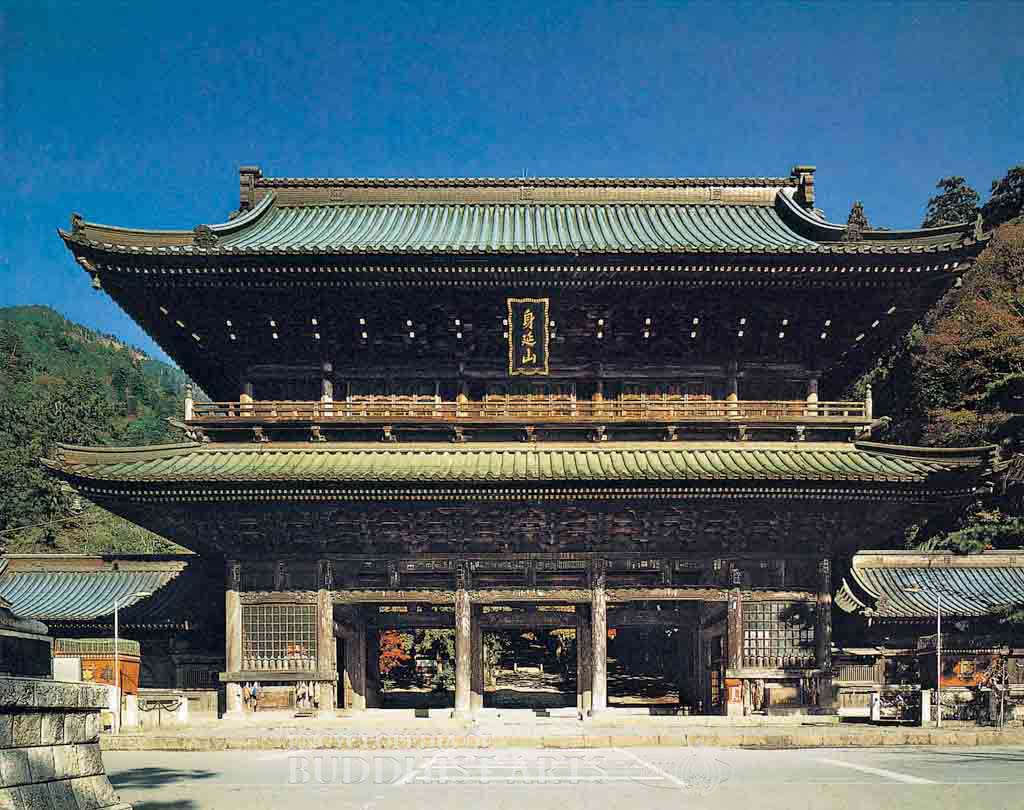
Kuonji Temple: Temple Gate
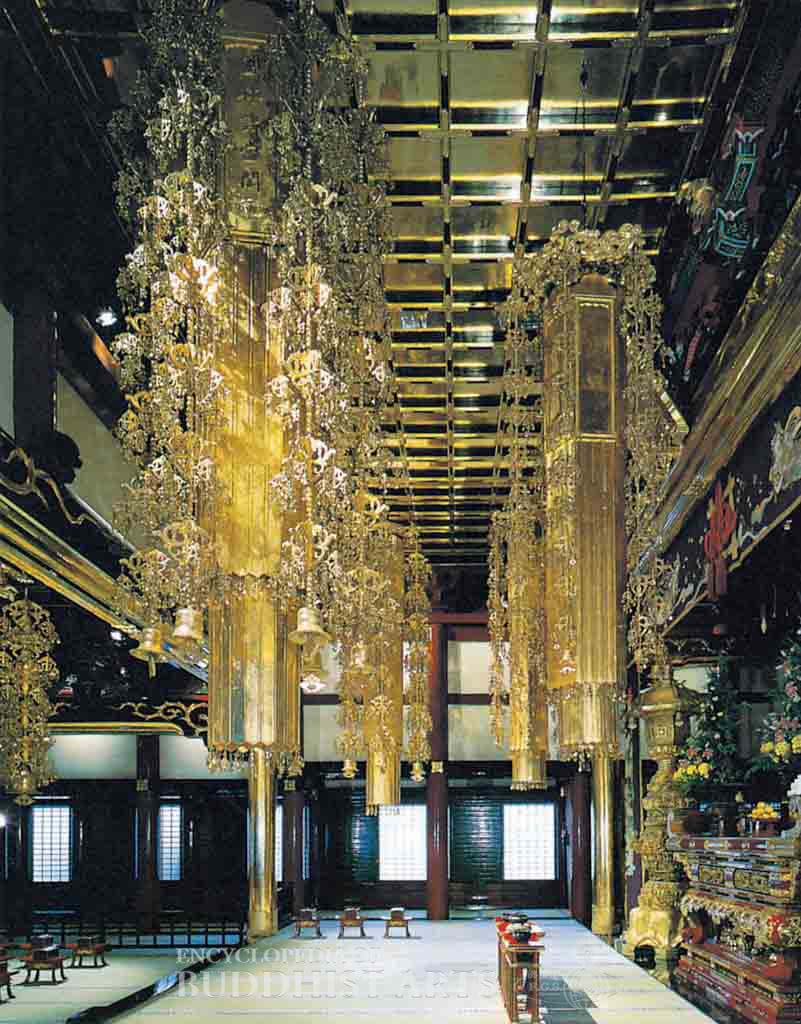
Kuonji Temple: Patriach Hall (interior)
Kuonji Temple
JAPAN, Yamanashi, Minamikoma
Kuonji means Distant Past Temple, and it is also known as Minobusan Myohokke Temple. Situated 1,153 m above sea level on Mount Minobu, Kuonji Temple is the head temple of the Nichiren school of Buddhism. Master Nichiren founded the temple in 1274 during the Kamakura period, at the request of his lay disciples after he returned from forced exile to Sado. Around this time, the Lotus Hall was completed in 1281 and used to hold Dharma services and train disciples. Master Nichiren passed away the following year and his remains were enshrined in a pagoda. In 1474 during the Muromachi period, it was reconstructed as a state-affiliated temple. In the middle of the Muromachi period (1392–1573), the temple was moved to its current location by the eleventh abbot, Nitcho. In 1875 during the Meiji period, the temple was destroyed by fire and reconstructed in its present form.
The principal buildings include the temple gate, main hall, Patriarch Hall, Founder Memorial Hall, Kaikido, Sakyamuni Hall, Dharma Joy Hall, Great Guest Hall, and five-story pagoda, laid out in a pine forest. The temple gate was rebuilt in 1907 during the Meiji period. The five-by-three bay two-story gate is made of wood and is 21 m high. Two benevolent kings are enshrined either side of the entrance, while statues of the Sixteen Arhats are enshrined on the upper story. The 17-by-28 bay main hall, constructed in 1985 during the Showa period, is made of steel and cement. The interior and exterior are decorated in wood. There is a museum in the basement displaying cultural items. The Patriarch Hall was built in 1881 during the Meiji period, and houses the portrait of Master Nichiren. The Founder Memorial Hall is an octagonal hall with white walls and contains the remains of Nichiren. The path from the entrance to the temple gate consists of 287 stone steps that are known as the Bodhi stairs.
For more details, go to the Encyclopedia of Buddhist Arts: Architecture G-L, page 635.
Cite this article:
author = Hsingyun and Youheng and Johnson, Peter and Mankuang and Lancaster, Lewis,
booktitle = {Encyclopedia of Buddhist Arts: Architecture G-L},
pages = 635,
title = {{Kuonji Temple}},
volume = 2,
year = {2016}}