
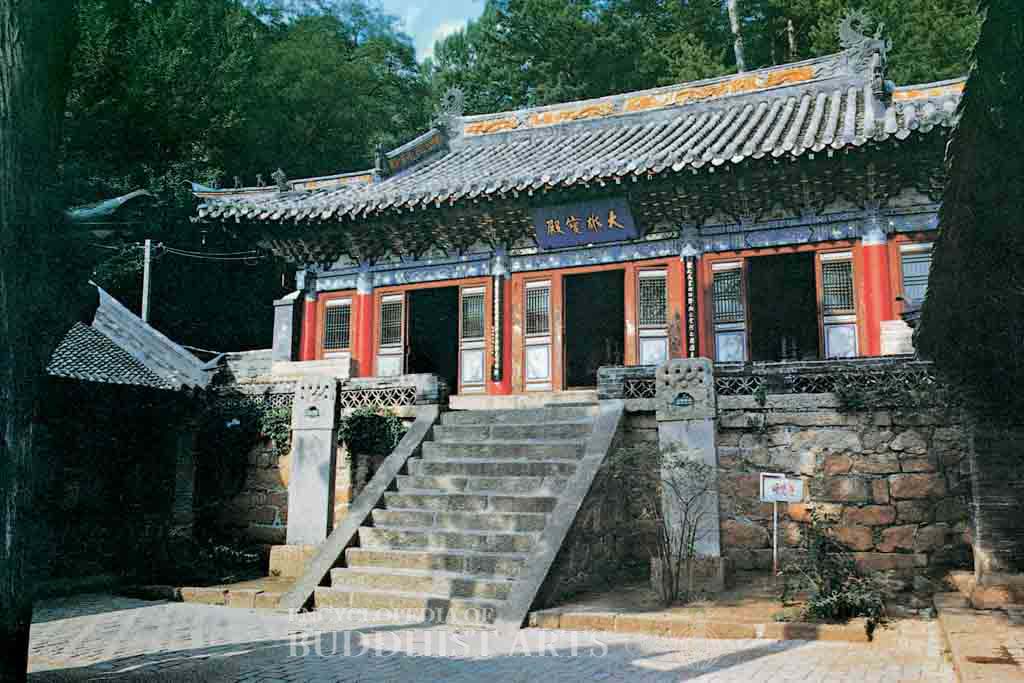
Qianshan Five Major Chan Monasteries: Longquan Temple - Great Hero Hall
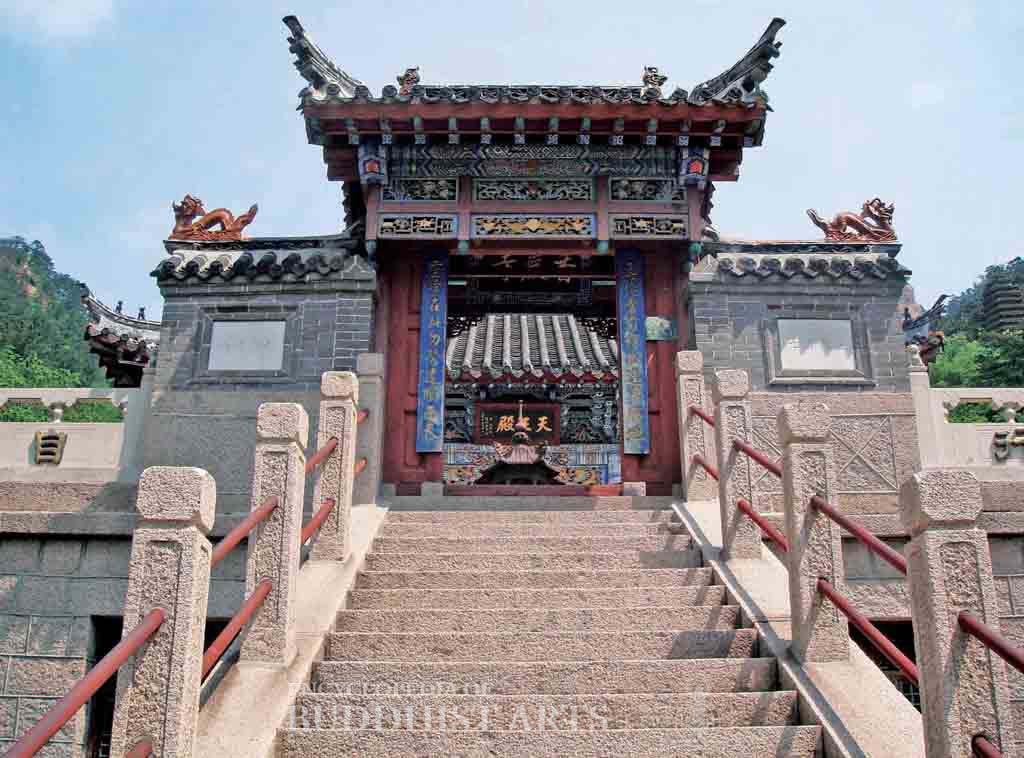
Qianshan Five Major Chan Monasteries: Xiangyan Temple - Main Temple Gate
Qianshan Five Major Chan Monasteries
CHINA, Liaoning, Anshan
These temples are distributed among Qianshan (Thousand Mountain). The temples on Qianshan were built during the Tang dynasty (618–907) but it was not until the Ming dynasty (1368–1644) that they started to thrive. The Five Major Chan Monasteries of Qianshan are Longquan, Da’an, Xiangyan, Zuyue, and Zhonghui. Among them, Xiangyan Temple and Zhonghui Temple were listed as Provincial Cultural Heritage Sites.
The largest temple is Longquan Temple, situated in the center of the Beigou Valley of Qianshan. Half of the compound is built along a cliff, while the other half is enclosed by walls. The Vajra Hall and meditation hall date back to the Ming dynasty. The main buildings include the Great Hero Hall, Heavenly King Hall, Skanda Hall, Vairocana Hall, Dragon Deity Shrine, and the sutra repository, which were all constructed during the Qing dynasty (1644–1911).
Da’an Temple is located to the southeast of Qianshan. It was built in the Ming dynasty and renovated during the Qing dynasty. Existing buildings include the main temple gate, Skanda Hall, Great Hero Hall, bell tower, and the Arhat Cave. An iron bell cast in 1530 during the Ming dynasty can be found within the temple. The most notable works of art in the temple are the statues of the Eighteen Arhats within the Arhat Cave. To the south of the main temple gate there is a seven-tier hexagonal stone pagoda.
Xiangyan Temple is situated to the south of Qianshan and it is the oldest of the temples. Notable buildings include a Jin dynasty (1115–1234) brick pagoda, which is located to the side of the temple, as well as the funerary pagoda of a monk along with a stele dating back to the Yuan dynasty (1271–1368). The compound once had a regular layout with front, back, and side halls. It has since increased considerably in size following a series of expansions.
Zuyue Temple is located below the Wuliang Guan West Pavilion and is built against a cliff with an inscription dated to 1568 during the Ming dynasty. Only three of its main halls still exist.
Zhonghui Temple is situated on the southern slope of Wulao Peak. A stele dating to 1799 during the Ming dynasty states that the temple was founded during the Tang dynasty, even though the present buildings were constructed in 1580 during the Ming dynasty, and further expansions were carried out after 1940. Along the central axis are the main temple gate, Vairocana Hall, Heaven and Earth Tower, Avalokitesvara Hall, and the Great Hero Hall. The Great Hero Hall is the main hall and has a flush gable roof. A statue of Sakyamuni Buddha is enshrined within the hall. The Vairocana Hall was constructed in 1999 in the style of Song architecture. Inside the hall is a 12 m high statue of Vairocana Buddha. The temple houses a large number of steles dating from the Ming and Qing dynasties.
For more details, go to the Encyclopedia of Buddhist Arts: Architecture M-S, page 867.
Cite this article:
author = Hsingyun and Youheng and Johnson, Peter and Mankuang and Lancaster, Lewis,
booktitle = {Encyclopedia of Buddhist Arts: Architecture M-S},
pages = 867,
title = {{Qianshan Five Major Chan Monasteries}},
volume = 3,
year = {2016}}