
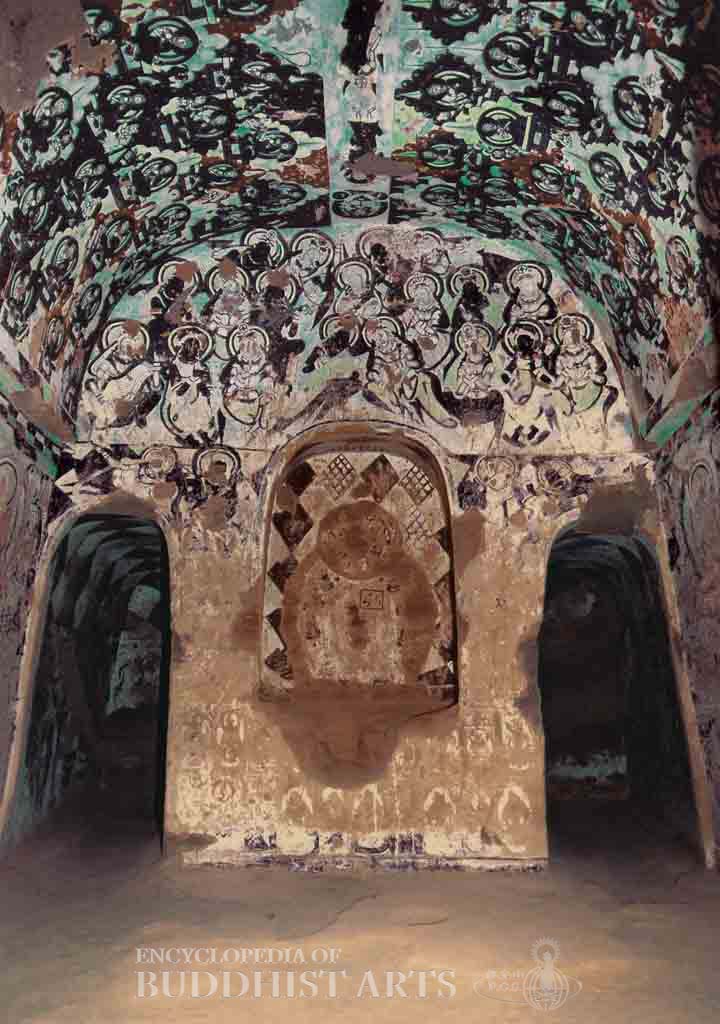
Kumtura Cave 46: Main Chamber - Back Wall
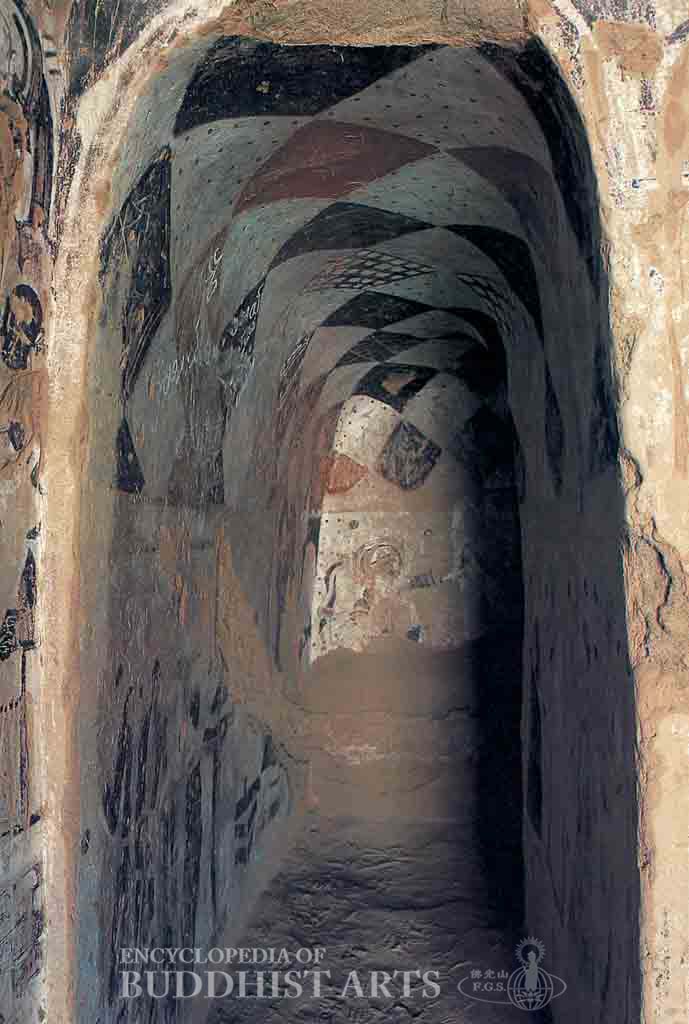
Kumtura Cave 46: East Corridor
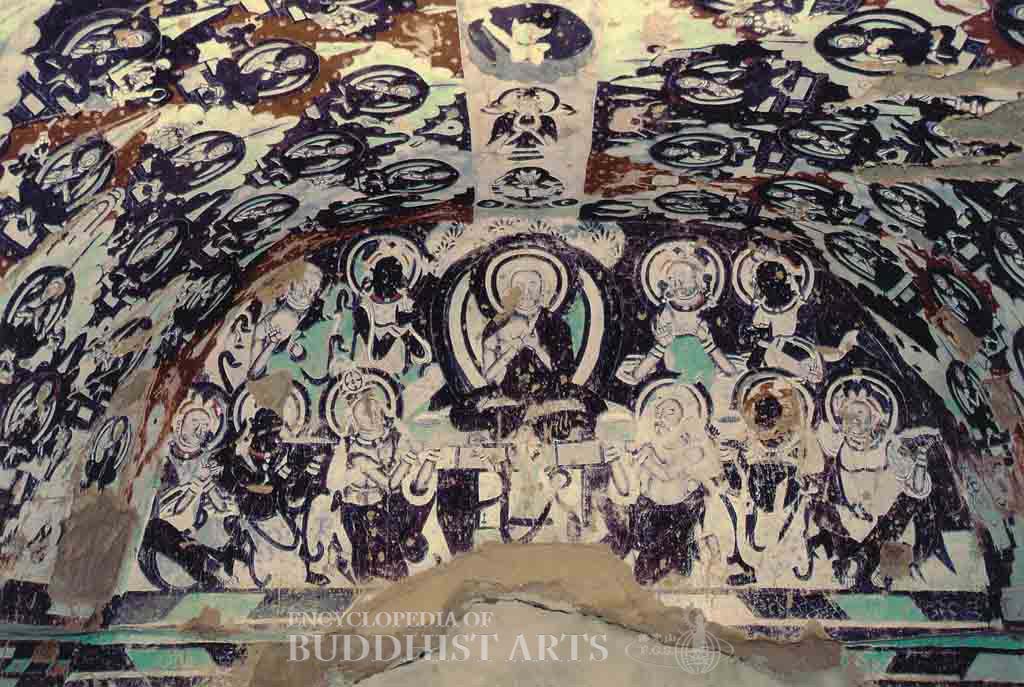
Kumtura Cave 46: Main Chamber - Buddha Teaching the Dharma (front wall, above the entrance)
Kumtura Cave 46
CHINA, Xinjiang, Aksu
Cave 46 is situated in the north area and faces north. It was constructed during the late Kucha Kingdom (5th–7th century), and is a typical Kuchean-style central pillar cave. The main chamber and three corridors have all been preserved.
The main chamber measures 3.57 m wide, 3.44 m high, and 3.28 m deep, with a barrel-vaulted ceiling. The astrological signs painted on the central ridge of the ceiling are well preserved and include images of Candra, two standing Buddhas, Vayu, garuda, and Surya. Both Candra and Surya wear crowns and armor, and are seated on two-wheeled chariots. The garuda has the body of a bird and the head of a human with a naga in its mouth. Diamond-shaped illustrations of karma stories are depicted on the slopes of the ceiling. There are six rows on the west slope, with each row displaying six to seven pictures, for a total of 39 images. Triangular-shaped illustrations of Jataka tales are found below the karma stories. The east slope is similar to the west, with 42 karma stories containing a variety of themes and vivid images.
An arched niche, which originally housed a statue of Sakyamuni Buddha, is found at the center of the back (south) wall. At present, only the outline of a nimbus and an aureole remain of the figure. Two lines of inscription written in Chagatai can be discerned on the east wall of the niche. The semicircular section above the niche and the area directly below it contain over 20 heavenly beings listening to the Dharma. They are painted in various postures and with different facial expressions. On the semicircular section of the front wall above the cave entrance, there is another depiction of the Buddha teaching the Dharma. The Buddha is seated in full lotus position upon a square throne in the center and forms the vitarka (teaching) mudra. On each side of the Buddha are five heavenly beings making offerings or forming mudras.
The side walls of the main chamber are in the style of the early Kucha Kingdom, with symmetrical panels depicting scenes from the Life of the Buddha. The side corridors are painted with diamond-shaped illustrations, with geometric patterns on the barrel-vaulted ceilings, portraits of monks on the inner walls, and images of Kuchean donors on the outer walls. Illustration of the Mahaparinirvana Sutra are depicted on the walls of the rear corridor. A mural of the Buddha’s cremation is portrayed on the inner wall, and on the outer wall is a painting of the Distribution of Relics Among the Eight Kings. A standing Buddha on the east side of the rear corridor holds a representation of a mountain in his left hand, and next to him is a monkey.
For more details, go to the Encyclopedia of Buddhist Arts: Caves R-L, page 627.
Cite this article:
author = Hsingyun and Youheng and Johnson, Peter and Mankuang and Huntington, Susan and Edson, Gary and Neather, Robert,
booktitle = {Encyclopedia of Buddhist Arts: Caves R-L},
pages = 627,
title = {{Kumtura Cave 46}},
volume = 6,
year = {2016}}