
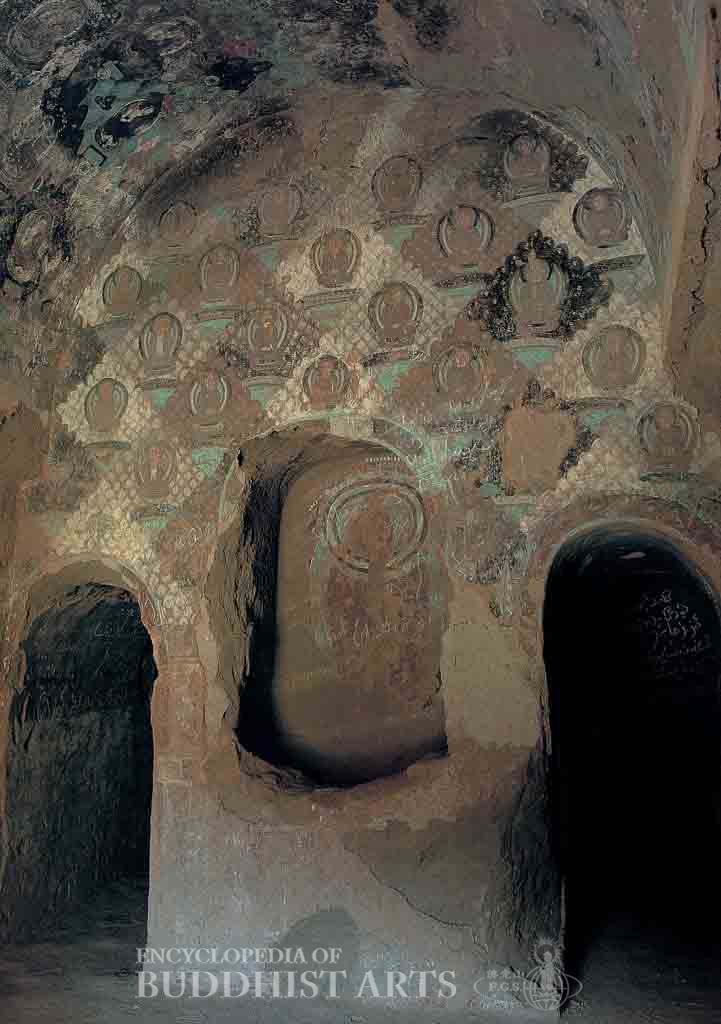
Kumtura Cave 43: Main Chamber - Back Wall
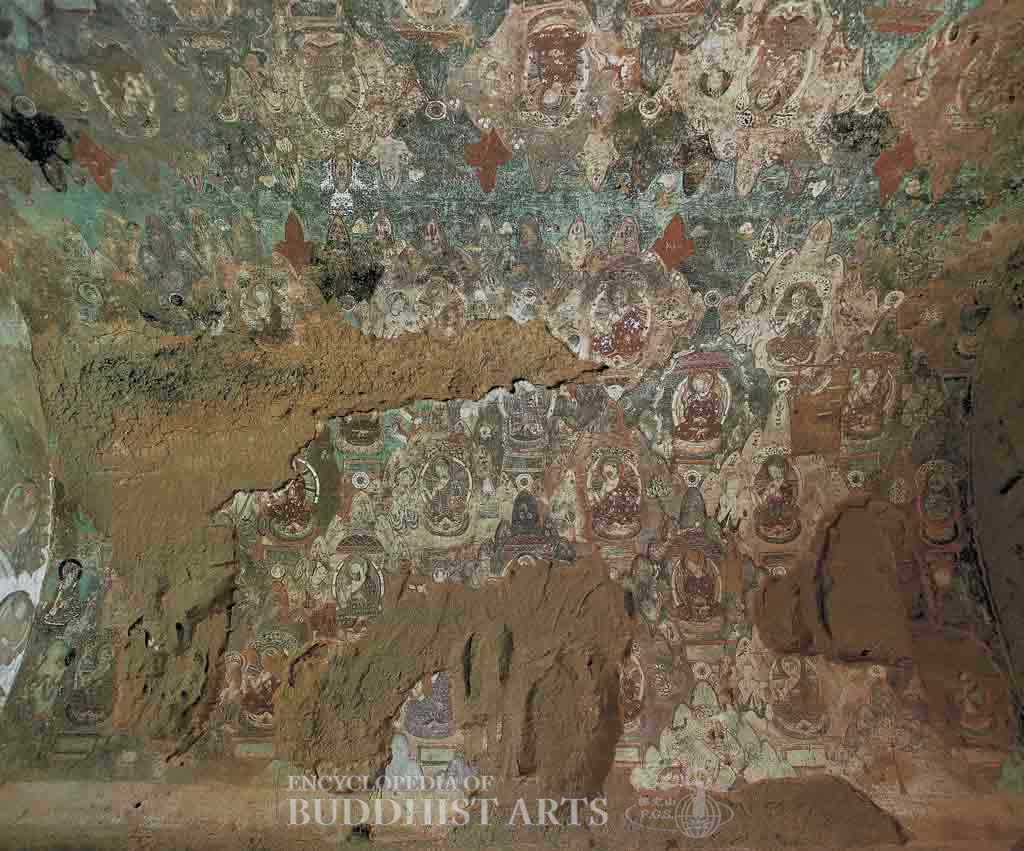
Kumtura Cave 43: Main Chamber - Ceiling (detail)
Kumtura Cave 43
CHINA, Xinjiang, Aksu
Cave 43 faces east and is situated among the north area. It was constructed during the Anxi Protectorate period (7th–8th century) and features Kuchean style murals. The main chamber is rectangular with a barrel-vaulted ceiling and measures 3.85 m in width, 4.25 m in height, and 4.3 m in depth. It is a Kuchean-style central pillar cave with three corridors at the rear of the cave. The south and north corridors have no murals, however, in the south corridor there are some illegible Uighur and Chinese inscriptions in red ink.
There is a niche at the center of the back (west) wall, now bereft of statues. Seated Buddhas depicted within diamond-shaped illustrations are found above the niche. A mural of Maitreya Buddha teaching the Dharma is portrayed at the top of the front (east) wall, with 12 heavenly beings on the right sides and a dancing figure in the foreground. The central ridge of the ceiling is painted green and has no astrological signs as seen in earlier caves at this site. Each side of the ceiling features diamond-shaped illustrations of karma stories, predominantly in a green background that contrasts with the red robes and orange skin of the characters, a distinctive trait of many Kuchean murals. Triangular-shaped illustrations along the bottom of the ceiling depict scenes from Jataka tales.
Another unique feature of this cave is the presentation of the karma stories. The karma stories along each vertical line are mostly identical, with an image of the Buddha in the same color and posture, and with the same patterns of aureoles and instruments. The characters in the stories, however, assume different postures. These karma stories include Conversion of Mrgasirsa, King Brahmadatta Offering Grain to a Brahmin, the Quarrel Between Maid and Goat, Sujata Offering Milk Porridge to the Buddha, and the Five Hundred Geese Reborn as Heavenly Beings.
For more details, go to the Encyclopedia of Buddhist Arts: Caves R-L, page 623.
Cite this article:
author = Hsingyun and Youheng and Johnson, Peter and Mankuang and Huntington, Susan and Edson, Gary and Neather, Robert,
booktitle = {Encyclopedia of Buddhist Arts: Caves R-L},
pages = 623,
title = {{Kumtura Cave 43}},
volume = 6,
year = {2016}}