
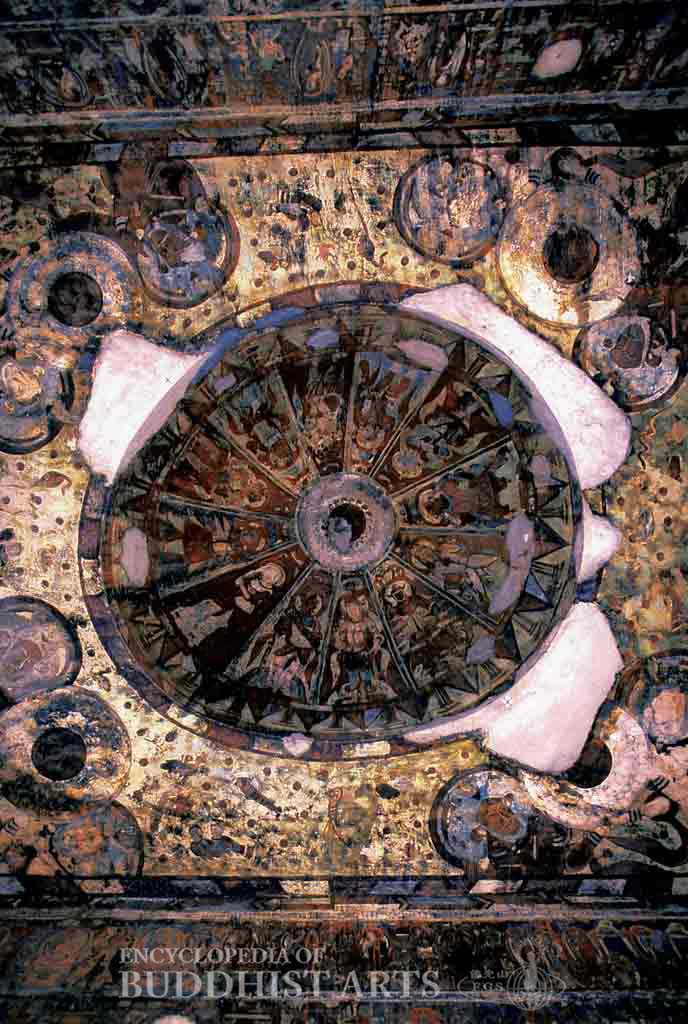
Kumtura Cave 34: Ceiling
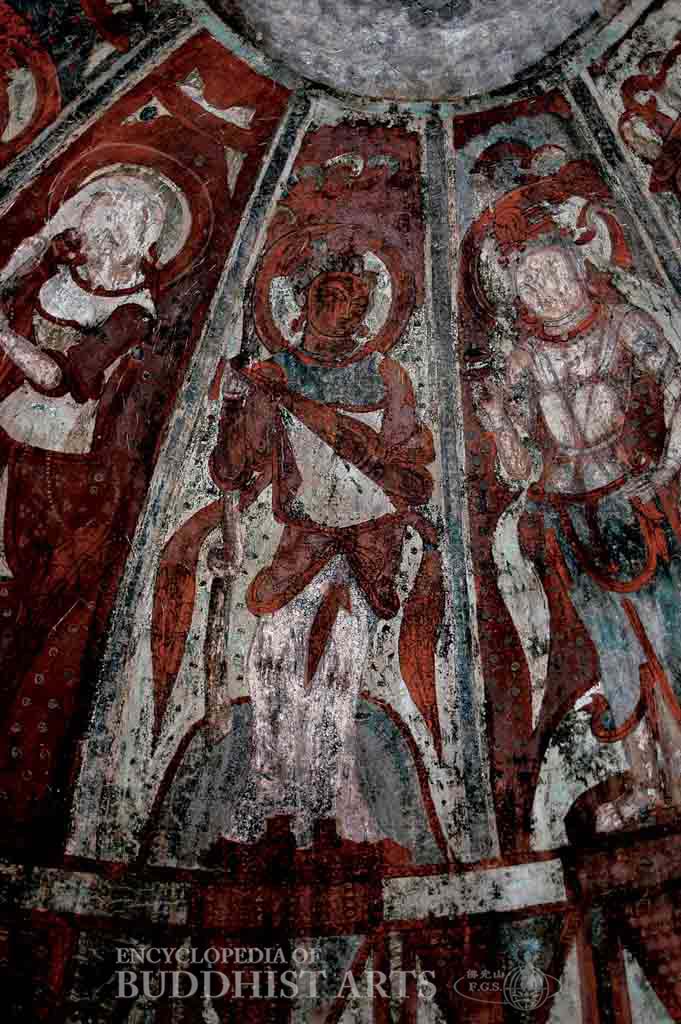
Kumtura Cave 34: Ceiling - Heavenly Beings (detail)
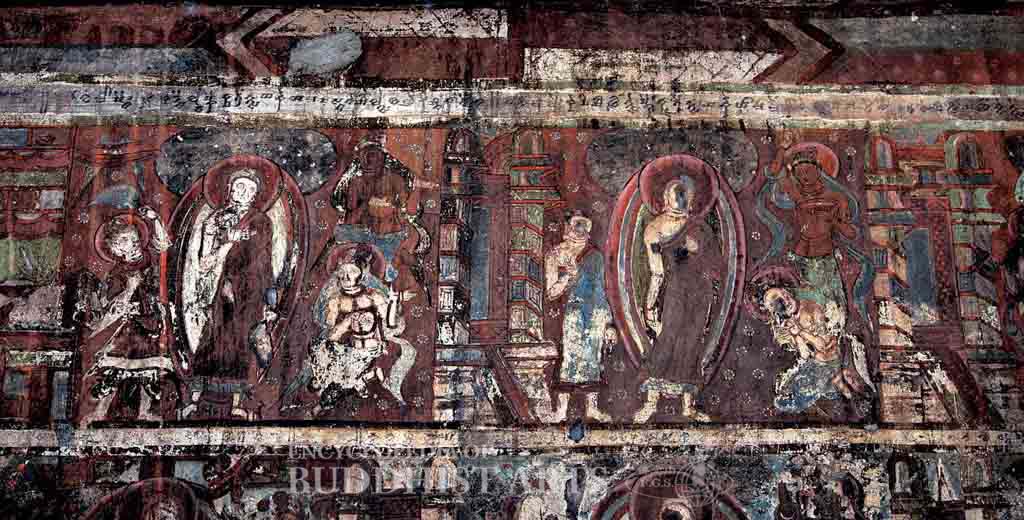
Kumtura Cave 34: Karma Stories (detail)
Kumtura Cave 34
CHINA, Xinjiang, Aksu
Cave 34 faces west and is situated in the southern section of the north area. It was constructed during the Anxi Protectorate period (7th–8th century) and is a good example of a cave that was built upon the styles of earlier Kuchean art. Small and square, the cave measures 2.75 m wide, 3.14 m high, and 2.75 m deep.
The domed ceiling has a lotus motif in the center surrounded by 12 segments depicting the Twelve Heavenly Beings. The figures within the segments hold musical instruments, jewels, and vases. Some wear headdresses that are decorated with four naga heads. In the outer corners of the ceiling are the Heavenly Kings.
Rows of karma stories line the four walls of the main chamber. Currently there are three rows of three illustrations preserved on the back (east) wall. A white band of inscriptions, 4 cm in height, is found above these illustrations. The front (west) wall has only one row of six illustrations left, and the inscriptions are no longer discernible. The south wall is relatively well preserved with a total of 25 illustrations and inscriptions in Kuchean script above. The north wall has five rows and a total of 31 preserved illustrations. Within each illustration, the Buddha is in the center, either standing or sitting, and figures or objects surrounding represent a particular story. The karma stories on the front and south walls are separated by patterns resembling Kuchean style buildings. The highly decorative murals emphasize symmetry, and the figures along with the use of ink lines and shading are all typical of the Kuchean style.
For more details, go to the Encyclopedia of Buddhist Arts: Caves R-L, page 620.
Cite this article:
author = Hsingyun and Youheng and Johnson, Peter and Mankuang and Huntington, Susan and Edson, Gary and Neather, Robert,
booktitle = {Encyclopedia of Buddhist Arts: Caves R-L},
pages = 620,
title = {{Kumtura Cave 34}},
volume = 6,
year = {2016}}