
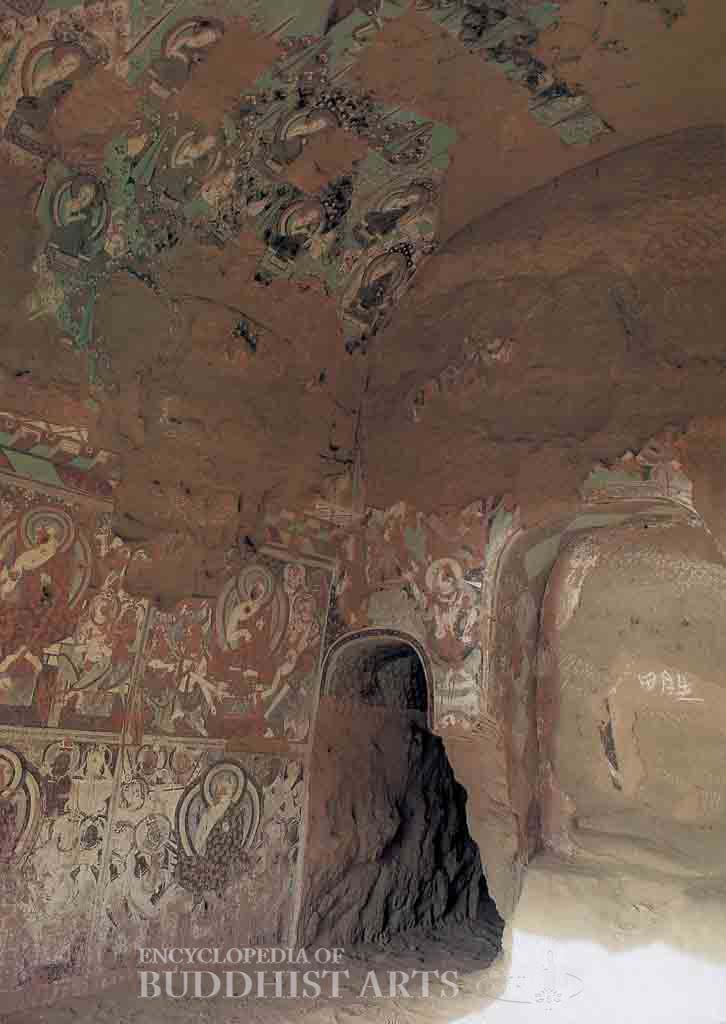
Kumtura Cave 23: Main Chamber (southeast corner)
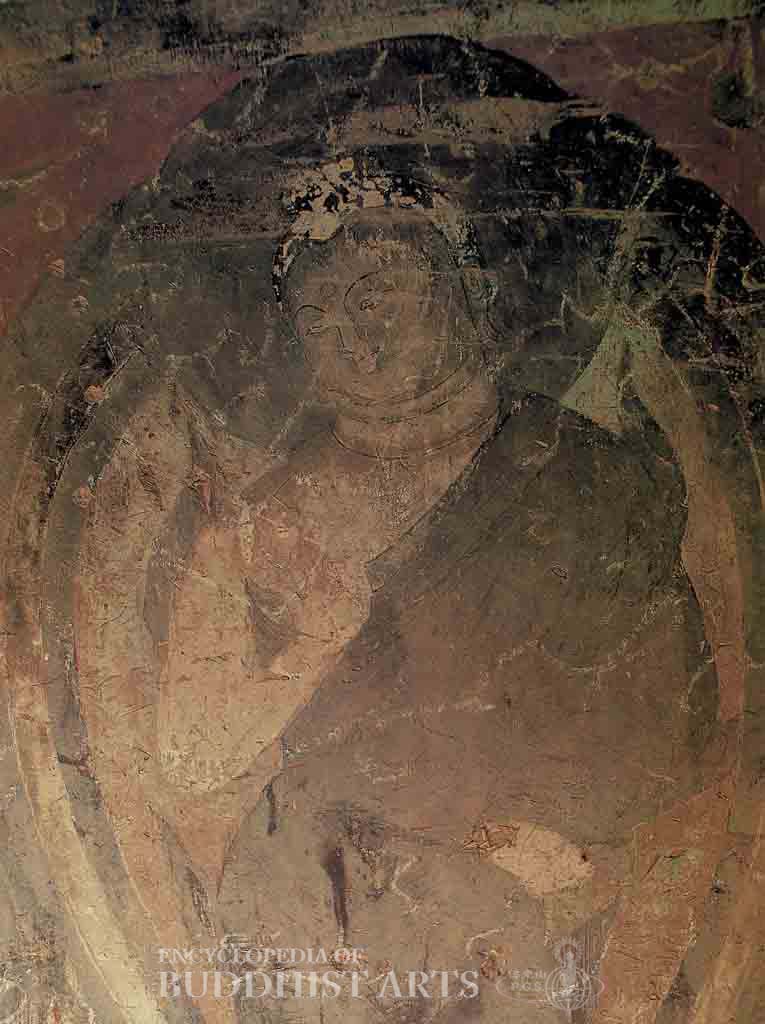
Kumtura Cave 23: Standing Buddha (south corridor, inner wall)
Kumtura Cave 23
CHINA, Xinjiang, Aksu
Cave 23 faces west and is situated in the southern section of the north area. It was constructed during the late Kucha Kingdom (5th–7th century) and measures 3.27 m in width, 3.7 m in height, and 3.35 m in depth. It is a typical Kuchean-style central pillar cave with three corridors for circumambulation. The main chamber and corridors have barrel-vaulted ceilings.
There is a niche on the back (east) wall of the main chamber; the statue once held here is now missing, and only traces of murals remain on either side of the niche and above the arched lintel. Along the central ridge on the ceiling of the main chamber are astrological signs, but only the images of Surya, two white geese, and a garuda are still visible. On the slopes of the ceiling are four rows of diamond-shaped illustrations depicting karma stories, each row consisting of four to five images. A Buddha seated on a square throne, with figures and instruments beside him, is found at the center of each diamond. Each Buddha is framed within a mountainous structure that is decorated with leaves and flowers. Triangular images with depictions of Jataka tales are found above and below the rows of karma stories.
The south and north walls of the main chamber follow the style of murals from the early Kucha Kingdom, with stories from the Life of the Buddha painted symmetrically in squares. Currently, six square panels are preserved on the north wall. The scenes are separated by straight lines or circular patterns. The Buddha is seated on a square throne in the center of each, wearing a monastic robe which crosses the left shoulder and has flame patterns over both shoulders. Bodhisattvas, heavenly beings, and monks surround the Buddha. Stories depicted include the First Turning of the Dharma Wheel and the Conversion of the Three Kasyapa Brothers.
Each of the inner walls of the north and south corridors has three portraits of standing Buddhas. The Buddhas have usnisas, urnas, delicate eyebrows, and wear robes with their right shoulders bared. Their hands form the vitarka (teaching) mudra. Ink inscriptions written in Uighur can still be found in the corridors. The murals on the outer walls, mostly composed of portraits of Kuchean donors, have all been damaged or removed. Scenes from the Mahaparinirvana Sutra are found on the rear corridor. The cremation scene is depicted on the inner wall, and on the center of the outer wall is the Distribution of Relics Among the Eight Kings. A portrait of a figure with a Kuchean inscription above is to the right.
For more details, go to the Encyclopedia of Buddhist Arts: Caves R-L, page 617.
Cite this article:
author = Hsingyun and Youheng and Johnson, Peter and Mankuang and Huntington, Susan and Edson, Gary and Neather, Robert,
booktitle = {Encyclopedia of Buddhist Arts: Caves R-L},
pages = 617,
title = {{Kumtura Cave 23}},
volume = 6,
year = {2016}}