
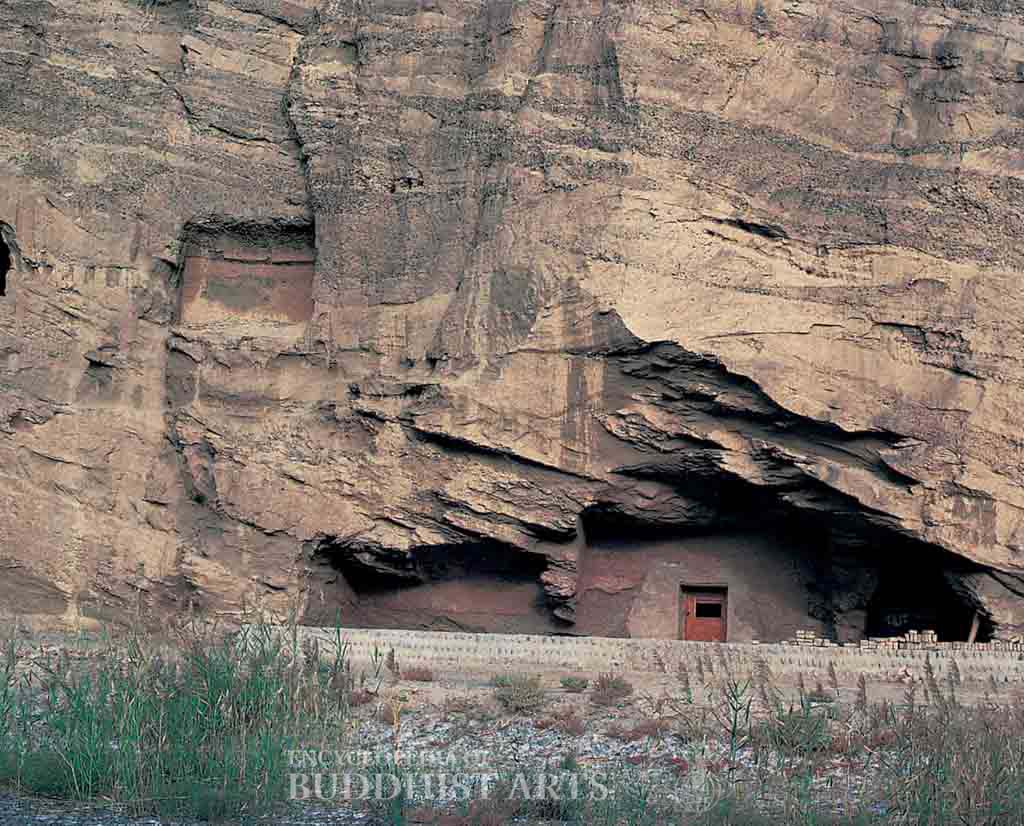
Kumtura Cave 16

Kumtura Cave 16: Main Chamber - Monks Listening to the Dharma (back wall)
Kumtura Cave 16
CHINA, Xinjiang, Aksu
Located in the southern section of the north area, Cave 16 was constructed during the Anxi Protectorate period (7th–8th century). Its main chamber is rectangular, measuring 3.75 m wide, 4.75 m high, and 4.37 m deep. It has an antechamber which is shared with Caves 15 and 17. The murals within the cave are painted predominantly in mineral green and have lively depictions typical of the Tang dynasty (618–907).
The back (east) wall of the main chamber features a niche which once housed a seated Buddha, however, the statue no longer remains. A large round flower is depicted on the ceiling of the niche, and on the left is an apsara playing a flute, while the right contains a lotus. A mural of monks listening to the Dharma is found on the wall outside the niche.
Rectangular murals, each with large sutra illustrations in the center, are painted on the north and south walls of the cave. The north wall mural depicts the Medicine Buddha Sutra, with panels on either side of the central panel portraying the Medicine Buddha’s Twelve Great Vows and the nine kinds of untimely death. The mural on the south wall has a similar layout, with an illustration of the Amitayurdhyana Sutra in the center, the story of King Ajatasatru on the left, and the Sixteen Contemplations on the right.
A donor figure, which is about 2 m in height and appears to represent a high ranking government official, is depicted on the front (west) wall of the main chamber. An illustration of the Mahaparinirvana Sutra is found above the entrance on the front wall. The seven treasures are depicted beneath a sala tree near the Buddha’s right shoulder and surrounding the Buddha are over 30 figures in mourning. Of the numerous illustrations of the Mahaparinirvana Sutra within the Kumtura Caves, this is the only one depicted in the Chinese style.
Along the edges of the cave ceiling are lotus and cloud designs. On each side of the ceiling are 17 rows, each of which contains between 34 and 36 figures depicting the Thousand Buddhas. They are painted in alternating colors of vermilion and red ocher. Each Buddha is depicted above a row of slanted, floating clouds. The rows of Buddhas seem to resemble a long line of flames above the clouds. Various Tang-style pomegranate tree designs are located along the central ridge of the barrel-vaulted ceiling. The murals in the rear corridor are badly damaged, but graceful apsaras are still visible.
For more details, go to the Encyclopedia of Buddhist Arts: Caves R-L, page 615.
Cite this article:
author = Hsingyun and Youheng and Johnson, Peter and Mankuang and Huntington, Susan and Edson, Gary and Neather, Robert,
booktitle = {Encyclopedia of Buddhist Arts: Caves R-L},
pages = 615,
title = {{Kumtura Cave 16}},
volume = 6,
year = {2016}}