
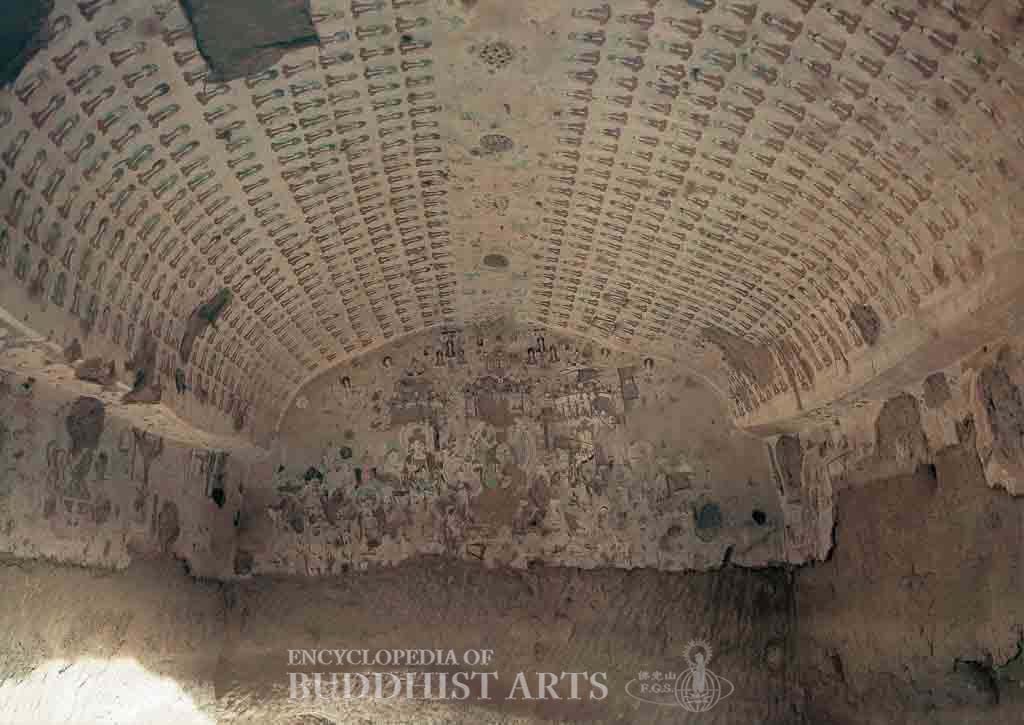
Kumtura Cave 14

Kumtura Cave 14: First Turning of the Dharma Wheel (north wall)
Kumtura Cave 14
CHINA, Xinjiang, Aksu
Cave 14 is located in the southern section of the north area and was created during the Anxi Protectorate period (7th–8th century) of the Tang dynasty (618–907). It measures 4.1 m in width, 5.1 m in depth, and 3.83 m in height. The cave has only one chamber and features a barrel-vaulted ceiling.
The upper section of the back (east) wall displays a mural of the Western Pure Land. Amitabha Buddha is seated in the center, flanked by Avalokitesvara and Mahasthamaprapta Bodhisattvas. Surrounding the Buddha is a multitude of Bodhisattvas, apsaras, and heavenly beings. The murals which remain on the north and south walls depict scenes from the Life of the Buddha. The Buddha’s Defeat of Mara and Enlightenment, and the First Turning of the Dharma Wheel are depicted on the north wall. Depictions of the Buddha’s Return from Trayastrimsa Heaven and scenes from the Mahaparinirvana Sutra are found on the south wall.
Seven lotuses, each of which is about 30 cm in diameter, are found in the center of the ceiling, surrounded by cloud patterns. The sides of the barrel-vaulted ceiling have a white background with the Thousand Buddhas. Each Buddha has hands joined in a dhyana (meditation) mudra, and are arranged in 37 columns and 12 rows. At one time, there were 444 Buddhas on each side, but at present only 400 Buddhas remain on the south side and 417 on the north. The wall above the entrance on the front (east) wall is semicircular and features an illustration of the Sutra on the Descent of Maitreya. A parasol, along with a drum, flute, and jewel-laden tree are depicted above Maitreya, and surrounding him are Bodhisattvas, among other figures.
For more details, go to the Encyclopedia of Buddhist Arts: Caves R-L, page 613.
Cite this article:
author = Hsingyun and Youheng and Johnson, Peter and Mankuang and Huntington, Susan and Edson, Gary and Neather, Robert,
booktitle = {Encyclopedia of Buddhist Arts: Caves R-L},
pages = 613,
title = {{Kumtura Cave 14}},
volume = 6,
year = {2016}}