
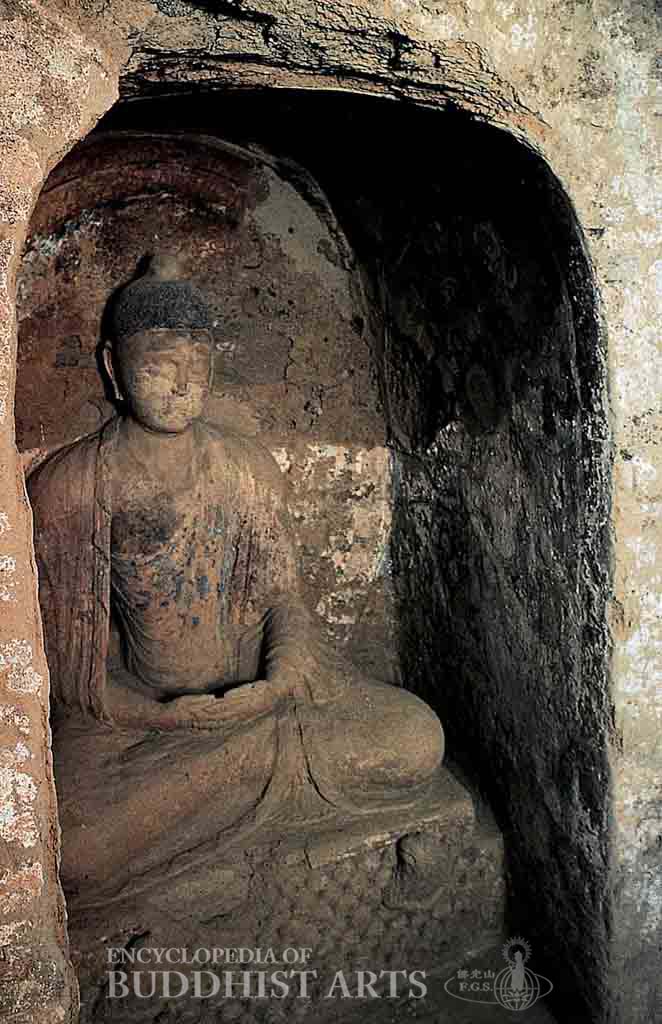
Kumtura Valley Entrance Cave 20: Main Chamber - Seated Buddha (front wall, right side niche)
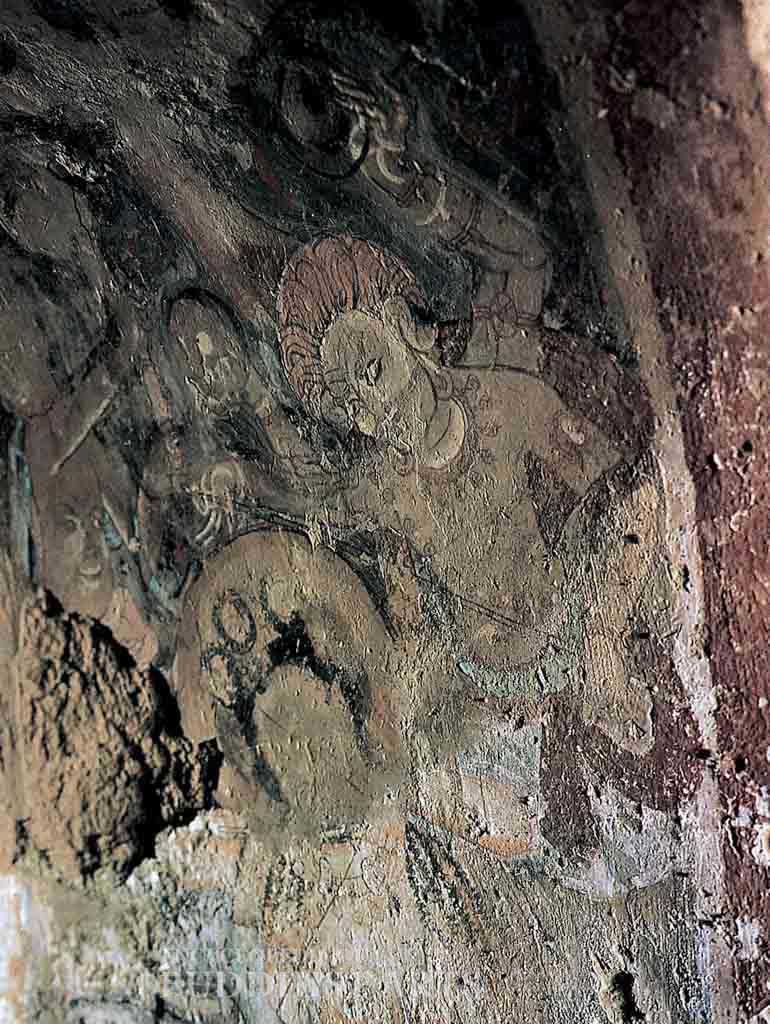
Kumtura Valley Entrance Cave 20: Main Chamber - Mara’s Army (front wall, right side niche)
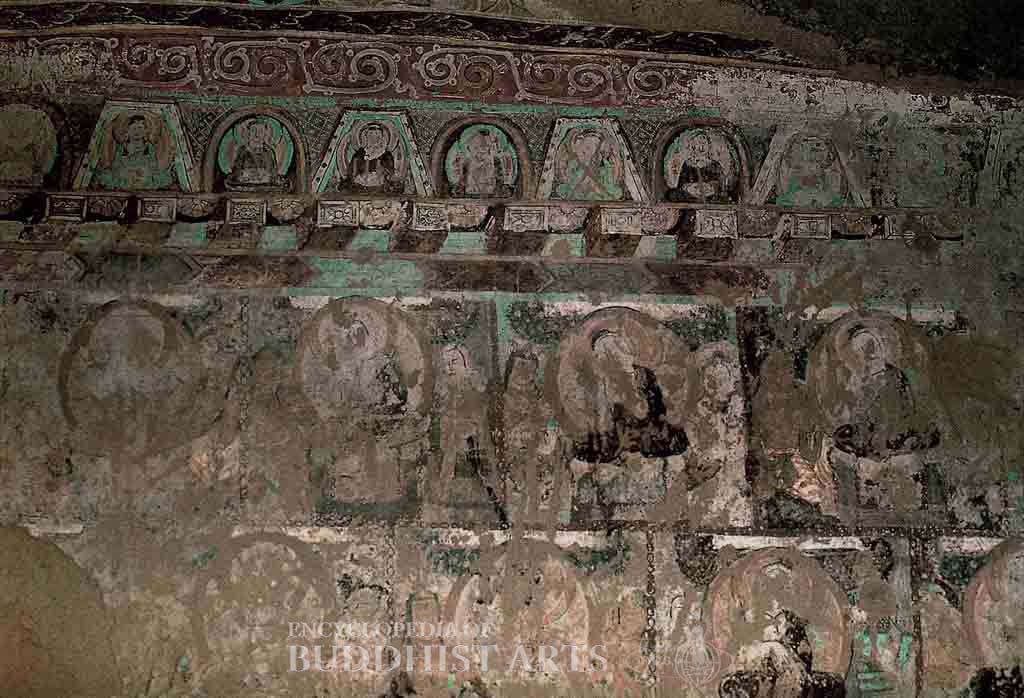
Kumtura Valley Entrance Cave 20: Main Chamber - Mural (east wall)
Kumtura Valley Entrance Cave 20
CHINA, Xinjiang, Aksu
Valley Entrance Caves are located in the south area, and this Cave 20 is situated on the north cliff face near the second flood ditch. It was excavated in the 5th to 6th century, and is one of the earliest caves at the site. Facing south, the cave is rectangular with a domed ceiling, and measures 3.13 m wide, 4.45 m high, and 3.2 m deep.
As one of the earliest caves, the art and architecture within Cave 20 are heavily influenced by foreign elements. The dome ceiling is influenced by Central Asian architecture, similar to the ones at Bamiyan and Fuladi valley. In contrast, the murals are heavily influenced by the Gandharan style, exemplified by the black outlines on clothing and red outlines on the skin.
The ceiling is divided into eleven segments radiating out from a lotus at the center, each segment alternately depicting a Buddha or a Bodhisattva. The figures stand on lotus pedestals, beneath which are images of figures making offerings.
Remnants of a statue which once stood on a rectangular platform in the center of the main chamber still remain within the cave. The front (south) wall contains an arched niche on each side of the doorway. The niche on the east side has a square lion throne where a figure once sat, while the niche on the west side contains the only remaining fully intact seated Buddha statue at Kumtura Caves. In combination with the surrounding murals of Mara’s daughters and army, it depicts the Buddha’s Defeat of Mara and Enlightenment.
With the exception of the back (north) wall, the murals on the walls are in relatively good condition. Most of the murals depict scenes from the Life of the Buddha and various images of Buddhas and Bodhisattvas. The front and side walls illustrate karma stories within square grids. The east wall is relatively well preserved. It is painted with cloud patterns at the top, followed by heavenly palace walls, and a series of Buddhas seated within the palace. The karma story grids have six rows and eight or nine columns. Each depiction is accompanied by a 2.5 m high inscription in white, and usually depicts the Buddha seated on a platform with one or two figures in attendance.
For more details, go to the Encyclopedia of Buddhist Arts: Caves R-L, page 640.
Cite this article:
author = Hsingyun and Youheng and Johnson, Peter and Mankuang and Huntington, Susan and Edson, Gary and Neather, Robert,
booktitle = {Encyclopedia of Buddhist Arts: Caves R-L},
pages = 640,
title = {{Kumtura Valley Entrance Cave 20}},
volume = 6,
year = {2016}}