
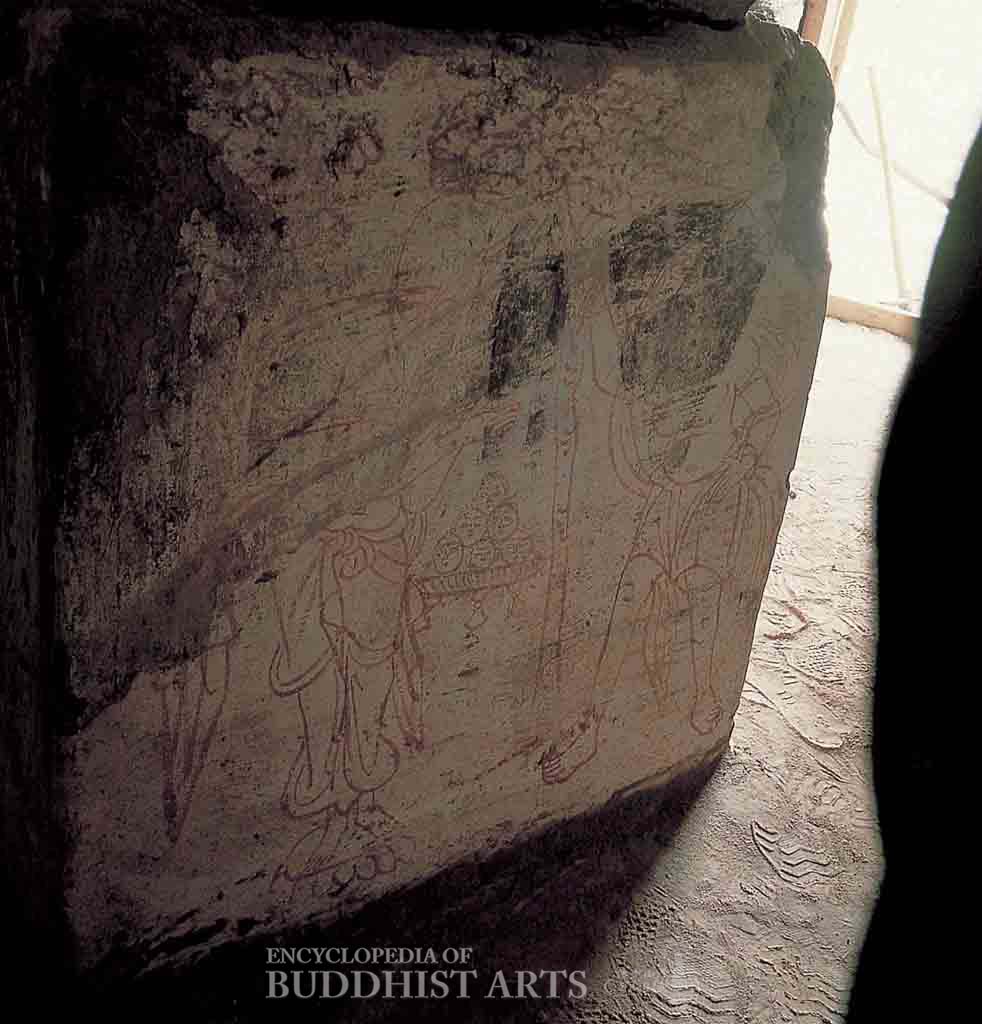
Kumtura Cave 79: Main Chamber - Donors (front wall)
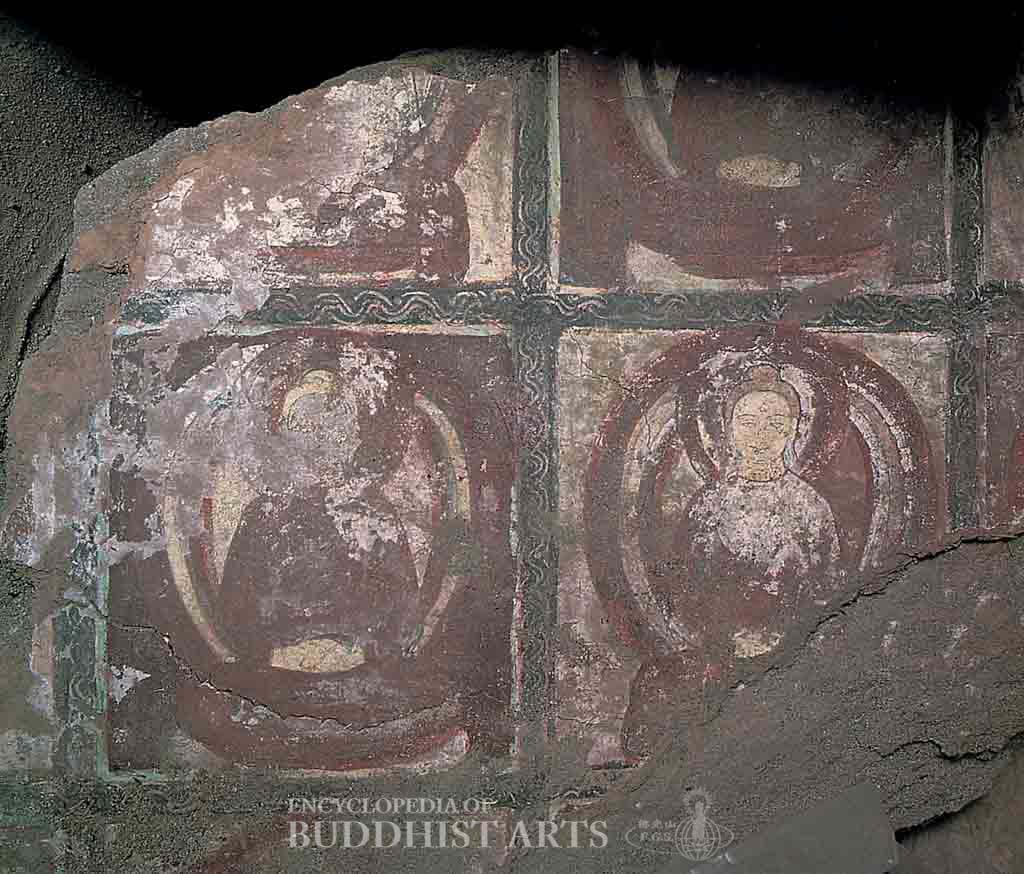
Kumtura Cave 79: Main Chamber - Jatakas (north side of platform)
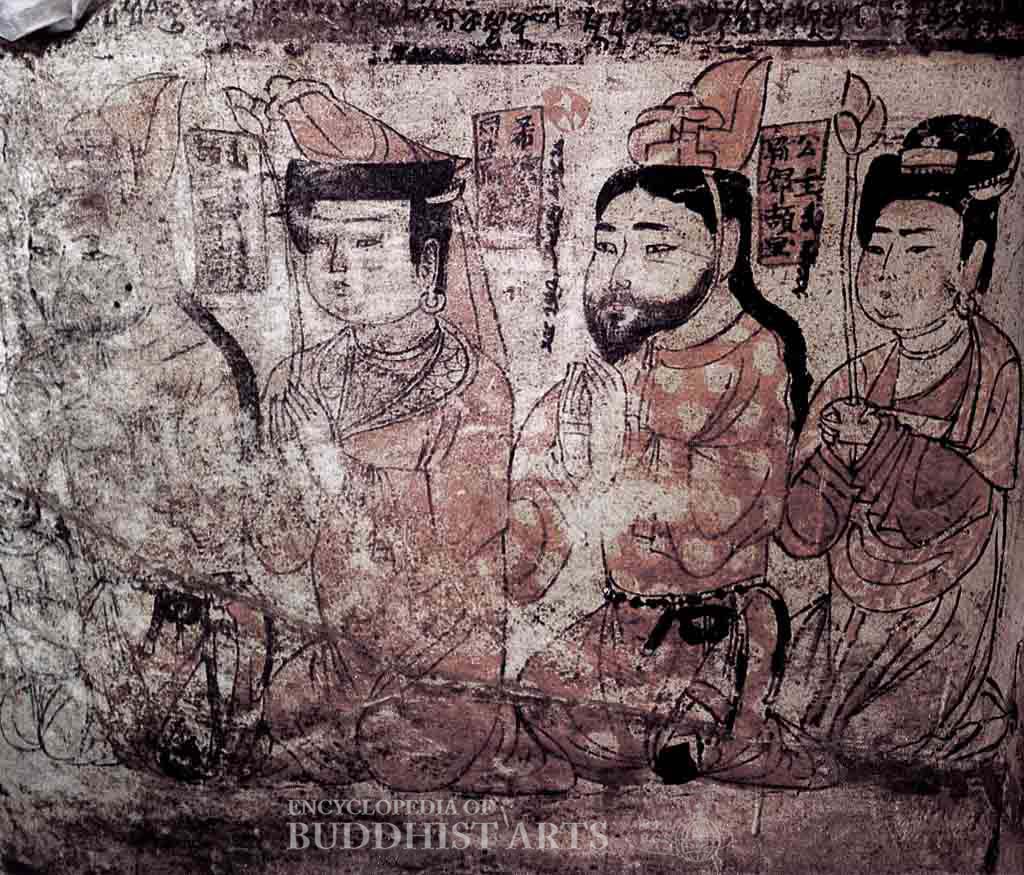
Kumtura Cave 79: Main Chamber - Donors (front of platform)
Kumtura Cave 79
CHINA, Xinjiang, Aksu
This west-facing cave is located within the southern section of the north area and was constructed in the late 9th century during the Uighur period. Cave 79 consists of one rectangular chamber which measures 3.4 m wide, 2.8 m high, and 3.8 m deep. Two of the walls and the ceiling have collapsed. One double-layered platform still exists at the center of the cave. The front of the platform is painted with seven donors, both monastics and lay people. Their names are written in Kuchean, Chinese, and Uighur near their images. The north and south sides of the platform have illustrations of Jataka tales painted in red ocher on a white background.
The murals on all four walls have been repainted three times: twice in the Kuchean style and once in the Chinese style. Two rows of Kuchean-style Buddhas in full lotus position are depicted on the north and south walls. Five kneeling donors are found on the right side of the doorway on the front (west) wall, bearing inscriptions in Chinese and Uighur. The two latter ones are more legible, and identify them as Asina Mise Khan and his wife Princess Illig. Most of the Kuchean murals have had their figures repainted in the Tang Chinese style, with round faces and fluid red outlines.
For more details, go to the Encyclopedia of Buddhist Arts: Caves R-L, page 636.
Cite this article:
author = Hsingyun and Youheng and Johnson, Peter and Mankuang and Huntington, Susan and Edson, Gary and Neather, Robert,
booktitle = {Encyclopedia of Buddhist Arts: Caves R-L},
pages = 636,
title = {{Kumtura Cave 79}},
volume = 6,
year = {2016}}