

Kumtura Caves 68 to 72

Kumtura Caves 68 and 69: Antechamber

Kumtura Cave 71: Main Chamber - Back Wall
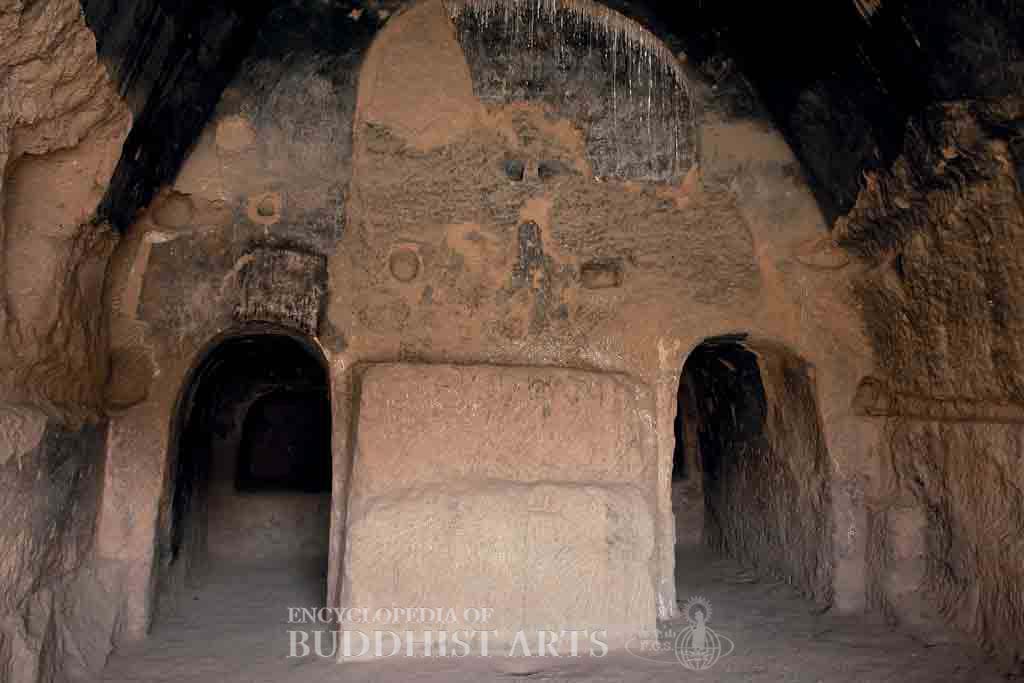
Kumtura Cave 68: Main Chamber - Back Wall
Kumtura Caves 68 to 72
CHINA, Xinjiang, Aksu
Caves 68 to 72 are a set of caves located on the northernmost end of the cave site. Their antechambers are connected, thus they are known as the Five Interconnected Caves. An inscription in one of the corridors dates the set of caves to the 8th century. All these caves face west. While their murals are mostly damaged and obscured, it is evident that the artworks were painted in the Chinese style as opposed to Kuchean.
Cave 68 is a central pillar cave with an antechamber, a main chamber, and three corridors. It shares an antechamber with Cave 69, and consists of a large opening at the front. The main chamber measures 4.03 m wide, 5.05 m high, and 4.54 m deep. Nimbuses carved in relief above the remains of a high throne are located by the back (east) wall. The vaulted ceiling has a central ridge 1.15 m wide, with paintings of floating musical instruments decorated with ribbons and flowers between them. The rear corridor has three niches and a platform upon which statues depicting the Buddha’s parinirvana once rested.
Cave 69 is a rectangular vihara cave, known as the Sutra Reciting Hall, which consists of an antechamber, a side corridor, a main chamber, and a rear chamber. The main chamber measures 5.64 m wide, 2.58 m high, and 6.34 m deep. The antechamber consists of a window on the north side and a doorway on the south side leading to the corridor. Inscriptions in Kuchean and Chinese are found on either side of the doorway. The rear chamber is rectangular with a barrel-vaulted ceiling and a low platform, now bereft of statues. Murals within the rear chamber have been repainted in both the Chinese and Kuchean styles.
Caves 70 to 72 are all quite similar in structure and layout. They are all central pillar caves, each consists of an antechamber, a main chamber, and corridors. The main chamber of Cave 70 measures 4.22 m wide, 4.19 m high, and 4.1 m deep, while Cave 71 is 5.1 m wide, 5.36 m high, and 4.94 m deep. Both caves have headless statues with nimbuses and aureoles against the back walls. The statues are made of clay with a stone core, which is unique to the Kuchean style. The rear corridors within both caves have platforms where reclining Buddhas were once placed. The murals of Cave 71 have been painted over, but images of clouds are still visible on the vaulted ceiling. Cave 72 is at the northernmost end. The antechamber contains remnants of imitation wooden structure and a few traces of mural. The main chamber measures 5.47 m wide, 5.03 m high, and 4.76 m deep.
For more details, go to the Encyclopedia of Buddhist Arts: Caves R-L, page 633.
Cite this article:
author = Hsingyun and Youheng and Johnson, Peter and Mankuang and Huntington, Susan and Edson, Gary and Neather, Robert,
booktitle = {Encyclopedia of Buddhist Arts: Caves R-L},
pages = 633,
title = {{Kumtura Caves 68 to 72}},
volume = 6,
year = {2016}}