
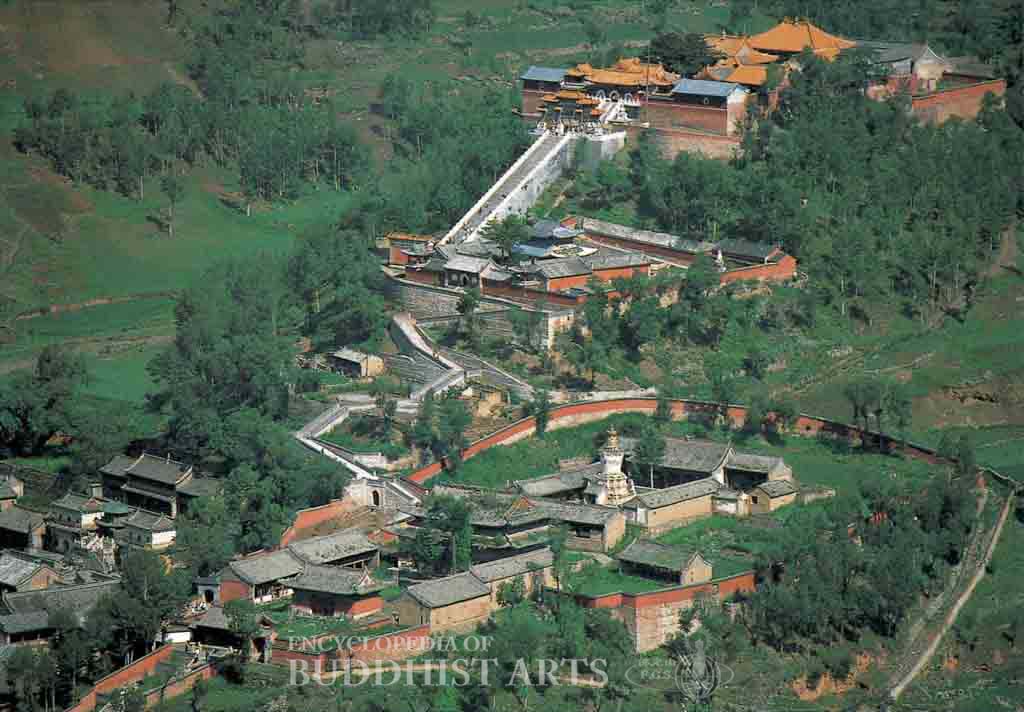
Wutaishan Pusa Ding Temple (aerial view)
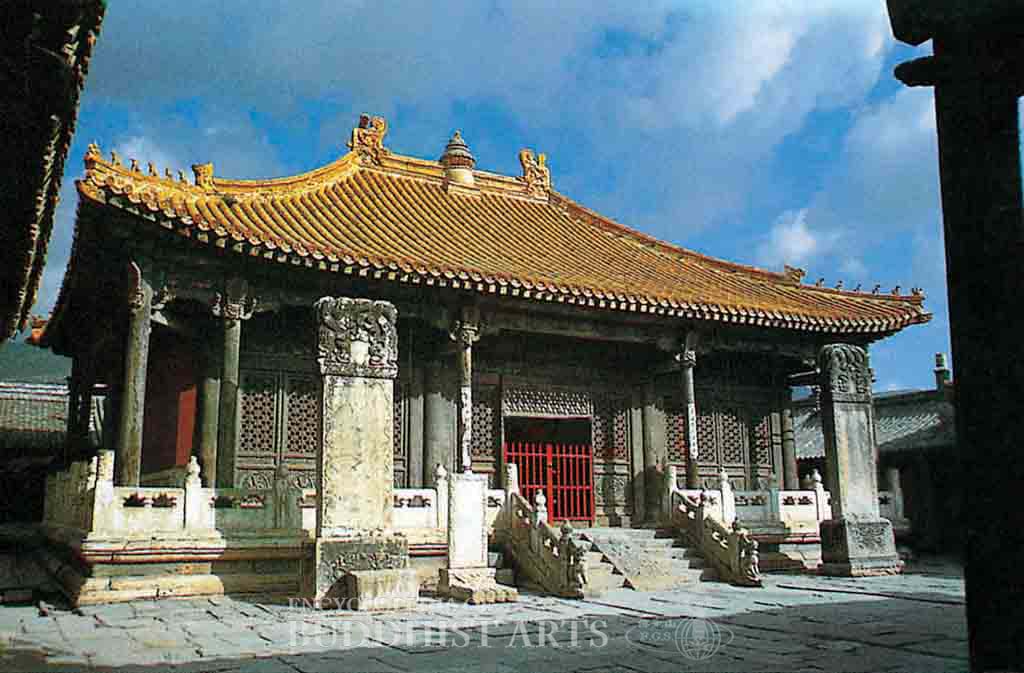
Wutaishan Pusa Ding Temple: Manjusri Hall
Wutaishan Pusa Ding Temple
CHINA, Shanxi, Xinzhou
Pusa Ding means Bodhisattva Summit. It is one of the Five Major Temples of Chan Buddhism on Wutaishan. The original temple was built during the reign of Emperor Xiaowen (reigned 471–499) of the Northern Wei dynasty. In 1656 it was converted to a Tibetan temple. The temple enjoyed great prosperity during the Qing dynasty (1644–1911). It was listed as a key Buddhist temple in the Han region of China in 1983.
A flight of 108 stone steps leads up to the temple, which occupies about 9,100 sq m. Behind the gateway the buildings lined up along the central axis include the Heavenly King Hall, Great Hero Hall, and Manjusri Hall. The two-story three-by-two bay Great Hero Hall has a double-eave overhanging gable roof covered in yellow glazed tiles. Inside the hall, at the front there is a statue of Tsongkhapa, the founder of the Gelug school, while at the back there are statues of Sakyamuni Buddha, Amitabha Buddha, and the Medicine Buddha.
The three-by-two bay Manjusri Hall has a single-eave hip roof covered in yellow glazed tiles. At the center of the main ridge there is a gilt bronze ornament as well as a decorative figure on either side. A statue of Manjusri Bodhisattva is enshrined within the hall, while 12 Tibetan paintings hang on the walls.
The temple houses imperial steles donated by Emperor Qianlong (reigned 1736–1795) of the Qing dynasty. Each side of the steles is inscribed in a different language: Chinese, Mongolian, Tibetan, and Manchu. Because the temple was built under imperial Qing regulations, the roofs are covered with blue, green, and yellow glazed tiles.
For more details, go to the Encyclopedia of Buddhist Arts: Architecture T-Z, page 1293.
Cite this article:
author = Hsingyun and Youheng and Johnson, Peter and Mankuang and Lancaster, Lewis,
booktitle = {Encyclopedia of Buddhist Arts: Architecture T-Z},
pages = 1293,
title = {{Wutaishan Pusa Ding Temple}},
volume = 4,
year = {2016}}