
Buddha Teaching the Dharma
Schist
Buddha Teaching the Dharma
PAKISTAN
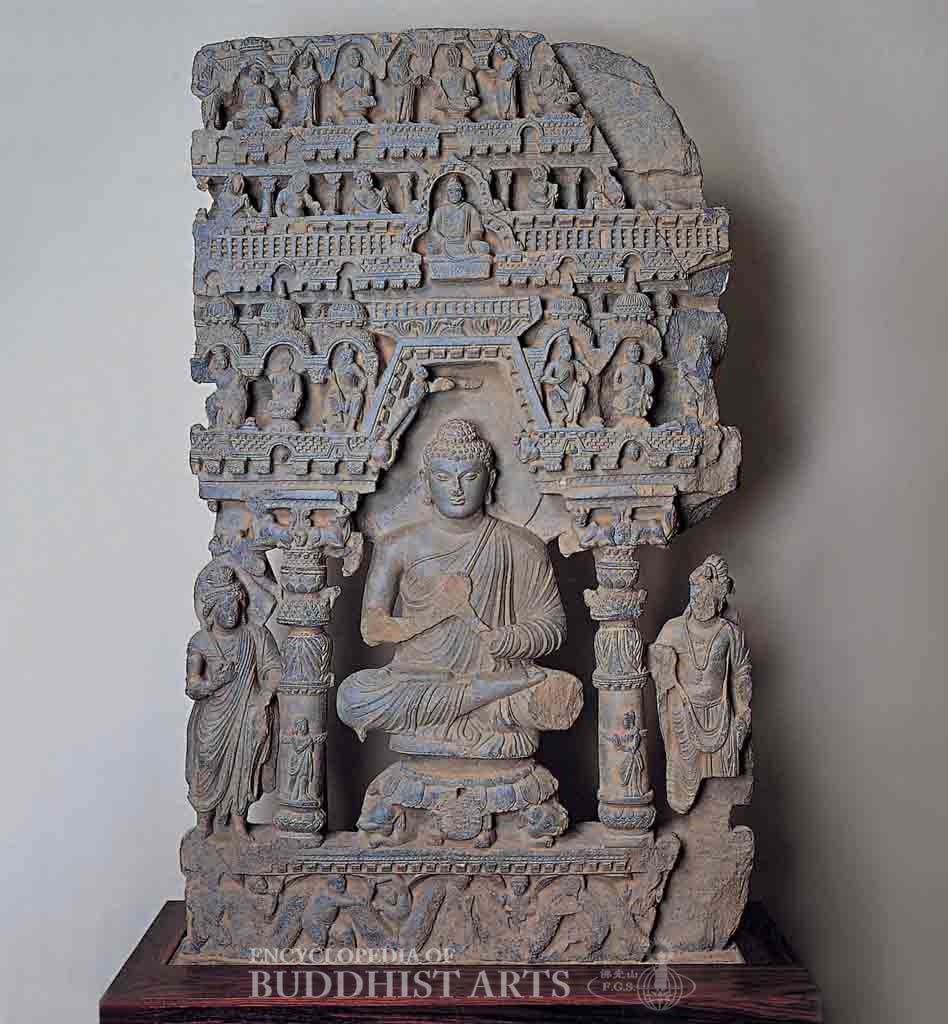
This Gandharan relief depicts the Buddha seated in full lotus position in a palace with a trapezoidal ceiling. Three elephants support the lotus throne. The Buddha has tightly curled hair and a prominent usnisa, and wears a robe that covers the left shoulder. Even though the arms are damaged, they were most likely forming the vitarka (teaching) mudra. A child making an offering of flowers is above the Buddha, while the accompanying child on the other side is missing. Attendant Bodhisattvas stand behind elaborately carved columns. The Bodhisattva on the right wears a turban and is believed to be Maitreya, while the other figure with the topknot and a robe over the left shoulder is thought to be Avalokitesvara. The two columns have children figures with their palms joined, while the capitals are decorated with lotuses and humped cattle, considered a fusion of Indian and Persian styles. The base of the relief depicts children holding garlands.
There are three registers above the main image. The first register depicts Buddhas and Bodhisattvas each within a stupa. The second register contains a row of heavenly beings gazing at the scene below, with each figure separated by a column. The topmost register is partly damaged and shows four Buddhas seated in niches, either meditating or teaching, accompanied by attendant Bodhisattvas on either side.
This relief was probably created during the late Gandhara period based on the Buddha’s curled hair, the sturdiness of his body, and the texture of his clothing.
For more details, go to the Encyclopedia of Buddhist Arts: Sculpture A-F, page 207.
Cite this article:
author = Hsingyun and Youheng and Lovelock, Yann and Chou, Yuan and Huntington, Susan and Edson, Gary and Neather, Robert,
booktitle = {Encyclopedia of Buddhist Arts: Sculpture A-F},
pages = 207,
title = {{Buddha Teaching the Dharma}},
volume = 10,
year = {2016}}