
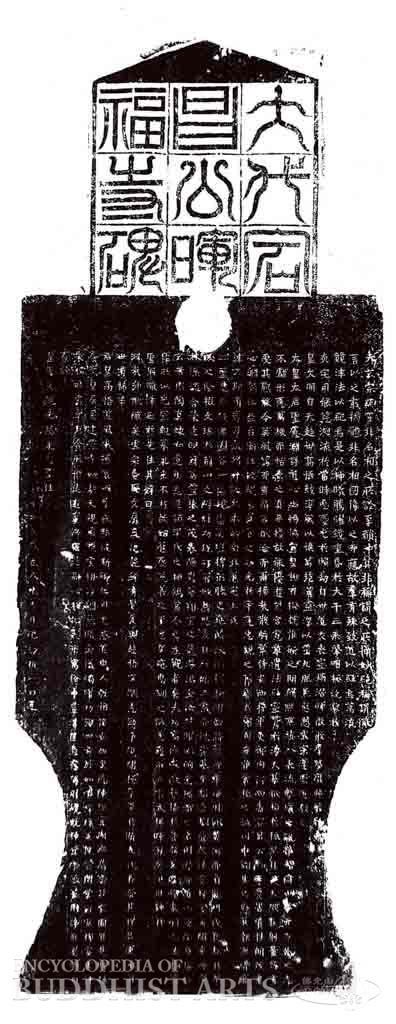
Huifu Temple: Stele
Rubbing
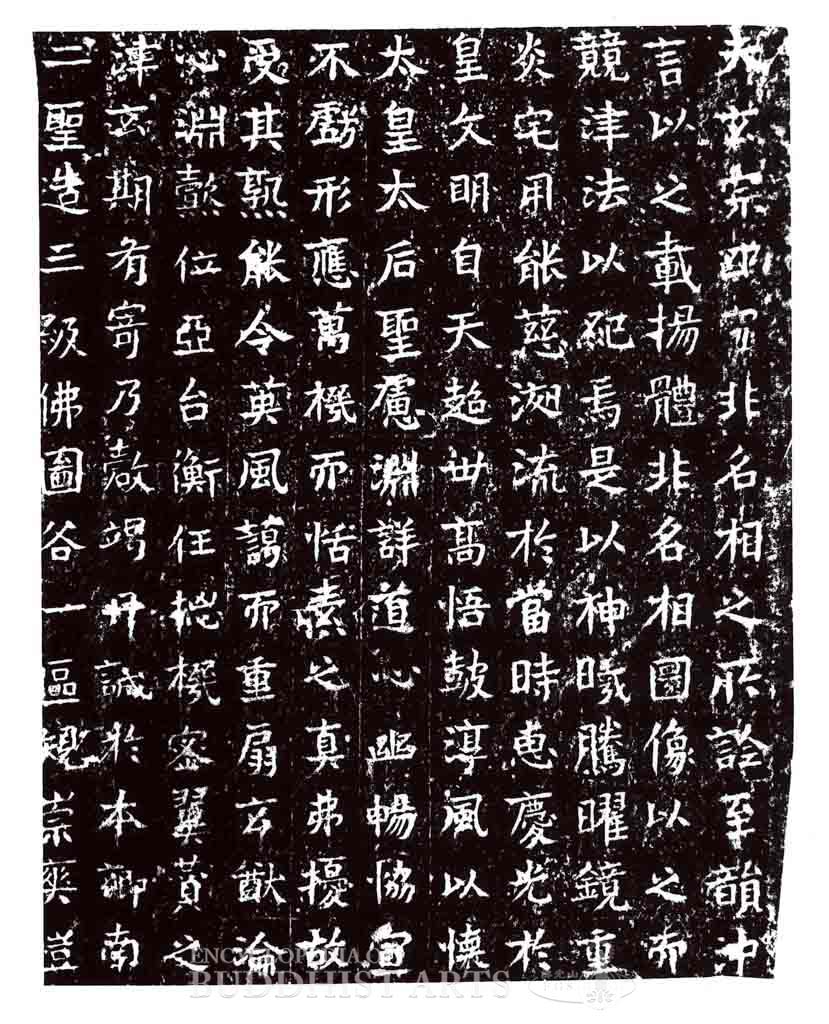
Huifu Temple: Stele (detail)
Rubbing
Huifu Temple: Stele
CHINA, Shaanxi, Chengcheng; Northern Wei dynasty
This stele erected in Huifu Temple in Shaanxi is framed with a sculptured mythical creature as the crown and a square base as the plinth. The upper portion of the stele is rectangular while the lower part is recessed on both sides in an hourglass shape. There are inscriptions carved on both sides. The front text consists of 24 lines of 44 characters each, while the rear is engraved with the official ranks and names of the family of Wang Yu, albeit largely unclear. The stele was moved to the Xi’an Beilin Museum in Shaanxi in 1971. The text records that Wang Yu, also known as Dangchang Gong, prayed for blessings for Empress Wenming and Emperor Xiaowen (reigned 471–499) of the Northern Wei dynasty. It also notes that Wang built a three-story pagoda in Huifu Temple to accrue merits and ensure safety from calamities for his family.
The stele was completed before the Northern Wei (386–534) dynasty shifted its capital city. This timing perhaps explains the rudimentary style of calligraphy, one that remained uninfluenced by the aristocratic aesthetics of the Southern Dynasties (420–589). There are characters on the header written in seal script within a symmetrical grid, as seen in a Han seal layout. Curves and straight strokes were concurrently employed throughout the stele within a lenient character structure and order. The expressive and natural style, which carries a touch of clerical script, is a unique trait that exemplifies the uninhibited attitude of ethnic Northerners.
For more details, go to the Encyclopedia of Buddhist Arts: Calligraphy, page 100.
Cite this article:
author = Hsingyun and Youheng and Youlu and Pokorski, Stefanie and Mankuang and Edson, Gary,
booktitle = {Encyclopedia of Buddhist Arts: Calligraphy },
pages = 100,
title = {{Huifu Temple: Stele}},
volume = 17,
year = {2016}}