
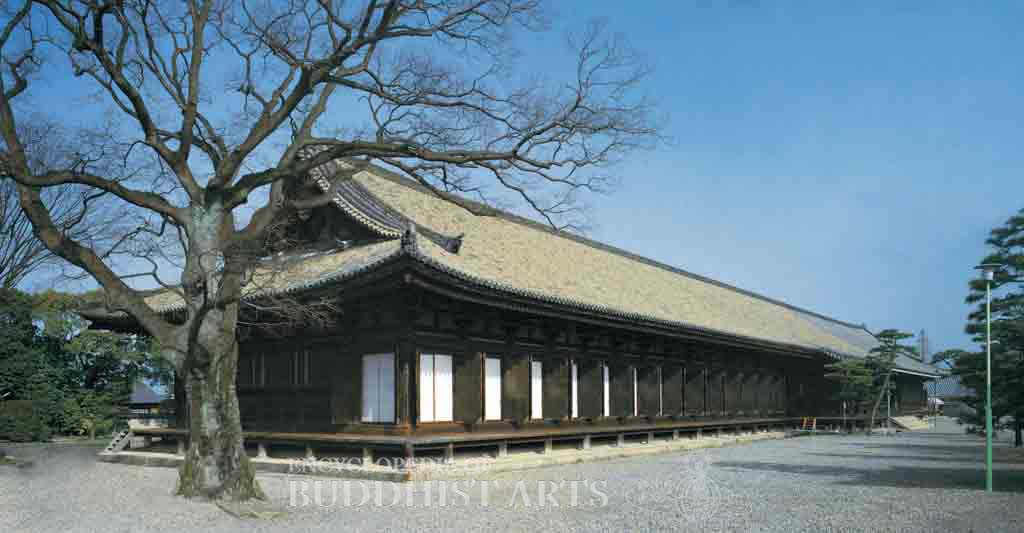
Sanjusangendo Temple
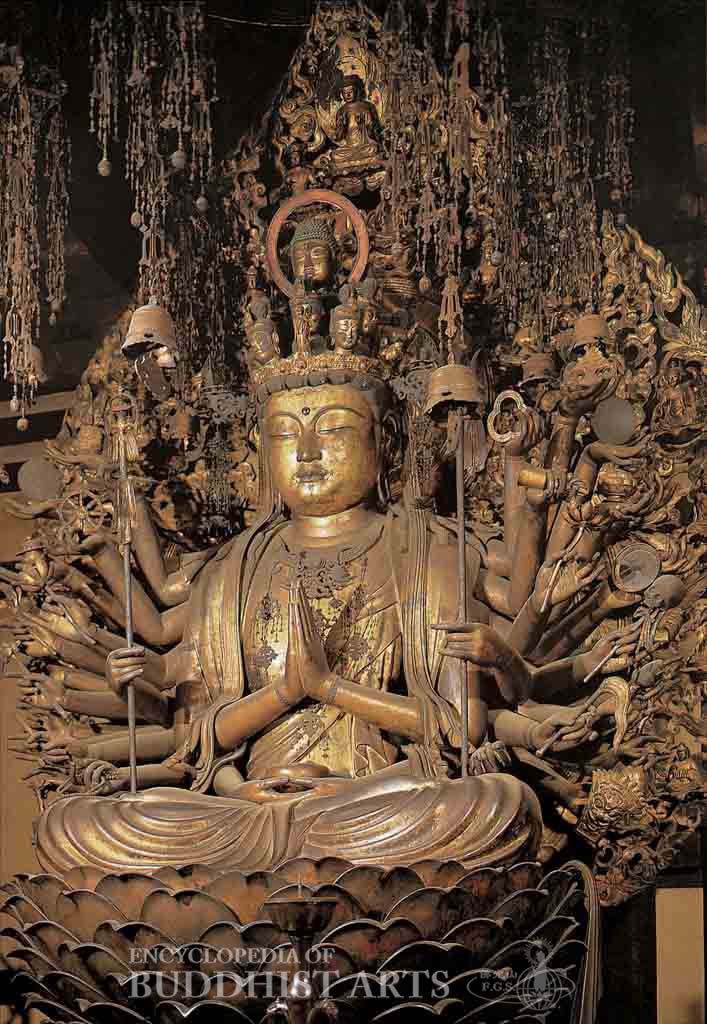
Sanjusangendo Temple: Thousand-Armed Avalokitesvara
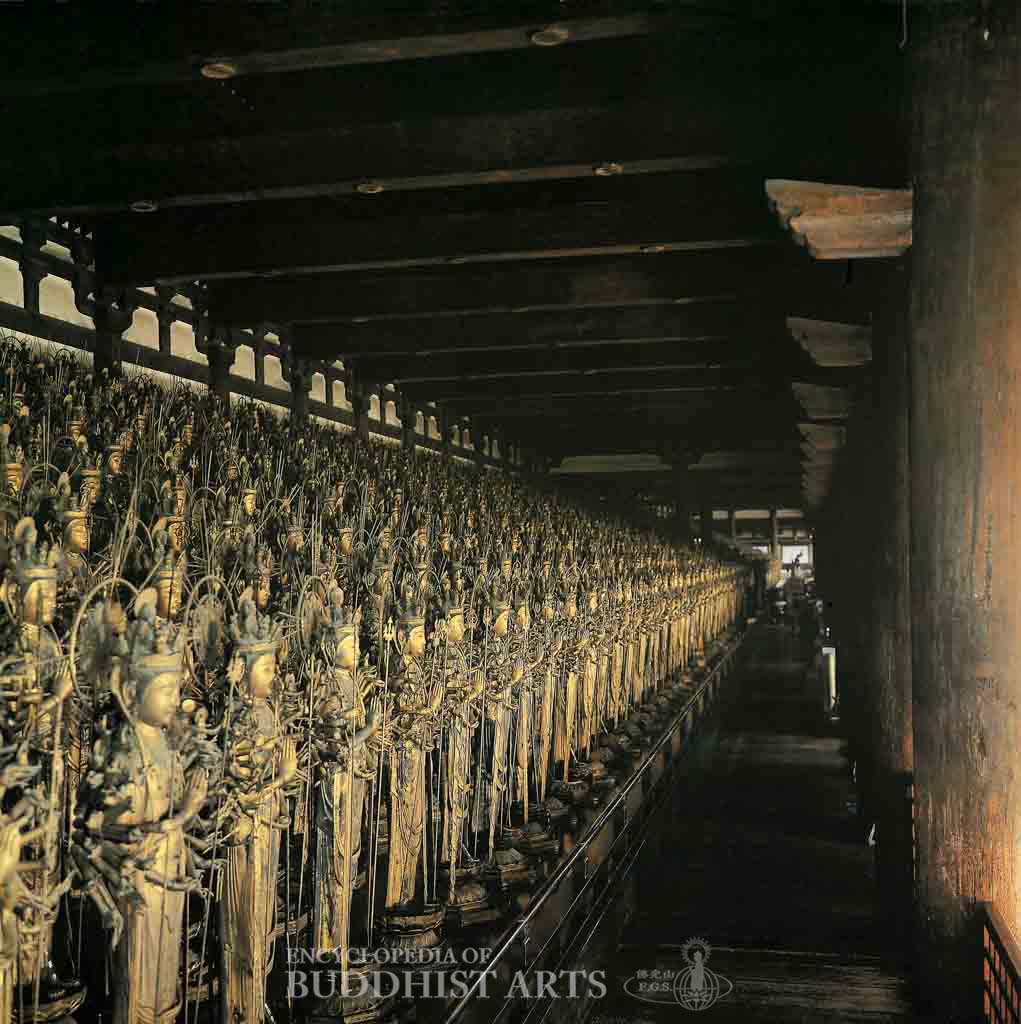
Sanjusangendo Temple (interior)
Sanjusangendo Temple
JAPAN, Kyoto
Sanjusangendo means Hall with Thirty-Three Bays. It is also known as Rengeoin (Lotus King Temple). The temple is a branch of Myohoin Temple, which belongs to the Tendai school of Japanese Buddhism. War regularly occurred towards the end of the Heian period (794–1185). At that time, building temples to house a thousand statues of Buddhas or Bodhisattvas to pray for protection was a popular activity. This temple is the only remaining structure left from this movement. The temple was constructed in 1164 by Taira no Kiyomori on the orders of Emperor Go-Shirakawa (reigned 1155–1158). In 1249 during the Kamakura period, the main hall, other buildings, and numerous statues of Avalokitesvara were destroyed by fire. The temple was rebuilt in 1266 on the instructions of Emperor Go-Saga (reigned 1242–1246). Throughout history, the temple was protected by shoguns including Ashikaga Yoshinori, Toyotomi Hideyoshi, and Tokugawa Iemitsu. In 1952 it was listed as a National Treasure.
The 35-bay main hall measures 120 m long and 22 m wide. It is 15 m high and has a single-eave hip-and-gable roof covered in cylindrical tiles. In the center of the hall, there is a three-bay wide Sumeru throne with a 715.3 cm high wooden seated statue of the Thousand-Armed Avalokitesvara, listed as a National Treasure. The 15 bays on each side have tiered platforms with 1,000 standing statues of the Thousand-Armed Avalokitesvara. In front of the Bodhisattvas there is a row of Twenty-Eight Classes of Dharma Protectors, as well as the temple guardians Fujin and Raijin. These wooden statues were carved by Unkei and Tankei during the Kamakura period (1185–1333) and are listed as National Treasures.
For more details, go to the Encyclopedia of Buddhist Arts: Architecture M-S, page 939.
Cite this article:
author = Hsingyun and Youheng and Johnson, Peter and Mankuang and Lancaster, Lewis,
booktitle = {Encyclopedia of Buddhist Arts: Architecture M-S},
pages = 939,
title = {{Sanjusangendo Temple}},
volume = 3,
year = {2016}}