
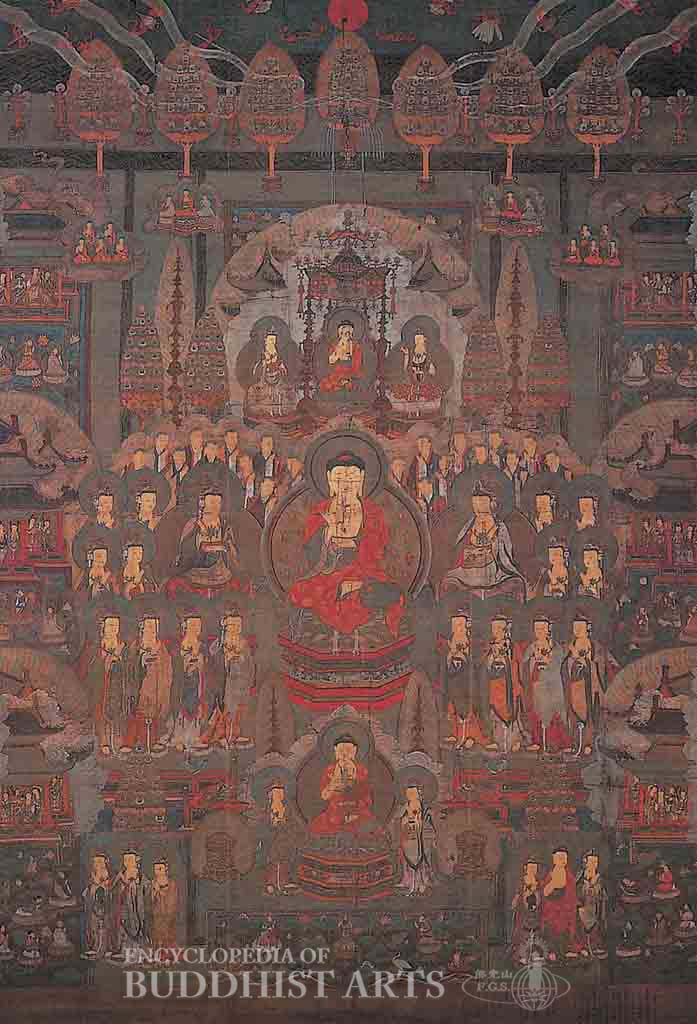
Illustration of the Amitayurdhyana Sutra (detail)
Ink and color on silk
Illustration of the Amitayurdhyana Sutra
KOREA; Joseon dynasty
Commissioned in 1465 by the royal family, this is the earliest Joseon dynasty (1392–1910) painting of the Western Pure Land. It depicts the Sixteen Contemplations of the Pure Land described in the Amitayurdhyana Sutra.
The contemplation of the sun is represented by the red disc at the top center of the painting. The water, ground, trees, ponds, pavilions, and the different grades of rebirths are depicted at the edges of the painting. They represent the second through the seventh contemplations, and the eighth through thirteenth contemplations.The remaining contemplations are not depicted.
In the center of the painting, Amitabha Buddha sits in full lotus position on a lotus throne. The aureole is filled with small Buddha images, and a jewel adorns the usnisa. Amitabha’s red monastic robe, decorated with gold circular patterns, is commonly seen in paintings from the late Goryeo dynasty (918–1392), while the straps that hang down in front of the lotus throne are more characteristic of Joseon dynasty art. Avalokitesvara and Mahasthamaprapta Bodhisattvas flank Amitabha, accompanied by standing Bodhisattvas and disciples who join their palms in reverence. Buddha triads are painted above and below the central figure.
For more details, go to the Encyclopedia of Buddhist Arts: Painting I-O, page 372.
Cite this article:
author = Hsingyun and Youheng and Youlu and Wilson, Graham and Manho and Mankuang and Huntington, Susan,
booktitle = {Encyclopedia of Buddhist Arts: Painting I-O},
pages = 372,
title = {{Illustration of the Amitayurdhyana Sutra}},
volume = 15,
year = {2016}}