
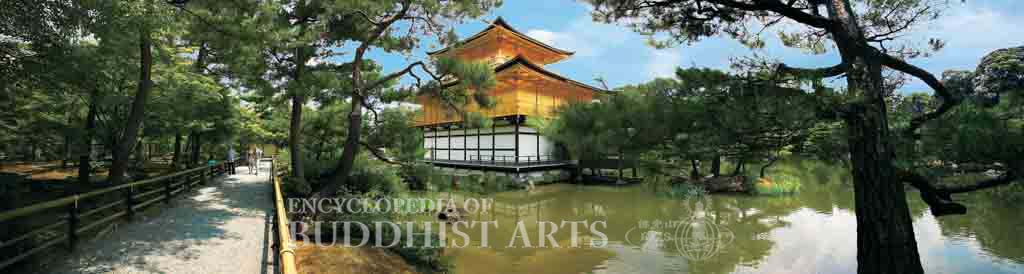
Rokuonji Temple: Golden Pavilion
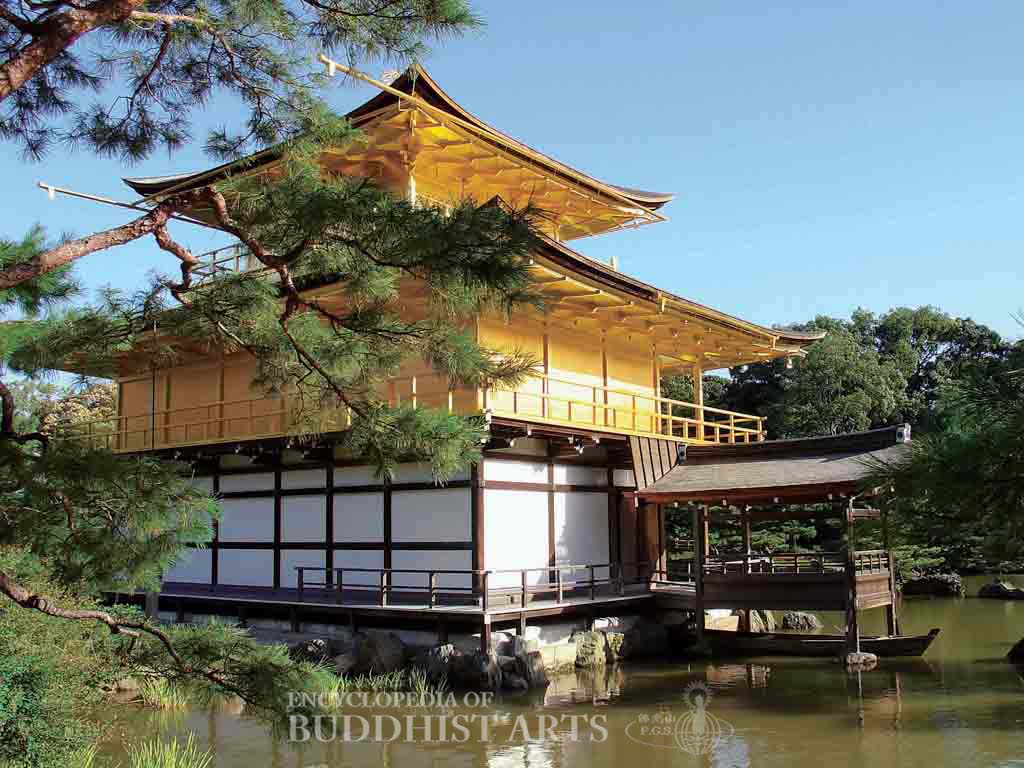
Rokuonji Temple: Golden Pavilion
Rokuonji Temple
JAPAN, Kyoto
Rokuonji means Deer Park Temple. It belongs to the Rinzai school of Japanese Buddhism. It is also known as Kinkakuji (Golden Pavilion Temple). Ashikaga Yoshimitsu of the Muromachi period built the pavilion in 1397, after his retirement. It became the center of a complex devoted to art and culture. After the death of Yoshimitsu, his son converted the complex into a Zen temple in 1422, in accordance with the wishes of his late father. During the Onin War (1467–1477) the temple was almost completely burned down with only the Golden Pavilion remaining. The Golden Pavilion was burnt down in 1950 and reconstructed in 1955. Along with the historical buildings of Kyoto, the temple was listed as a UNESCO World Heritage Site in 1994.
The temple structures include the Golden Pavilion, abbot’s quarters, study room, kitchen, and bell tower. The Golden Pavilion, also known as the reliquary hall, is a three-story wooden structure with a pyramidal roof covered in thin cypress shingles. The sides of the second and third stories are covered in gold foil and a different style is adopted on each story. The first story, called the Chamber of Dharma Waters, is where boats can be docked. The second story is called the Tower of Sound Waves and enshrines a statue of Avalokitesvara Bodhisattva, as well as statues of the Four Heavenly Kings at its four corners. The third story, called the Highest Level, is built in the Zen Buddhist style. The interior is square, measuring 5.5 m along each side, and consists of three rooms. A 103.5 cm high gilt bronze garuda stands in the center of the roof.
The stroll-style garden in the temple was designed by Muso Soseki, who utilized the external landscape as background scenery. The garden was modeled on those of the Muromachi period (1392–1573) and is now an important historical site and place of interest.
For more details, go to the Encyclopedia of Buddhist Arts: Architecture M-S, page 898.
Cite this article:
author = Hsingyun and Youheng and Johnson, Peter and Mankuang and Lancaster, Lewis,
booktitle = {Encyclopedia of Buddhist Arts: Architecture M-S},
pages = 898,
title = {{Rokuonji Temple}},
volume = 3,
year = {2016}}