
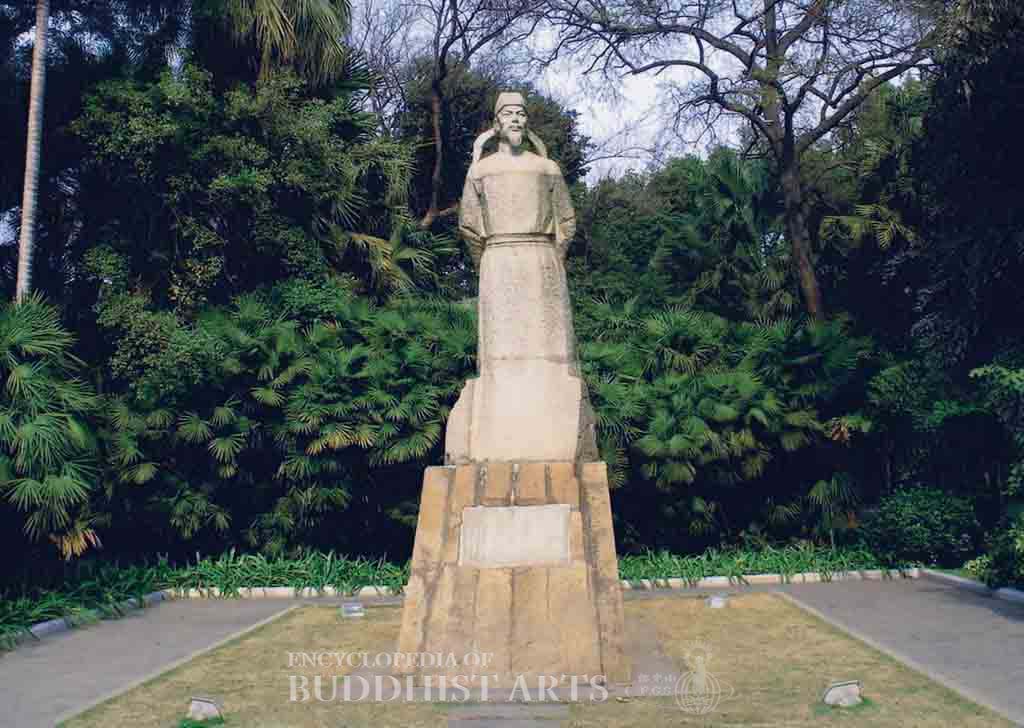
Liu Zongyuan
Liu Zongyuan
CHINA, Shanxi, Yuncheng; Tang dynasty
Known as one of the Eight Great Classical Literature Masters of the Tang (618–907) and Song (960–1279) dynasties, Liu Zongyuan was a writer and calligrapher from Hedong (present day Yongji, Yuncheng). He also was popularly known as either Liu Hedong or Liu Liuzhou. Able to recite poetry by the age of four, he became well-known for his own poetry and essays by the age of 17. During his term serving as an assistant censor in the Ministry of Justice, he wrote Eight Excursion Articles in Yongzhou.
Liu served as the provincial governor of Liuzhou in 815, a period during which he taught local people farming, weaving, and construction, as well as implemented ways to improve livelihood. After his passing, the people under his governorship revered him as a deity, and subsequently funds were raised to construct the Luochi Shrine in his honor. Han Yu, a close contemporary of Liu’s was invited to create the stele inscription. The two calligraphers worked together to promote both the classical writing style and the neoclassical movement, which contributed greatly to the further formation of Chinese characters.
Highly-regarded for his calligraphy, Liu’s legacy has been well-documented in various texts such as Digests of Calligraphy History and Record of Inscriptions on Metal and Stone, the latter of which describes his extant stele calligraphy. Liu’s works that were still seen in the Northern Song dynasty (960–1127) were stele inscriptions of eminent monks, which reference his close relationship with Buddhism. In addition, among Liu’s extensive collection of written works is an article in which he elaborates the teachings of the Pure Land school.
For more details, go to the Encyclopedia of Buddhist Arts: People, page 180.
Cite this article:
author = Hsingyun and Youheng and Youlu and Pokorski, Stefanie and Yichao and Mankuang and Miaohsi,
booktitle = {Encyclopedia of Buddhist Arts: People },
pages = 180,
title = {{Liu Zongyuan}},
volume = 19,
year = {2016}}