
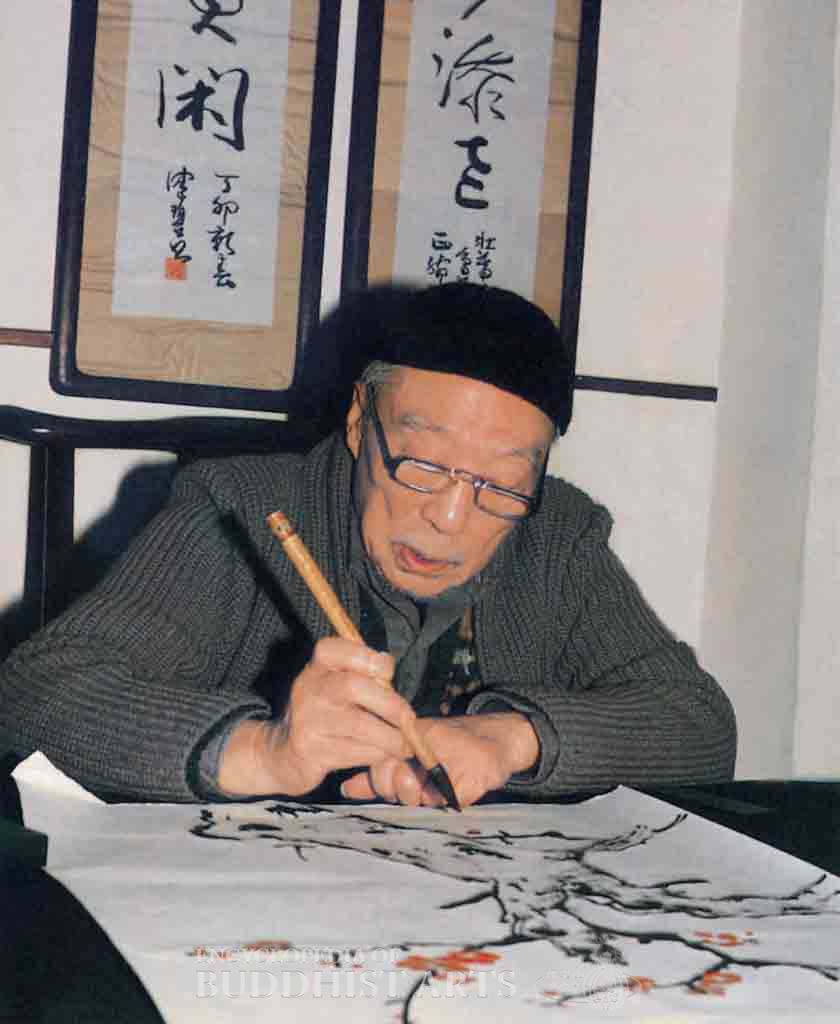
Xie Zhiliu
Xie Zhiliu
CHINA, Jiangsu, Changzhou
Xie Zhiliu had an original name of Xieliu and was also known as Zhuangmu. He was a student of the Jiangnan scholar Qian Mingshan, who introduced him to the world of art and poetry. He learned to copy the works of great masters with diligence and great passion, and as a result he not only became a great painter and calligrapher, but also an adviser and connoisseur of artwork for the Shanghai Museum, as well as a professor of painting.
To master the painting of landscapes, Xie copied the works of masters such as Li Cheng, Fan Kuan, and Yan Wenguai. He also specialized in the painting of flowers, birds, and figures, which he learned by copying the style of Chen Hongshou, characterized by his meticulous fine lines and brilliant colors. Xie was equally attracted to the refined and elegant calligraphic style of Chen, but he infused it with the cursive styles of other masters such as Zhang Xu, Huang Tingjian, and monk Huaisu. The outcome was a form that was balanced, fluid, and rhythmic, giving one a sense that the work was done at speed but not with haste.
In 1942, Xie met artist Chang Dai-Chien, who introduced him to the art of Buddhist cave murals. Together they traveled to Dunhuang in northwest China and studied the wall paintings in the caves. They painted life-size reproductions of various images, especially that of Avalokitesvara Bodhisattva.
Xie’s painting, High Mountain and Winding Stream, is kept at the Shanghai Art Museum, while Birds Gathering Around a Lotus Pond, Black Monkey, and Birds in Bamboo Bush are at the National Art Museum of China. A stele inscription of his calligraphy can be found at Fo Guang Shan Monastery in Kaohsiung, Taiwan. Also the author of several art books, his collection includes Ink Painting, Xie Zhiliu Collection of Painting, Appreciation and Authentication of Art and Calligraphy, Catalog of Dunhuang Caves, and Documentation of Dunhuang Art.
For more details, go to the Encyclopedia of Buddhist Arts: People, page 305.
Cite this article:
author = Hsingyun and Youheng and Youlu and Pokorski, Stefanie and Yichao and Mankuang and Miaohsi,
booktitle = {Encyclopedia of Buddhist Arts: People },
pages = 305,
title = {{Xie Zhiliu}},
volume = 19,
year = {2016}}