
Life of the Buddha - Miracle at Sravasti
Gilt bronze
Life of the Buddha - Miracle at Sravasti
CHINA; Sixteen Kingdoms
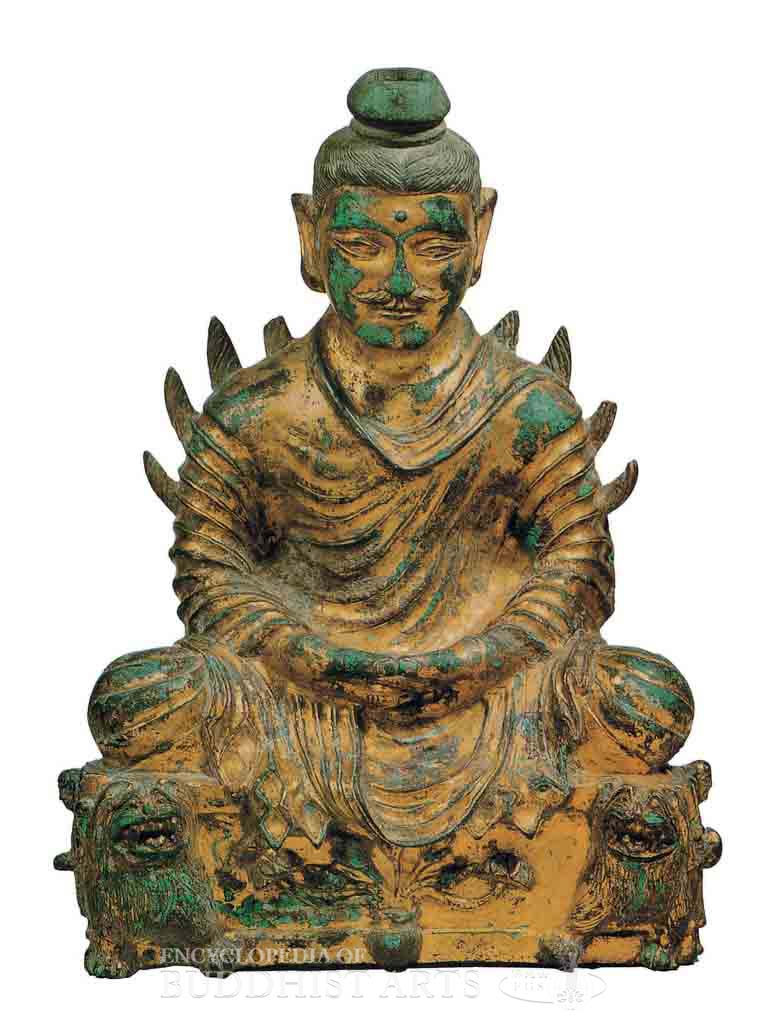
This is one of the earliest Buddha figures in China, and is believed to have been unearthed from Shijiazhuang in Hebei. The Buddha’s usnisa is pierced by a square hole that served as a support for an inserted canopy. The monastic robe, stylistically reminiscent of Gandharan figures, has heavy flowing folds that partly cover the front of the base. The Buddha sits cross-legged in meditation, with head slightly bowed and hands in the dhyana (meditation) mudra. The throne is guarded by lions on either side, with flowers in a pot between them.
The flames at the figure’s shoulders depict the miracle of Sravasti. As recorded in the Abhiniskramana Sutra, the Buddha rose into the air and produced fire from his upper body and water from the lower body. A few of such images were unearthed from Paitara in Parwan, Afghanistan, but are rarely seen in China. Whilst the whole is strongly Gandharan in style, elements of the hairstyle show affinities with Chinese pieces of the same period.
For more details, go to the Encyclopedia of Buddhist Arts: Sculpture G-M, page 597.
Cite this article:
author = Hsingyun and Youheng and Lovelock, Yann and Chou, Yuan and Huntington, Susan and Edson, Gary and Neather, Robert,
booktitle = {Encyclopedia of Buddhist Arts: Sculpture G-M},
pages = 597,
title = {{Life of the Buddha - Miracle at Sravasti}},
volume = 11,
year = {2016}}